|

NIO Stock Forecast: Nio Inc nosedives ahead of third quarter earnings call

  • NYSE: NIO fell by 5.93% during Tuesday’s trading session.
  • NIO reported its third quarter earnings after the closing bell.
  • Investors look to the Nio Day event for further developments in 2022.

NYSE: NIO shareholders did not get the result they anticipated on Tuesday as the company prepared to report its third quarter earnings after the close. Shares of Nio fell by 5.93% during trading hours and closed the session at $40.64. After being on a recent bullish breakout, the US markets pulled back and took a breather on Tuesday. All three major indices closed the day in the red, with the tech-heavy NASDAQ falling by 0.60%. The EV sector was hit especially hard on Tuesday, following Tesla (NASDAQ:TSLA) CEO Elon Musk confirming he would be selling at least 10% of his stock in the company. Shares of TSLA were down by 12% during the session, while other EV companies like XPeng (NYSE:XPEV), Li Auto (NASDAQ:LI), and Lucid (NASDAQ:LCID) were all trading lower in sympathy. 


Stay up to speed with hot stocks' news!


Nio reported its third quarter earnings after the market closed on Tuesday, and despite topping Wall Street estimates, investors were not enthused. Nio saw its revenues jump 117% year over year to hit $1.522 billion, easily beating analyst estimates of $1.442 billion. Earnings per share also improved from a loss of $0.15 per share last year, to a loss of $0.06 per share in 2021. 

NIO stock price
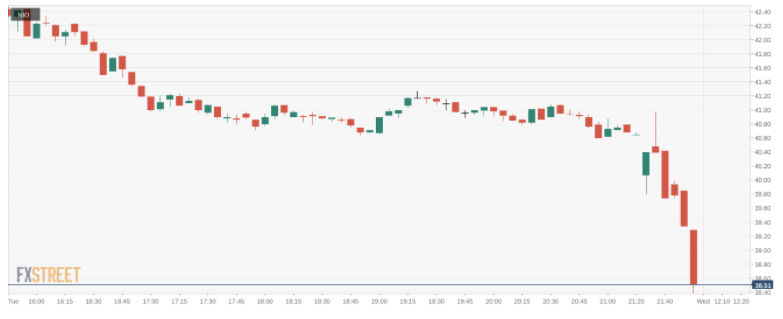
NIO Stock

Disappointed Nio investors will be looking ahead to its Nio Day event in December now for any new announcements for 2022. There are rumors circulating that Nio could be introducing a new entry level sedan, as well as potentially an entry-level spin-off brand that would help to maintain Nio’s status as a luxury EV maker. 

Author

More from Stocks Reporter
Share:

Editor's Picks

GBP/USD flirts with weekly highs in the Fed's aftermath

GBP/USD reversed early losses following the Federal Reserve decision to keep rates on hold and neared the 1.3360 level before shedding some ground. Focus shifts to Governor Kevin Warsh's speech, while the Bank of England will announce its monetary policy decision on Thursday.

EUR/USD extends rally pass 1.1450 on Fed's Warsh

EUR/USD trades at fresh weekly highs above 1.1450, following the Federal Reserve monetary policy decision to keep interest rates on hold. The statement showed policymakers remain confident in economic progress while blaming inflation on energy prices. The divided vote among officials put in doubt a September hike, leading to sharp US Dollar losses.

Gold  hovers around $4,100 as Fed decision hits the USD

Gold surged following the Federal Reserve's decision to keep the benchmark interest rate unchanged at 3.50%-3.75%. Policymakers noted that inflation remains elevated and that economic activity is expanding at a solid pace despite elevated uncertainty, spurring doubts about a rate hike in September. XAU/USD peaked above $4,100, now battling to retain the level.

No soft target: Warsh vows to return inflation to 2%
The Fed left interest rates unchanged at 3.50%-3.75%, but the decision carried a distinctly hawkish edge as three officials voted for an immediate 25-basis-point increase. Chair Kevin Warsh reinforced that message, insisting there was no tolerance for a softer inflation target and warning that the Fed would not hesitate to act.
How the CLARITY Act unlocks Wall Street’s tokenization pipeline
The United States (US) Digital Asset Market Clarity Act (CLARITY Act), awaiting a full Senate floor vote, promises to unlock Wall Street’s potential to tokenize financial assets, including equities, US Treasuries, private credit, real estate and commodities at a scale that could supercharge the real-world asset (RWA) market from the current $17 billion level to $5.5 trillion by 2030, according to
US Dollar mid-year outlook: Exceptional currency, exceptional risks?
The US Dollar enters the second half of 2026 in a markedly different position from a year ago. The King currency has recovered, reflecting persistent US inflation, changing expectations for Fed policy, geopolitical tensions and renewed demand for defensive assets.