|

NIO Stock Forecast: Nio Inc jumps higher as Chinese EV demand returns

  • NYSE:NIO gained 6.08% during Monday’s trading session.
  • Nio and AMD join forces to supply new chups for Nio’s vehicles.
  • A positive story in the South China Morning Post has investors bullish on Chinese EVs.

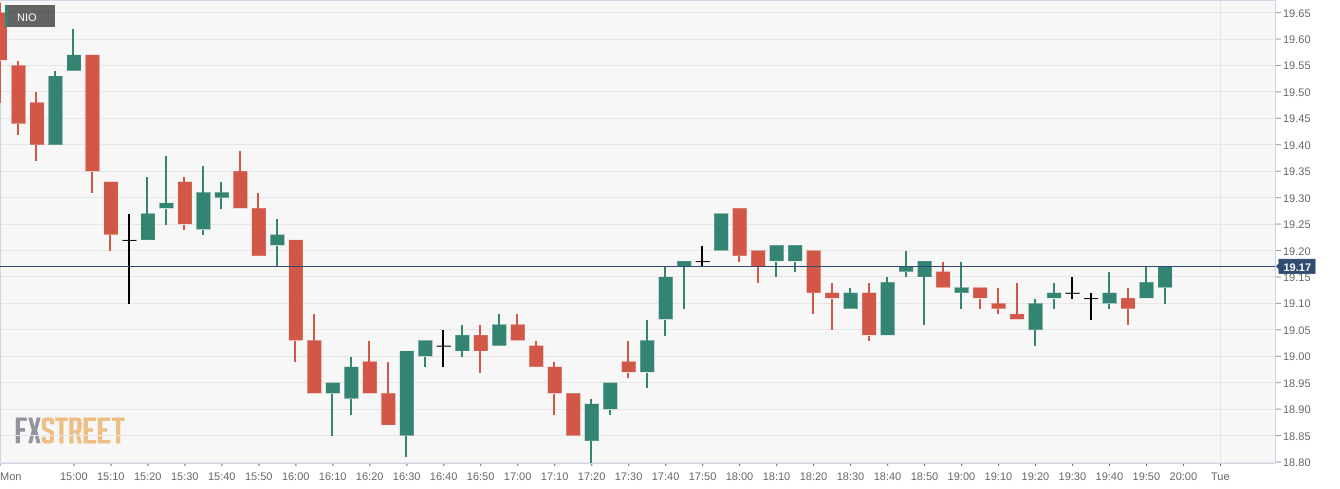
NYSE:NIO kicked off the second week of June on the right foot as some bullish headlines and a new tech partnership has investors feeling bullish. On Monday, shares of Nio rose by 6.08% and closed the trading session at $19.18. Nio is now back firmly above its 50-day moving average price of $17.87, as the stock’s bounce from hitting a 52-week low has been impressive. US markets closed Monday mostly flat although all three major indices managed to post a small gain for the day. The Dow Jones inched higher by 16 basis points, the S&P 500 gained 0.31%, and the NASDAQ posted a 0.40% gain for the session.


Stay up to speed with hot stocks' news!


Nio announced a new partnership with chip giant AMD (NASDAQ:AMD) on Monday as the EV maker secured the chips for the next generation of vehicles. Nio will use AMD’s EPYC line of chips for its HPC or High Performance Computer platform. The belief is that the powerful AMD chips will be able to accelerate the machine learning aspects of the program. Nio is currently using chips from Qualcomm (NASDAQ:QCOM), NVIDIA (NASDAQ:NVDA), and Mobileye. Shares of AMD were down by 0.61% on Monday.

NIO stock price
NIO Stock

An article in the South China Morning Post on Monday reported that Chinese demand for electric vehicles is as strong as ever. After the COVID-19 restrictions were lifted, production for EV makers should be back to full capacity. It has also helped that Beijing announced cash subsidies for Chinese consumers who want to buy EVs. Shares of Li Auto (NASDAQ:LI) were up by 10.91% while XPeng (NYSE:XPEV) rose by 5.17% on Monday.


Like this article? Help us with some feedback by answering this survey:

Author

More from Stocks Reporter
Share:

Editor's Picks

AUD/USD looks inconclusive near 0.7120

AUD/USD has been struggling for direction on Monday, coming under fresh downside pressure soon after retesting the 0.7140 area and looking to stabilise in the low 0.7100s ahead of the opening bell in Asia on Tuesday. The pair’s daily decline comes on the back of the generalised improvement in the sentiment surrounding the Greenback.

USD/JPY eases below 157.00 amid looming intervention risks

USD/JPY is easing back below 157.00 in Asia on Monday, undermined by modest Japanese Yen strength amid looming intervention risks after Friday's BoJ rate check. A Japanese holiday also keeps traders on edge amid escalating geopolitical tensions between Russia and Ukraine and in the Middle East. As a result, the US Dollar pauses its pullback, limiting the pair's downside.

Gold meets resistance around $4,400

Gold kicks in the new trading with on the back foot, keeping its trade near $4,350 per troy ounce. The precious metal’s correction comes on the back of the firmer US Dollar and espite declining US Treasury yields across the curve.

Bitcoin and Gold Outlook: BTC surges past $85K as Gold slips
Bitcoin (BTC) rises alongside the broader cryptocurrency market on Monday, trading near $86,000 at the time of writing. The Crypto King has maintained a robust bullish outlook since September 16 and is currently targeting a short-term breakout to the resistance range between $88,000 and $90,000. Meanwhile, Gold (XAU/USD) remains under pressure as it posts a minor correction.
The week ahead: Fuel prices in focus as we lead up to key eco releases

Financial markets are in a strange position as we move to the final weeks of Q3, uncertainty and volatility continue to grip markets, but the oil price is falling; and European and US stocks are poised to open higher later on Monday. Market stresses are concentrated in sovereign bonds, and European and US yields had another scare late on Friday, and moved higher.

BoJ Recap: Not as hawkish as expected

The Bank of Japan (BoJ) raised its short-term interest-rate target to 1.25% from 1.00% in a 7-2 vote, marking another step in the normalisation of monetary policy and widely matching what everyone has been expecting for weeks.