New Zealand Dollar moves back to November 3 lows against US Dollar following RBNZ report
- The New Zealand Dollar loses ground against the US Dollar after the RBNZ publishes its latest inflation expectations.
- The central bank report suggests prices are likely to come down in the future, capping interest rates – a negative for NZD.
- NZD/USD remains in a long-term downtrend with commentary from Fed officials as potential near-term influences.

The New Zealand Dollar (NZD) has traded more than one-third of a percentage point lower against the US Dollar on Wednesday. The NZD/USD pair has lost 0.37% on the day and has moved back to lows not witnessed since November 3. The market mood sours on the back of a vaguely downbeat outlook for the global economy. Since New Zealand is a major exporter of commodities, a slowdown in global growth would not help its currency.
An inflation report released overnight by the Reserve Bank of New Zealand (RBNZ) has not helped the Kiwi after it showed a widespread perception that a fall in prices lies ahead, possibly as a result of a slowdown in the economy and falling demand for goods and services.
Hawkish commentary from several Fed officials, most recently Fed governor Michelle Bowman stimulated further loses by NZD against the US Dollar.
Daily digest market movers: New Zealand Dollar weakens on lower price expectations
- The New Zealand Dollar trades lower versus the US Dollar as a result of a generally risk-off tone to markets on Wednesday.
- The Kiwi further weakened against the US Dollar after the RBNZ released its Q3 inflation expectations report. Respondents expected inflation to fall to a lower level in a year’s time than in the previous report. A year out, they saw inflation of 3.60%, which is lower than the 4.17% in the Q2 report.
- Actual inflation in New Zealand, as reported by Stats NZ, showed inflation drop to 5.6% in Q3 versus the 6.0% of the previous quarter.
- The lower inflation expectations imply the RBNZ is less likely to raise interest rates, of which the principal Cash Rate currently stands at 5.50%. Higher interest rates tend to strengthen a currency by increasing capital inflows from foreign investors searching for higher returns. This explains why the report may have had a negative impact on NZD/USD.
- The RBNZ report also showed inflation expectations two years out, falling to 2.76% from 2.83% previously.
- The current widespread view is that the US Federal Reserve (Fed) is also now unlikely to raise interest rates. With the Fed Funds Rate currently at 5.25-5.50%, there is little incentive for traders to borrow in either NZD or USD and invest in the other, an operation known as the ‘carry trade’.
- That said, Fed Governor Michelle Bowman commented on Tuesday, that the Fed may need to raise interest rates further to control inflation. However, she also noted that the significant increase in Treasury yields since September has led to tighter financial conditions.
- A speech by Federal Reserve Chair Jerome Powell failed to ignite markets on Wednesday as he did not discuss monetary policy. Commentary expected from several other Fed governors in the near-term may still impact the pair.
New Zealand Dollar technical analysis: NZD/USD slips lower on charts
NZD/USD – the number of US Dollars one New Zealand Dollar can buy – slipped lower for the third day in a row on Wednesday. The pair is pulling back after peaking at 0.6002 on November 6.
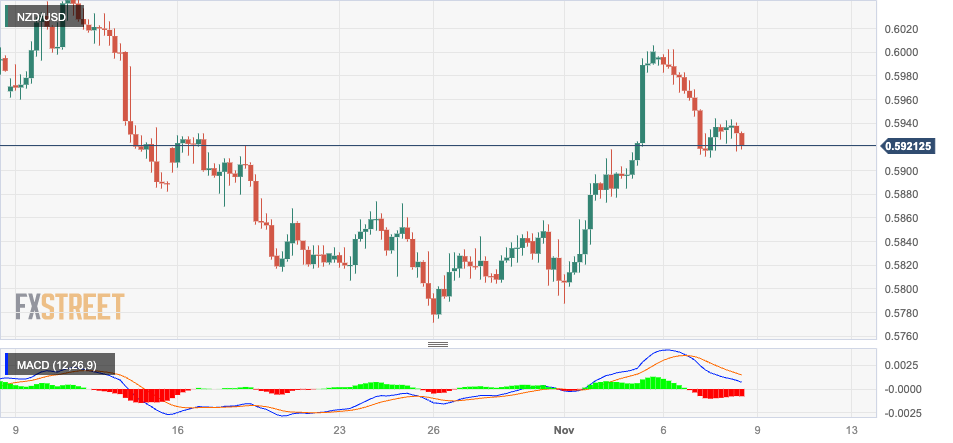
New Zealand Dollar vs US Dollar: 4-hour Chart
The pair has found support at the 50-day Simple Moving Average (SMA) (see chart below). It remains in a short-term uptrend, favoring a recovery.
A decisive break above the November 3 high would reconfirm the short-term bullish bias, with a likely target thereafter at the 0.6055 high of October.
-638350565423108687.png)
New Zealand Dollar vs US Dollar: Daily Chart
The trend remains bearish, however, on both the daily chart and weekly charts suggesting the potential for more downside is strong.
In line with the dominant longer-term bear trends seen on higher time frames, a break below 0.5884 would signal a continuation of the broader downtrend to a target at the 0.5773 October low.
Bulls would have to push above the 0.6055 October high to change the intermediate outlook to one that was bullish and suggested the possibility of the birth of a new uptrend.
RBNZ FAQs
What is the Reserve Bank of New Zealand?
The Reserve Bank of New Zealand (RBNZ) is the country’s central bank. Its economic objectives are achieving and maintaining price stability – achieved when inflation, measured by the Consumer Price Index (CPI), falls within the band of between 1% and 3% – and supporting maximum sustainable employment.
How does the Reserve Bank of New Zealand’s monetary policy influence the New Zealand Dollar?
The Reserve Bank of New Zealand’s (RBNZ) Monetary Policy Committee (MPC) decides the appropriate level of the Official Cash Rate (OCR) according to its objectives. When inflation is above target, the bank will attempt to tame it by raising its key OCR, making it more expensive for households and businesses to borrow money and thus cooling the economy. Higher interest rates are generally positive for the New Zealand Dollar (NZD) as they lead to higher yields, making the country a more attractive place for investors. On the contrary, lower interest rates tend to weaken NZD.
Why does the Reserve Bank of New Zealand care about employment?
Employment is important for the Reserve Bank of New Zealand (RBNZ) because a tight labor market can fuel inflation. The RBNZ’s goal of “maximum sustainable employment” is defined as the highest use of labor resources that can be sustained over time without creating an acceleration in inflation. “When employment is at its maximum sustainable level, there will be low and stable inflation. However, if employment is above the maximum sustainable level for too long, it will eventually cause prices to rise more and more quickly, requiring the MPC to raise interest rates to keep inflation under control,” the bank says.
What is Quantitative Easing (QE)?
In extreme situations, the Reserve Bank of New Zealand (RBNZ) can enact a monetary policy tool called Quantitative Easing. QE is the process by which the RBNZ prints local currency and uses it to buy assets – usually government or corporate bonds – from banks and other financial institutions with the aim to increase the domestic money supply and spur economic activity. QE usually results in a weaker New Zealand Dollar (NZD). QE is a last resort when simply lowering interest rates is unlikely to achieve the objectives of the central bank. The RBNZ used it during the Covid-19 pandemic.
Author

Joaquin Monfort
FXStreet
Joaquin Monfort is a financial writer and analyst with over 10 years experience writing about financial markets and alt data. He holds a degree in Anthropology from London University and a Diploma in Technical analysis.