Gold climbs to seven-week highs on Fed rate cut bets, safe-haven demand
- Gold attracts some buyers in Monday’s early European session, up 1.0% on the day.
- Fed rate cut expectations and safe-haven flows provide some support to the Gold price.
- Traders await the US NFP data for October and November on Tuesday for fresh impetus.

Gold price (XAU/USD) rises to seven-week highs to near $4,350 during the early European trading hours on Monday. The precious metal extends its upside amid the prospect of interest rate cuts by the US Federal Reserve (Fed) next year. Lower interest rates could reduce the opportunity cost of holding Gold, supporting the non-yielding precious metal. Additionally, uncertainty and the risk-off sentiment could boost the safe-haven flows, benefiting the yellow metal price.
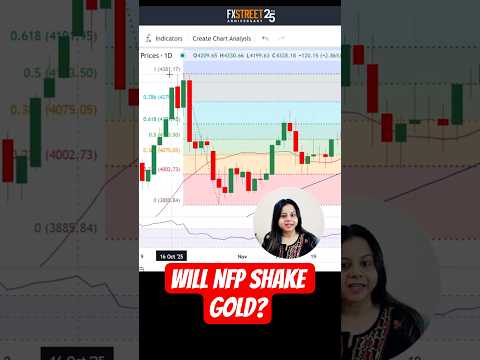
Nonetheless, hawkish remarks from Fed officials last week could lift the US Dollar (USD) and weigh on the USD-denominated commodity price. Traders will take more cues from the speeches by Fed Governor Stephen Miran and New York Fed President John Williams later on Monday.
The US employment report for October and November will take center stage on Tuesday, including Nonfarm Payrolls (NFP), Average Hourly Earnings and Unemployment Rate. These reports could provide more clarity on the labor market's health and likely influence expectations for the Fed's January meeting.
Daily Digest Market Movers: Gold jumps as Fed delivered its final 2025 rate cut, safe-haven flows
- Bloomberg reported on Sunday that a mass shooting at Bondi Beach in the Australian city of Sydney had killed at least 16 people and wounded 40. Australian Prime Minister Anthony Albanese said in a press conference early Monday that the shooting was a “targeted attack” on the Jewish community. He had previously described the incident as an “act of evil antisemitism, terrorism that has struck the heart of our nation.”
- Chicago Fed President Austan Goolsbee said on Friday that he “felt the more prudent course would have been to wait for more information” before cutting rates again after a government shutdown delayed several key economic reports in October and November.
- Cleveland Fed President Beth Hammack stated that the central bank should keep rates high enough to continue putting downward pressure on inflation.
- The US Fed last week announced its third and final quarter-point rate reduction this year, cutting interest rates by 25 basis points (bps) to a target range of 3.50% to 3.75%.
- Fed Chair Jerome Powel said that the reduction puts the central bank in a comfortable position as far as rates go. “We are well positioned to wait and see how the economy evolves,” said Powell.
- Markets are currently pricing in nearly a 76% probability that the Fed will hold interest rates steady in January 2026, compared with a 70% chance just before the December rate cut announcement, according to the CME FedWatch tool.
Gold maintains its constructive outlook in the longer term
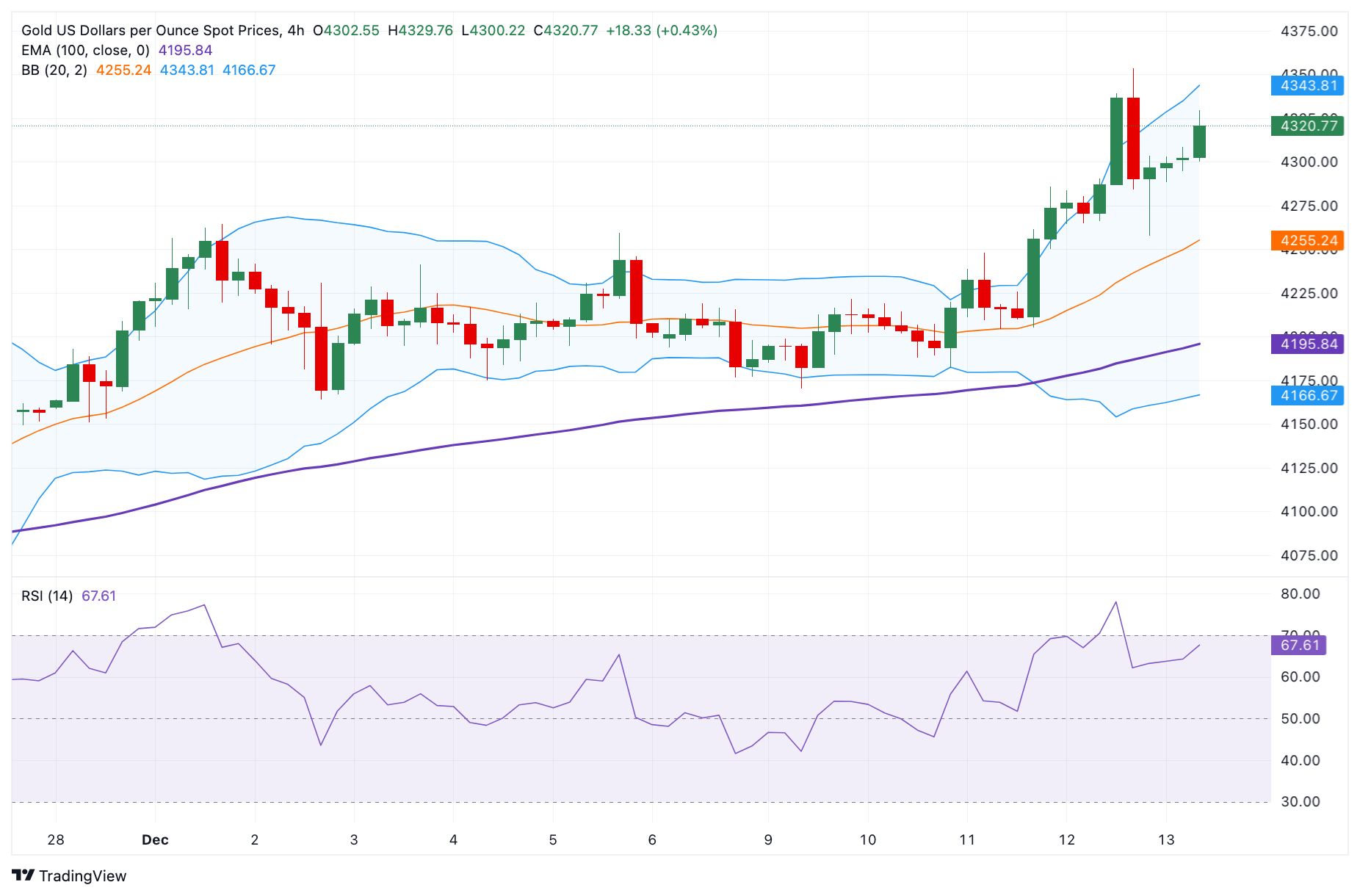
Gold price trades in positive territory on the day. According to the four-hour timeframe, the positive outlook of the precious metal remains in play as the price holds above the key 100-day Exponential Moving Average. The Bollinger Band widens, suggesting a strong bullish trend. Furthermore, the upward momentum is reinforced by the 14-day Relative Strength Index (RSI), which stands above the midline near 68.75. This displays the bullish momentum for the yellow metal.
On the bright side, the first upside barrier to watch is in the $4,345-$4,355 zone, representing the upper boundary of the Bollinger Band and the high of December 12. Sustained upside momentum could take XAU/USD back up to an all-time high of $4,381. Further north, the next resistance level is located at the $4,400 psychological mark.
On the downside, the initial support level for the yellow metal is seen at the low of December 12 at $4,257. More bearish candlesticks reflect a continuation of downside pressure, possibly dragging the price down to the next bearish target at $4,200, the 100-day EMA. The next contention level emerges at $4,166, the lower limit of the Bollinger Band.
Gold FAQs
Gold has played a key role in human’s history as it has been widely used as a store of value and medium of exchange. Currently, apart from its shine and usage for jewelry, the precious metal is widely seen as a safe-haven asset, meaning that it is considered a good investment during turbulent times. Gold is also widely seen as a hedge against inflation and against depreciating currencies as it doesn’t rely on any specific issuer or government.
Central banks are the biggest Gold holders. In their aim to support their currencies in turbulent times, central banks tend to diversify their reserves and buy Gold to improve the perceived strength of the economy and the currency. High Gold reserves can be a source of trust for a country’s solvency. Central banks added 1,136 tonnes of Gold worth around $70 billion to their reserves in 2022, according to data from the World Gold Council. This is the highest yearly purchase since records began. Central banks from emerging economies such as China, India and Turkey are quickly increasing their Gold reserves.
Gold has an inverse correlation with the US Dollar and US Treasuries, which are both major reserve and safe-haven assets. When the Dollar depreciates, Gold tends to rise, enabling investors and central banks to diversify their assets in turbulent times. Gold is also inversely correlated with risk assets. A rally in the stock market tends to weaken Gold price, while sell-offs in riskier markets tend to favor the precious metal.
The price can move due to a wide range of factors. Geopolitical instability or fears of a deep recession can quickly make Gold price escalate due to its safe-haven status. As a yield-less asset, Gold tends to rise with lower interest rates, while higher cost of money usually weighs down on the yellow metal. Still, most moves depend on how the US Dollar (USD) behaves as the asset is priced in dollars (XAU/USD). A strong Dollar tends to keep the price of Gold controlled, whereas a weaker Dollar is likely to push Gold prices up.
Author

Lallalit Srijandorn
FXStreet
Lallalit Srijandorn is a Parisian at heart. She has lived in France since 2019 and now becomes a digital entrepreneur based in Paris and Bangkok.