Nasdaq 100 Elliott Wave update: Just a correction or something more sinister?

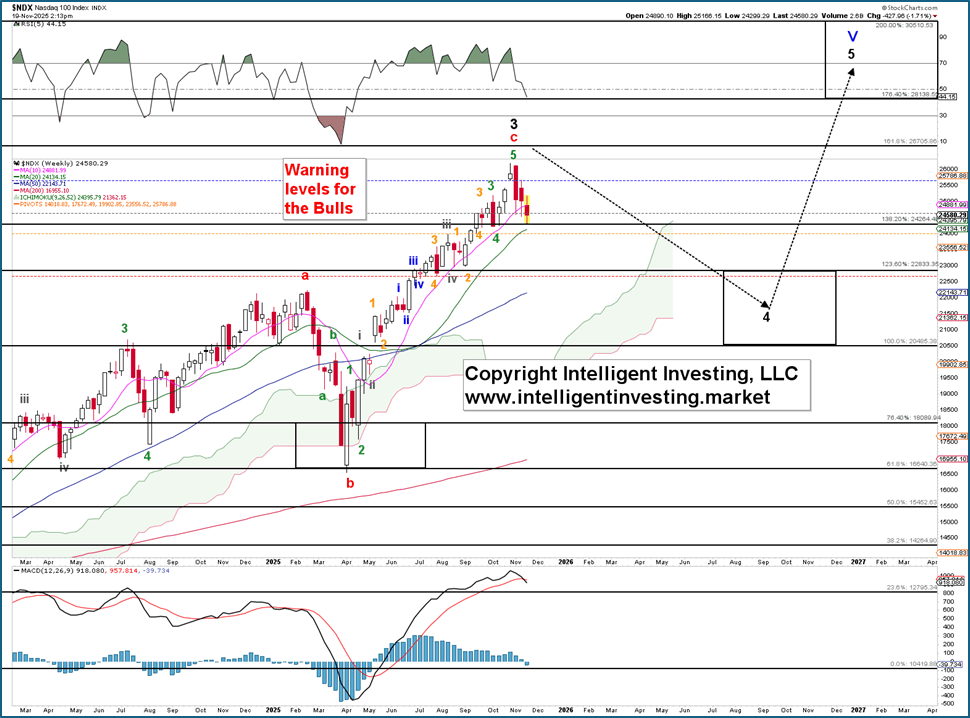
We have been monitoring the NASDAQ 100 (NDX) to reach approximately 26700 in an Elliott Wave (EW) Principle impulse (five-wave) move upward from the early April lows for a more significant top for some time, and in our previous update from October 28 we were tracking a last move to that level, contingent on the index staying above its warning levels:
“first at 25864 (blue, 25% chance that the green W-5 is over), second at 25656 (gray, 50% chance that the green W-5 is over), third at 25195 (orange, 75% chance that the green W-5 is over), and fourth at 24652 (red, indicating that the green W-5 is definitely over).”
Fast forward to today, the index peaked at 26182 on October 29, then fell below 24652 on November 7, and is now trading around 24550. Therefore, it's entirely possible that the larger W-4 correction to ideally between 20485 and 22835 is in progress. However, we need to see a weekly close below 24000 to be more confident (75% chance), which corresponds to the third, orange warning level for the Bulls on the weekly chart. See Figure 1 below.
Figure 1. Long-term Elliott Wave count for the NDX
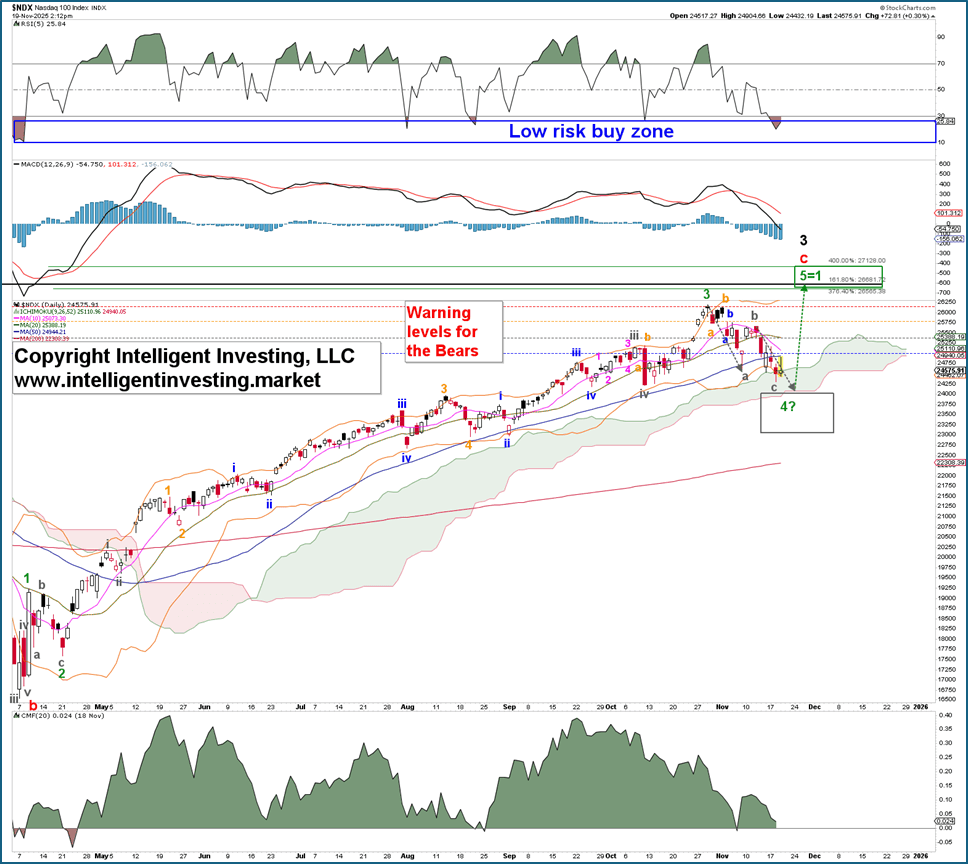
Namely, the index missed the ideal upside target by about 500 points or 2%, which is a notable gap considering that stock markets tend to be more accurate. Therefore, it is entirely possible that the index is still in its minor 4th wave, to be followed by the final 5th wave (green W-5) closer to the 26700 level. See Figure 2 below. So far, the price action from the recent all-time high to today looks very much like a simple zigzag, a three-wave (the gray W-a, W-b, W-c) pattern. That’s corrective, so the smaller 4th wave can be considered underway, especially since the green W-2 in April was a flat correction; satisfying EW’s “rule of alternation,” in which 2nd and 4th waves tend not to be the same pattern. The ideal target zone is 23000-24000, but the index does not have to go that low.
Figure 2. Short-term Elliott Wave count for the NDX
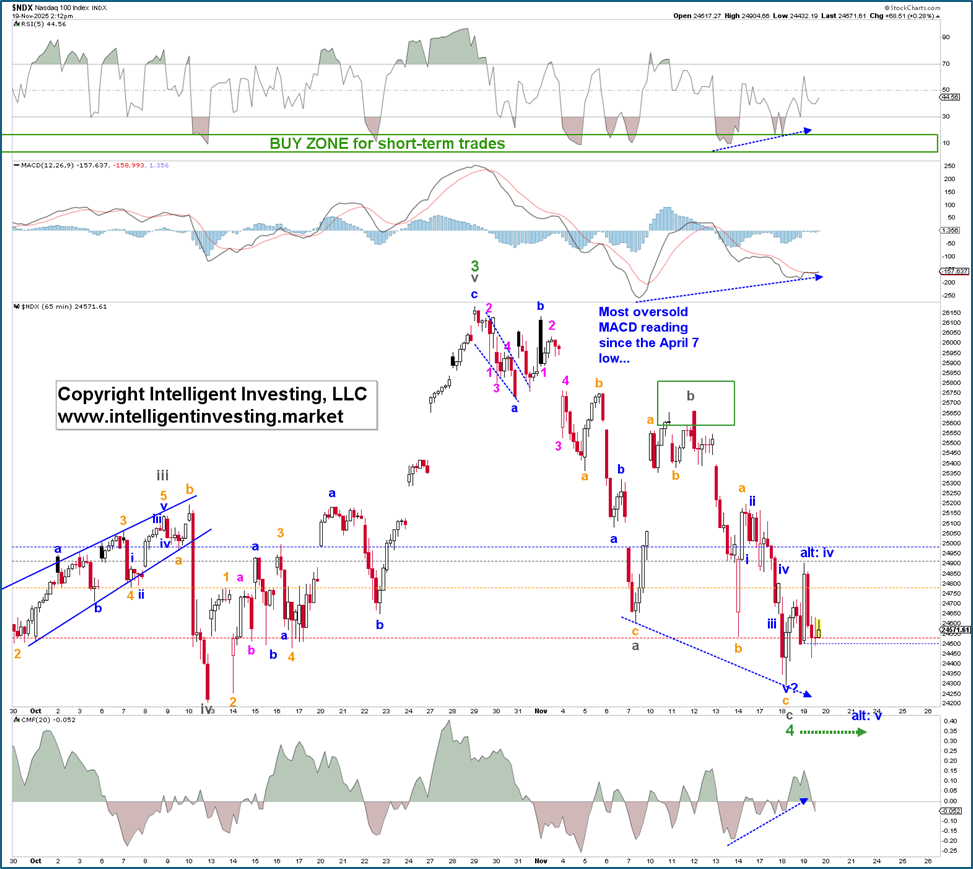
Lastly, by examining the 65-minute chart, we can see that, so far, the price action since the recent ATH has been trending lower, overlapping. While this does not rule out the larger 4th wave scenario, since it could also start similarly, it indicates that the downward move is corrective and will eventually resolve to the upside. However, even the very short-term shows that we can still see at least one more (blue) wave lower. Meanwhile, although it is a condition rather than a trade trigger, positive divergences (blue dotted arrows) are building in the technical indicators, suggesting that at this stage, the downside is losing strength, momentum, and selling pressure.
Figure 2. Intra-day Elliott Wave count for the NDX
Since stock markets tend to rise over the long term, a bullish stance is generally preferable to a bearish one, and a final W-5 to the ideal 26700 level cannot be ruled out yet. Moreover, the price action since the October 29 ATH has been moving downward in an overlapping pattern — a corrective, countertrend move. While we cannot rule out the possibility of a larger 4th wave correction like 2022, we expect that its “dead cat bounce,” i.e., a B-wave, will most likely reach 26700 because “when the 3rd wave fails, the B-wave often does the trick.”
Author
Dr. Arnout Ter Schure
Intelligent Investing, LLC
After having worked for over ten years within the field of energy and the environment, Dr.