Microsoft stock gets slammed on hawkish Fed dot plot
- Federal Reserve releases interest rate projections for only two cuts in 2025.
- NASDAQ, Dow Jones reel on news with equities shedding weight.
- US Dollar surges on thought of higher rates for longer.
- MSFT stock looks likely to continue pulling back toward $410.


Microsoft (MSFT) stock crashed along with the general market on Wednesday as the Federal Reserve’s (Fed) more hawkish view of 2025 interest rates made Wall Street rethink the post-election run-up.
MSFT stock closed 3.76% lower to $437.39, worse than the Dow Jones Industrial Average (DJIA)’s -2.58% performance or the NASDAQ’s -3.56% outing.
Microsoft stock news: Fed only sees two cuts next year
Just like everyone expected, Jerome Powell’s Fed cut interest rates by 25 basis points on Wednesday. That wasn’t what the market cared about though.
The Fed produces a Summary of Economic Projections (SEP) each quarter, and the latest version arrived on Wednesday. The SEP includes the so-called “dot plot” — a projection of where each voting member on the Federal Open Market Committee (FOMC) expects interest rates to be in the future.
The newest dot plot tells us that the central bank is now expecting a much slower rate cutting cycle than it did before. One year from now, the dot plot shows interest rates at 3.9% rather than the 3.4% predicted in September. Two years from now, the Fed is expected to have interest rates at 3.4% rather than 2.9%.
This means that the central bank is expected by the very board who will be voting on rate changes in the future to only introduce two 25 bps cuts in 2025. Then the Fed is expected to do the same in 2026. The more hawkish posture comes as the market is worried by recent inflation reports that show prices failing to push much below the 3% threshold. The Fed targets 2% core price growth on an annual basis. Additionally, the market is worried that President-elect Donald Trump's tariff policies will help inflation to resurface.
Higher interest rates may be good for banks, but they are mostly bad for large corporations with debt like Microsoft. Additionally, higher interest rates make bonds more attractive, which usually leads stocks to trade at lower multiples.
Tech stocks were hurt the worst on Wednesday with Tesla (TSLA) shedding more than 8% and Amazon (AMZN) giving up 4.6%.
The Financial Times reported on Wednesday that Microsoft is leagues ahead of competitors in getting its hands on Nvidia (NVDA) chips used for artificial intelligence (AI) projects. Microsoft is a major investor in OpenAI, the creator of ChatGPT.
Microsoft purchased 485,000 of Nvidia's Hopper GPUs this year, based on estimates by Omdia. Meta Platforms (META) is estimated to have purchased 224,000 Hopper chips, while Amazon (AMZN) and Alphabet (GOOGL) purchased 196,000 and 169,000, respectively.
China’s ByteDance, which owns TikTok, ordered 230,000, while Tencent (TCEHY) ordered a similar number. Chinese firms are being forced to order H20 chips, which are less powerful than other Hopper versions due to strict US government protocols against Chinese buyers.
Microsoft stock chart
MSFT stock looks poised to fall back to the $400 to $410 demand zone. Wednesday's sell-off pushed the price tag below the mid-September resistance level of $441.50.
The 50-day, 100-day and 200-day Simple Moving Averages (SMAs) are all bunched up in the $420s, so expect that region to serve momentarily as a support range.
However, interest rates are incredibly important to asset valuations, so a move back to the $400-$410 range if not the $385-$390 support area would appear unsurprising. It would only be a move toward pre-election valuations.
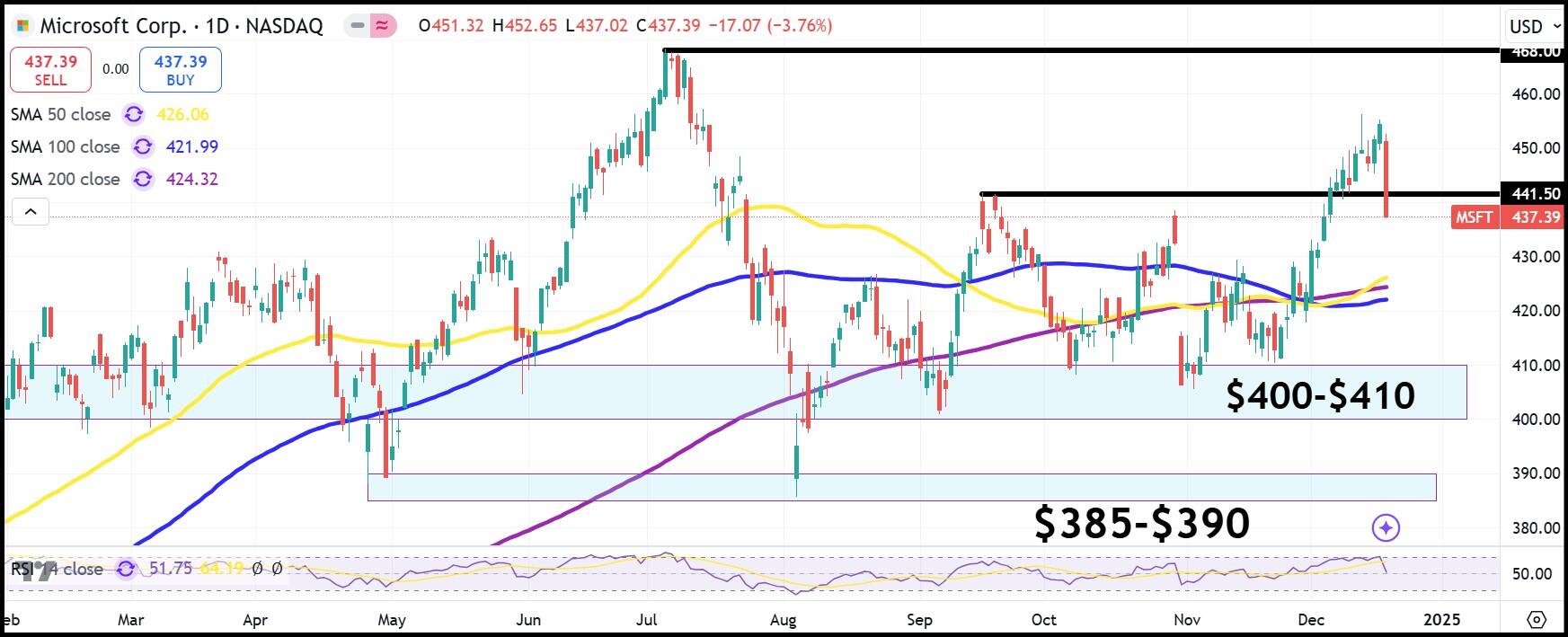
MSFT daily stock chart
Premium
You have reached your limit of 3 free articles for this month.
Start your subscription and get access to all our original articles.
Author
Clay Webster
FXStreet
Clay Webster grew up in the US outside Buffalo, New York and Lancaster, Pennsylvania. He began investing after college following the 2008 financial crisis.

















