Micron surges on Wednesday, day after hitting $1 trillion valuation
- Micron stock soars higher on Wednesday as historic rally leads to $1 trillion valuation.
- Goldman Sachs says the wider equity market is in the middle of a gamma squeeze.
- UBS raised its price target on MU stock to $1,625 on Tuesday.
- Oil prices and Treasury yields decline, a boost to the equity market.

Micron (MU) isn't taking the day off on Wednesday after becoming the newest US company to attain a $1 trillion market capitalization.

Micron stock spiked another 9% in premarket trading on Wednesday, raising its market valuation to $1.1 trillion after ending Friday's session close to $800 billion.
Memory chip stocks are on fire as the wider market realizes that the memory chip shortages could become the new normal. NAND maker Sandisk (SNDK) has also added 4% on Wednesday, reaching a new all-time high.
Micron stock rallied 19% on Tuesday after analyst Timothy Arcuri raised his price target to $1,625 from $535. At that valuation, Micron would be worth close to $1.8 trillion.
The broad market is also in rally mode midweek as US Treasury yields decline and Oil (WTI) pulls back more than 5% on further headlines that Iran and the US are on the brink of a peace deal that would reopen the Strait of Hormuz despite the US military briefly attacking Iranian naval vessels and missile launch sites on Tuesday.
Micron's historic rally continues
Arcuri argued in his note to clients earlier this week that Micron's turn toward multi-year supply agreements would keep earnings elevated over the next three years.
“With [long-term agreements] now firmly in place across most of the industry, we are again raising C2027-2029 estimates and expect EPS to remain comfortably >$100 throughout the period, with MU generating over $400B in FCF across the same timeframe,” Arcuri wrote in a rally-inducing note.
UBS now expects earnings per share (EPS) to reach $155, $167, and $77 between 2027 and 2029.
“We believe the market will start to put a more 'normal' multiple on the stock and MU will continue to re-rate higher as more details emerge about the structural changes AI has driven to the entire memory complex," Arcuri wrote.
The May 29 call options chain is at least partially to blame for the buying frenzy this week. As call option buyers have made an extremely large number of bets that Micron will continue to rally, this has forced the sellers or dealers in those calls to buy up more shares.
This process is known as delta hedging. As the stock rises, those hedges must be continuously increased, forcing more buying, which increases the stock price still higher, which in turn leads to more call buying. This leads to what is known in the industry as a gamma squeeze.
For May 29, Micron's most popular strike price is $1,000, which had 13,312 contracts in open interest at the end of Tuesday's regular session. About four times that number of contracts traded hands on Tuesday alone.
Goldman Sachs says it has seen the same process unfold in the S&P 500 options market this week as well. The notional value of S&P 500 call options has reached 2.81% of the underlying index market cap against a long-run average of 0.64%.
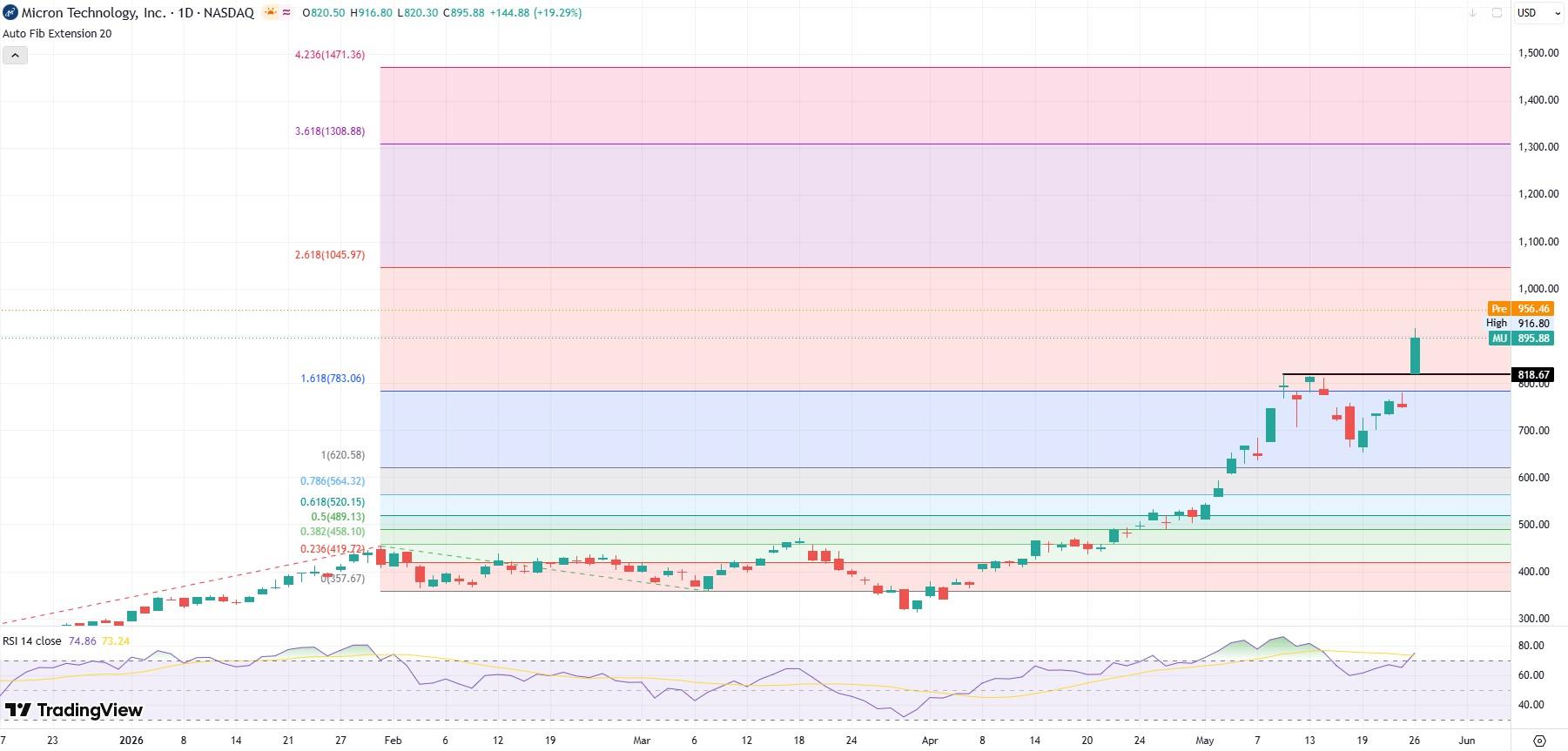
Micron stock chart
It goes without saying that Micron stock is now heavily overbought on the Relative Strength Index (RSI), with Tuesday's reading reaching nearly 75, above the significant 70 threshold. But a continued gamma squeeze could mean the share price soars to new heights, disregarding that indicator.
The Fibonacci Extension tells us that there are a number of targets for bulls to aim for. First, there's the 261.8% Fibo above $1,045. Then the 361.8% Fibo arrives near $1,308, followed by the 423.6% Fibo at $1,471.
Author

Clay Webster
FXStreet
Clay Webster grew up in the US outside Buffalo, New York and Lancaster, Pennsylvania. He began investing after college following the 2008 financial crisis.