Mexican Peso plummets ahead of Banxico’s decision

Most recent article: Mexican Peso climbs ahead of Banxico’s decision
- The Mexican Peso depreciates as USD/MXN climbs above 20.50 as trade tensions between the US and Mexico ease.
- Mixed investment data and anticipated Banxico rate cut further pressure on the Mexican Peso.
- The White House clarifies trade measures with Mexico, focusing on anti-drug efforts.
The Mexican Peso (MXN) dropped for the second straight day versus the US Dollar (USD) as trade war fears began to fade. Upbeat United States (US) jobs data pressured the Mexican currency, which has failed to capitalize on broad US Dollar weakness. The USD/MXN trades at 20.57, up by 0.45%.
Mexico’s economic docket revealed mixed Gross Fixed Investment figures in November. The data underscores the ongoing economic slowdown and undermines the already battered Mexican Peso, which could weaken further as the Banco de Mexico (Banxico) is expected to lower interest rates by at least 25 basis points from 10% to 9.75% on Thursday.
Although trade disputes between the US and Mexico have found common ground, USD/MXN traders should know that there is a 30-day pause and that tensions could arise throughout the end of February. Peter Navarro, a trade adviser for the White House, said that Canada misunderstood that it is not a “trade war” but a drug war.
Therefore, tariffs on Mexico will remain paused if the Government improves on its fight against drug cartels.
In the US, data keeps the Greenback on the back foot. The Institute for Supply Management (ISM) revealed that business activity in the US services sector cooled down in January. Other data showed that the jobs market remains solid as traders prepare for the release of US Nonfarm Payrolls numbers on Friday.
Daily digest market movers: Mexican Peso remains heavy amid broad USD weakness
- Gross Fixed Investment in Mexico rose 0.1% MoM in November, down from 0.3% in October, but exceeded forecasts of -0.1%. On a yearly basis, it improved from -2.6% contraction to -0.7%.
- Mexico’s Business Confidence in January showed signs of improvement, though business activity contracted, according to S&P Global. The manufacturing sector contracted for the seventh straight month in January, indicating that the economy is slowing down
- Banxico’s private economists survey showed that Mexico’s economy is expected to grow by 1% in 2025, down from 1.2% in the December survey. Inflation is expected to tick higher from 3.80% to 3.83%, while core prices are foreseen at 3.74%, up from 3.72%.
- Economists estimate the USD/MXN pair exchange rate to finish the year at 20.90, up from 20.53 in December, and estimate 150 basis points of easing from Banxico.
- The US ADP National Employment Change in January grew from 176K to 183K, exceeding estimates of 150K.
- The ISM Services PMI, for the same period as the ADP, rose 52.9 and exceeded forecasts of 52.8 but dipped compared to December’s 54.0.
- S&P Global featured Services PMI for January, which dipped from 56.8 to 52.9, better than the 52.8 expected.
- Money market fed funds rate futures are pricing in 52 basis points (bps) of easing by the Federal Reserve in 2025.
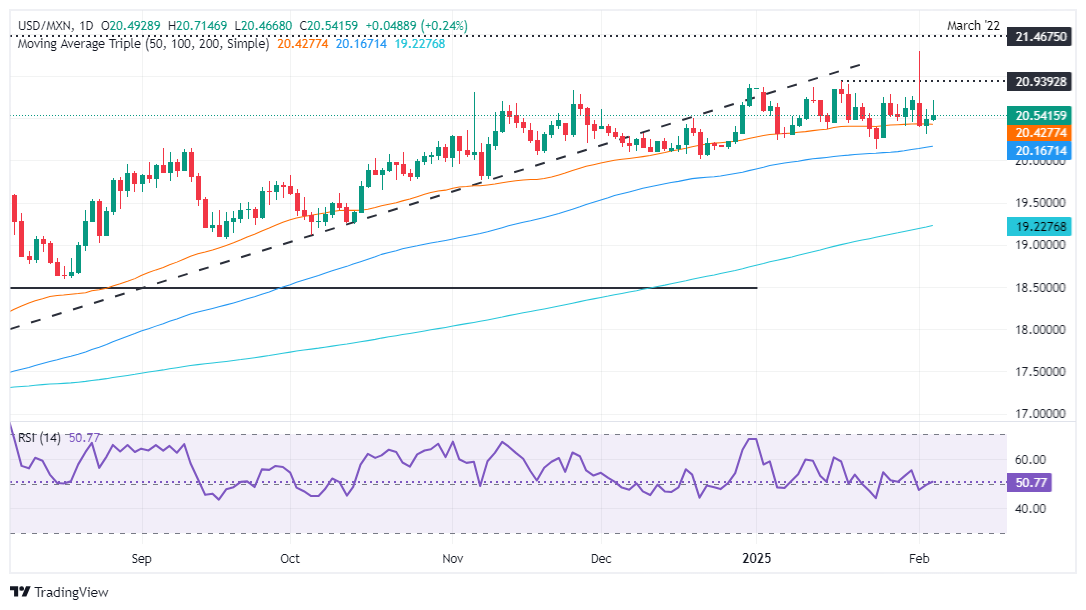
USD/MXN technical outlook: Mexican Peso weakens past 20.50 as buyers target 20.90
USD/MXN rose 0.265, recovering from a weekly low of 20.30 on Monday. Nevertheless, buyers' inability to achieve a daily close below the 50-day Simple Moving Average (SMA) of 20.41 sponsored the buck’s recovery to the detriment of the Peso.
For a bullish resumption, buyers must clear the previous year-to-date (YTD) peak of 20.90, ahead of the 21.00 figure. Further upside lies above the current YTD peak of 21.29.
Conversely, if sellers push USD/MXN below 20.30, it could fall to the 100-day SMA at 20.15. ahead of the 20.00 figure.
Mexican Peso FAQs
The Mexican Peso (MXN) is the most traded currency among its Latin American peers. Its value is broadly determined by the performance of the Mexican economy, the country’s central bank’s policy, the amount of foreign investment in the country and even the levels of remittances sent by Mexicans who live abroad, particularly in the United States. Geopolitical trends can also move MXN: for example, the process of nearshoring – or the decision by some firms to relocate manufacturing capacity and supply chains closer to their home countries – is also seen as a catalyst for the Mexican currency as the country is considered a key manufacturing hub in the American continent. Another catalyst for MXN is Oil prices as Mexico is a key exporter of the commodity.
The main objective of Mexico’s central bank, also known as Banxico, is to maintain inflation at low and stable levels (at or close to its target of 3%, the midpoint in a tolerance band of between 2% and 4%). To this end, the bank sets an appropriate level of interest rates. When inflation is too high, Banxico will attempt to tame it by raising interest rates, making it more expensive for households and businesses to borrow money, thus cooling demand and the overall economy. Higher interest rates are generally positive for the Mexican Peso (MXN) as they lead to higher yields, making the country a more attractive place for investors. On the contrary, lower interest rates tend to weaken MXN.
Macroeconomic data releases are key to assess the state of the economy and can have an impact on the Mexican Peso (MXN) valuation. A strong Mexican economy, based on high economic growth, low unemployment and high confidence is good for MXN. Not only does it attract more foreign investment but it may encourage the Bank of Mexico (Banxico) to increase interest rates, particularly if this strength comes together with elevated inflation. However, if economic data is weak, MXN is likely to depreciate.
As an emerging-market currency, the Mexican Peso (MXN) tends to strive during risk-on periods, or when investors perceive that broader market risks are low and thus are eager to engage with investments that carry a higher risk. Conversely, MXN tends to weaken at times of market turbulence or economic uncertainty as investors tend to sell higher-risk assets and flee to the more-stable safe havens.
Author

Christian Borjon Valencia
FXStreet
Markets analyst, news editor, and trading instructor with over 14 years of experience across FX, commodities, US equity indices, and global macro markets.