Mexican Peso declines as tensions rise on escalating war of words
- The Mexican Peso trades lower on Wednesday, but an escalation in rhetoric between US and Mexican leaders poses risks.
- Mexico’s President Sheinbaum reads out a letter on television warning Trump she’ll retaliate with tit-for-tat tariffs if he starts.
- Technically, USD/MXN remains at the top of a mini range as it consolidates within a broader uptrend.

The Mexican Peso (MXN) trades lower Wednesday after closing on average over 1.5% lower on Tuesday. Markets remain tense as the rhetoric between the United States (US) and Mexico leaders ramps up.
The previous day’s decline was caused by President-elect Donald Trump’s threat to tear up the US, Mexico and Canada free trade agreement (USMCA), and whack a 25% tariff on imports from both countries, unless they tightened their borders with the US and put an end to illegal immigration and narcotics trafficking. This led to a broad depreciation of the MXN and the CAD on fears that tariffs would result in lower exports and reduced demand for the FX to purchase them.
Mexican Peso weakens on escalating trade rhetoric
The Mexican Peso continued to see weakness after the President of Mexico, Claudia Sheinbaum, responded to Trump’s tariff threat during one of her regular televised press conferences on Tuesday. Sheinbaum read from an overhead projector passage from a letter she had written in response to Trump’s tariff threat.
“One tariff would lead to another in response,” said Sheinbaum, inferring that if the US raised levies on Mexican goods entering America, Mexico would do the same on US goods entering Mexico, adding that a trade war would achieve nothing more than “place at risk common businesses” in both country’s economies.
Sheinbaum highlighted Mexico’s existing willingness to cooperate with the US on border issues. She said illegal immigration into the US from Mexico had fallen by 75% from December 2023 to November 2024, according to US border patrol figures.
Mexico had always been willing to work with the US on reducing the traffic of Fentanyl across the border. Still, she added that the problem of drug abuse was the US “public health and consumption” problem, not a Mexican problem.
The Mexican President’s pugnacious response raised the spectre of a tariff war between the two countries that would significantly raise prices for US citizens, especially in the automotive spare parts sector of the economy.
Such a war would almost certainly increase inflation in the US, especially if it included Canada too, according to economists. This would lead the Federal Reserve (Fed) to maintain interest rates at elevated levels, which, in turn, would likely strengthen the US Dollar since higher interest rates tend to attract more foreign capital inflows.
Technical Analysis: USD/MXN tests the ceiling of mini range
USD/MXN remains at elevated levels above 20.50 on Wednesday, trading close to the top of the mini range (green dashed line on the chart below) formed during November.
The final C wave of a Measured Move pattern that has unfolded within the confines of the mini range now looks complete. Resembling zig-zags, such patterns normally exhibit a symmetry between waves A and C, which are usually of a similar length. This is currently the case with the example of USD/MXN.
USD/MXN Daily Chart
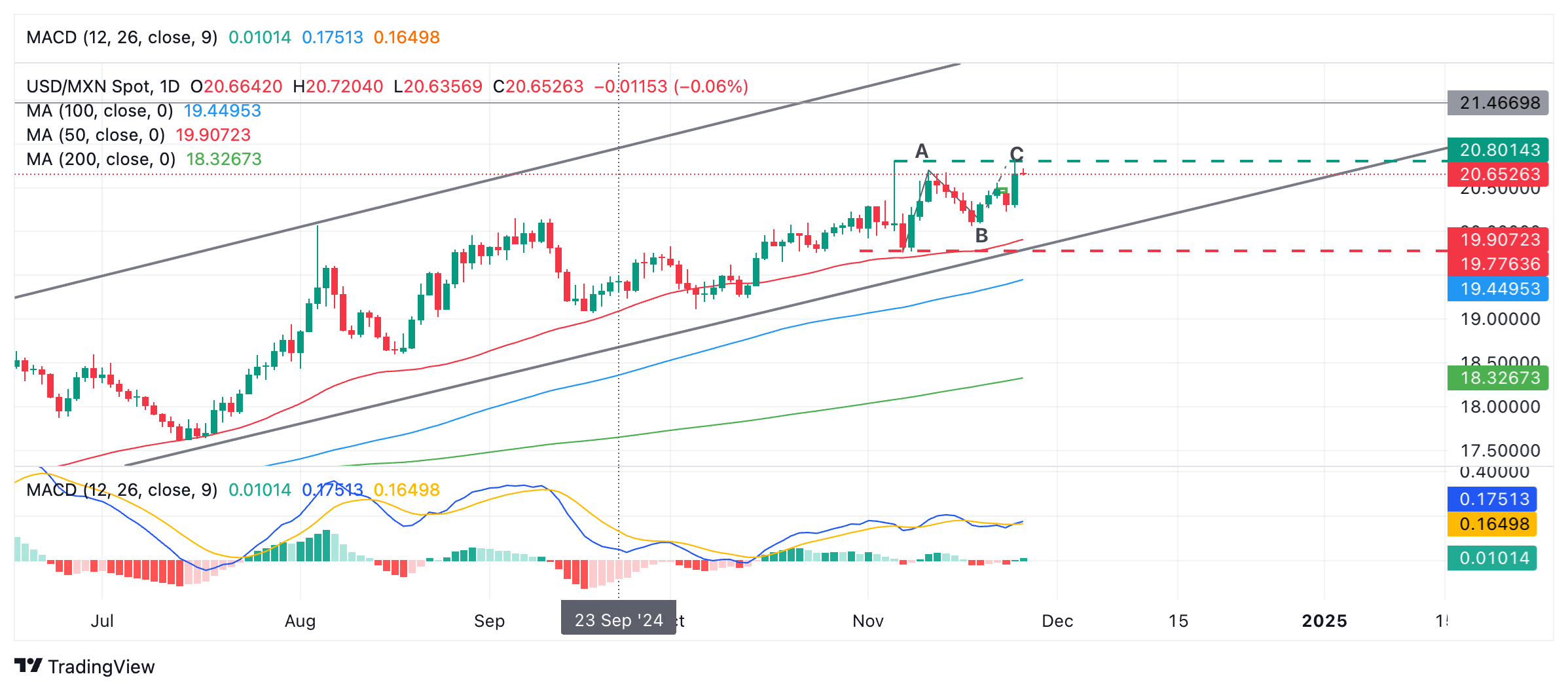
USD/MXN is probably range-bound in the short term as it oscillates within this mini range. However, it is still in an uptrend within a rising channel in the medium and long term.
It would require a decisive break above the top of the range at 20.80 to signal the start of a more bullish short-term trend in line with longer-term up cycles.
In the absence of such a breakout, the pair is likely to continue to oscillate within the parameters of its range, with the next move probably back down towards the range floor in the 19.70s (red dashed line).
A decisive breakout higher would be one accompanied by a long green candle that pierced and rose well above the range highs before then closing near its highs, or three green candles in a row that broke above the level.
Mexican Peso FAQs
The Mexican Peso (MXN) is the most traded currency among its Latin American peers. Its value is broadly determined by the performance of the Mexican economy, the country’s central bank’s policy, the amount of foreign investment in the country and even the levels of remittances sent by Mexicans who live abroad, particularly in the United States. Geopolitical trends can also move MXN: for example, the process of nearshoring – or the decision by some firms to relocate manufacturing capacity and supply chains closer to their home countries – is also seen as a catalyst for the Mexican currency as the country is considered a key manufacturing hub in the American continent. Another catalyst for MXN is Oil prices as Mexico is a key exporter of the commodity.
The main objective of Mexico’s central bank, also known as Banxico, is to maintain inflation at low and stable levels (at or close to its target of 3%, the midpoint in a tolerance band of between 2% and 4%). To this end, the bank sets an appropriate level of interest rates. When inflation is too high, Banxico will attempt to tame it by raising interest rates, making it more expensive for households and businesses to borrow money, thus cooling demand and the overall economy. Higher interest rates are generally positive for the Mexican Peso (MXN) as they lead to higher yields, making the country a more attractive place for investors. On the contrary, lower interest rates tend to weaken MXN.
Macroeconomic data releases are key to assess the state of the economy and can have an impact on the Mexican Peso (MXN) valuation. A strong Mexican economy, based on high economic growth, low unemployment and high confidence is good for MXN. Not only does it attract more foreign investment but it may encourage the Bank of Mexico (Banxico) to increase interest rates, particularly if this strength comes together with elevated inflation. However, if economic data is weak, MXN is likely to depreciate.
As an emerging-market currency, the Mexican Peso (MXN) tends to strive during risk-on periods, or when investors perceive that broader market risks are low and thus are eager to engage with investments that carry a higher risk. Conversely, MXN tends to weaken at times of market turbulence or economic uncertainty as investors tend to sell higher-risk assets and flee to the more-stable safe havens.
Author

Joaquin Monfort
FXStreet
Joaquin Monfort is a financial writer and analyst with over 10 years experience writing about financial markets and alt data. He holds a degree in Anthropology from London University and a Diploma in Technical analysis.