Mexican Peso surges as US Dollar gets battered on Moody’s news
- Mexican Peso appreciates as USD/MXN hovers near 19.30, with traders eyeing Mexico GDP and upcoming US data.
- Banxico’s Governor maintains a dovish tone, while Mexico’s IOAE suggests economy stalled in April.
- Moody’s downgrades US debt to AA1, citing fiscal inaction; USD broadly weaker amid long-term debt concerns.


The Mexican Peso (MXN) advanced by 0.60% against the US Dollar (USD) on Monday, as investors shifted away from the Greenback amid Moody’s International rating agency's review of the US government's debt prospects. USD/MXN trades at 19.32 after hitting a daily high of 19.48.
Market appetite has improved as the session progresses, as traders brushed aside Moody’s news. The international agency downgraded the US government's debt rating from AAA to AA1, citing that the inaction by successive US administrations and Congress has contributed to the country’s worsening fiscal position, raising concerns over long-term debt sustainability.
Banco de Mexico (Banxico) Governor Victoria Rodriguez Ceja crossed the newswires and remained dovish. News from Mexico’s National Statistics Agency warned that the economy likely stalled in April, according to the Timely Indicator of Economic Activity..
In the meantime, some Federal Reserve (Fed) officials crossed the newswires.
Traders are eyeing the release of Mexican Retail Sales and Gross Domestic Product (GDP) figures. On the US front, investors will digest the S&P Global Flash PMI figures, as well as housing and jobs data.
Mexican Peso daily market movers: Peso poised to extend gains
- Banxico’s Governor Victoria Rodriguez Ceja said that monetary policy would remain restrictive but hinted that there is room to reduce the benchmark interest rate, she said in an interview published by El Financiero.
- Last week, Banxico reduced its rates to 8.50%, citing the need for additional calibration of monetary policy and anticipating further easing. The central bank forecasts that headline inflation will converge to the 3% goal by Q3 2026.
- INEGI revealed the results of the Timely Indicator of Economic Activity (IOAE), with figures remaining unchanged at 0% in April compared to March’s -0.2% MoM contraction.
- Analysts surveyed by El Economista project Mexico’s main reference rate at around the 7.25% to 7.75% range by the end of 2025.
- Fed officials Raphael Bostic, John Williams and Philip Jefferson agreed that the current monetary policy stance remains appropriate due to uncertainty regarding tariffs. Williams noted that economic data has been solid and echoed Jefferson's concerns about the tariffs potentially triggering a re-acceleration in inflation. Bostic projects one interest rate cut in 2025.
- The December 2025 fed funds rates futures contract shows that market players expect 52 basis points of easing.
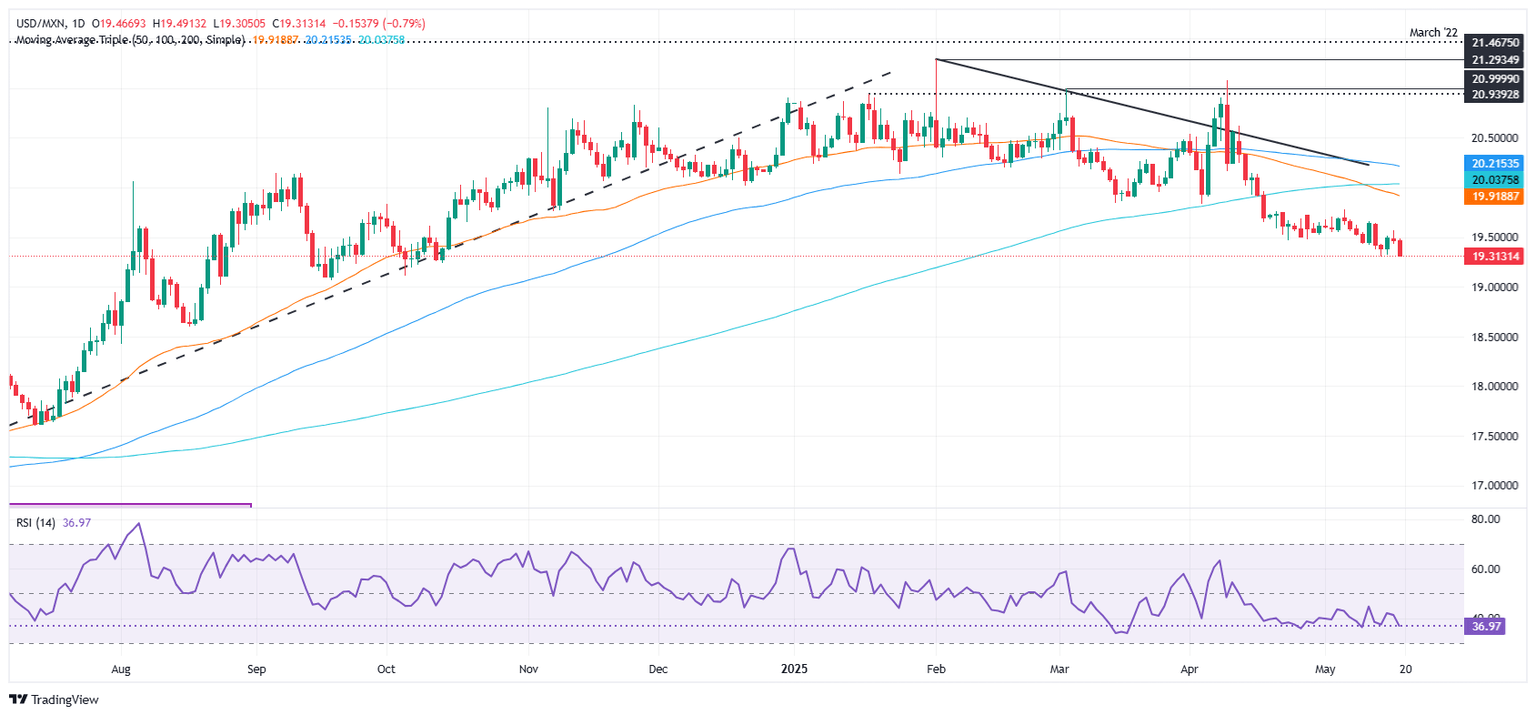
USD/MXN technical outlook: Mexican Peso surges as USD/MXN poised for daily close below 19.35
USD/MXN remains downward biased, but sellers have failed to refresh the year-to-date (YTD) lows of 19.29 hit on May 14, which, once cleared, could pave the way for further downside. The Relative Strength Index (RSI) shows that bears remain in charge. That said, the exotic pair could retest the 19.00 figure, last hit on August 21, 2024.
In that outcome, USD/MXN next support would be 18.50, followed by the 18.00 psychological mark. Conversely, buyers must reclaim 19.50 to remain hopeful of hitting higher prices, with the first resistance seen at 19.53, the 20-day Simple Moving Average (SMA), followed by the 50-day SMA at 19.90.
Mexican Peso FAQs
The Mexican Peso (MXN) is the most traded currency among its Latin American peers. Its value is broadly determined by the performance of the Mexican economy, the country’s central bank’s policy, the amount of foreign investment in the country and even the levels of remittances sent by Mexicans who live abroad, particularly in the United States. Geopolitical trends can also move MXN: for example, the process of nearshoring – or the decision by some firms to relocate manufacturing capacity and supply chains closer to their home countries – is also seen as a catalyst for the Mexican currency as the country is considered a key manufacturing hub in the American continent. Another catalyst for MXN is Oil prices as Mexico is a key exporter of the commodity.
The main objective of Mexico’s central bank, also known as Banxico, is to maintain inflation at low and stable levels (at or close to its target of 3%, the midpoint in a tolerance band of between 2% and 4%). To this end, the bank sets an appropriate level of interest rates. When inflation is too high, Banxico will attempt to tame it by raising interest rates, making it more expensive for households and businesses to borrow money, thus cooling demand and the overall economy. Higher interest rates are generally positive for the Mexican Peso (MXN) as they lead to higher yields, making the country a more attractive place for investors. On the contrary, lower interest rates tend to weaken MXN.
Macroeconomic data releases are key to assess the state of the economy and can have an impact on the Mexican Peso (MXN) valuation. A strong Mexican economy, based on high economic growth, low unemployment and high confidence is good for MXN. Not only does it attract more foreign investment but it may encourage the Bank of Mexico (Banxico) to increase interest rates, particularly if this strength comes together with elevated inflation. However, if economic data is weak, MXN is likely to depreciate.
As an emerging-market currency, the Mexican Peso (MXN) tends to strive during risk-on periods, or when investors perceive that broader market risks are low and thus are eager to engage with investments that carry a higher risk. Conversely, MXN tends to weaken at times of market turbulence or economic uncertainty as investors tend to sell higher-risk assets and flee to the more-stable safe havens.
Author
Christian Borjon Valencia
FXStreet
Christian Borjon began his career as a retail trader in 2010, mainly focused on technical analysis and strategies around it. He started as a swing trader, as he used to work in another industry unrelated to the financial markets.