Mexican Peso edges higher after Mexican inflation data
- The Mexican Peso trades steadily after the release of Mexican inflation data.
- Banxico will hold its meeting on Thursday; a 25 bps rate cut is expected.
- USD/MXN claws higher from the base of a rising channel, supported by firm momentum.

The Mexican Peso (MXN) edges higher in its major pairs on Tuesday, after the release of Mexican inflation data for September.
Mexican 1st half-month inflation data came out at 0.09% in September, above the 0.03% decline of August but not as high as the 0.15% economists had expected, according to data from the Instituto Nacional de Estadística Geografía e Informática (INEGI).
Core 1st half-month inflation rose by 0.21% for September, which was above the 0.10% of the previous month, but fell short of the 0.23% expected.
The data comes out two days before the conclusion of the Bank of Mexico (Banxico) September policy meeting on Thursday. The lower-than-expected inflation may increase the already-high odds that the Banxico will cut interest rates.
Mexican Peso marginally higher ahead of Banxico meeting
The Mexican Peso has seen moderate weakening against both the US Dollar (USD) and the Pound Sterling (GBP) over the last few days, whilst against the Euro (EUR), it has traded mixed due to the single currency weakening on Monday on growth fears in the Eurozone.
Banxico currently holds its official interest rate at 10.75%, but this will probably change after Thursday’s meeting. According to a recent Bloomberg survey, 20 out of the 25 economists and bank analysts believe Banxico will go ahead with a 25 basis points (bps) (0.25%) cut. Four analysts expect a 50 bps (0.50%) cut and only one that the central bank will leave interest rates unchanged. The expectation of lower interest rates is generally negative for a currency since it lessens foreign capital inflows.
“We expect Banxico to cut the policy rate 25bp from 10.75% to 10.50% at the September 26th meeting,” says Christian Lawrence, Senior Cross-Asset Strategist at Rabobank, in a recent note. “CPI inflation data released since the last meeting point to progress on a headline basis after the food-induced spike (August at 4.99%), and core inflation has now fallen to the top of the Bank’s +/-1pp tolerance band around its 3% target,” he added.
Whilst some analysts have speculated that Banxico may be dissuaded from cutting rates to support the flagging Peso, which has lost over 10% of its value since June, Rabobank does not think this is the case.
“The recent weakening of MXN will be of some concern for the Bank, given the potential pass-through to inflation. However, moves remain within recent ranges, and much of this can be attributed to the unwind of the carry trade. That said, the perceived rise in sovereign risk premium may support some further structural weakness in MXN, and we would argue that the risk of inflation from the currency has now flipped to the upside,” says Lawrence.
At the August meeting, Banxico decided to cut interest rates by 0.25%, bringing its official rate from 11.00% to 10.75%. The decision, however, was a close call, with only three members voting for the cut versus two who wanted to keep rates unchanged.
“Since that meeting, inflation readings have fallen further,” says Dr. Win Thin, Global Head of Markets Strategy at Brown Brothers Harriman (BBH). “Next Banxico meeting is September 26 and if disinflation continues, another 25 bp cut to 10.50% seems likely. The swaps market is pricing in 175 bp of easing over the next 12 months.”
Technical Analysis: USD/MXN edges higher, backed by bullish momentum
USD/MXN continues edging higher after bouncing off technical support at the base of a long-term rising channel.
The 50-day Simple Moving Average (not shown on the chart below) also bolstered support at the base of the channel.
USD/MXN 4-hour Chart
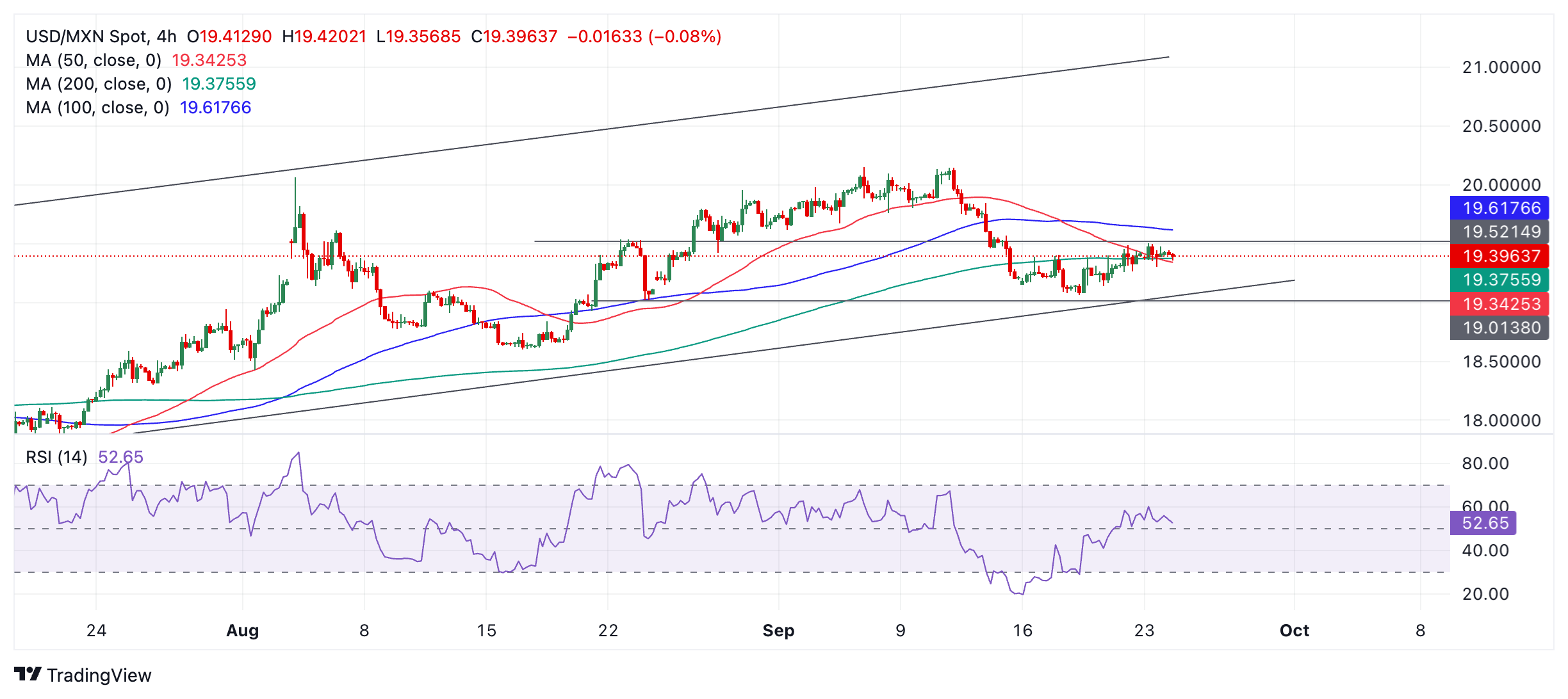
There is a possibility USD/MXN has begun a short-term uptrend within the channel. It is already in a medium and long-term uptrend, so the “current” is flowing north.
The Relative Strength Index (RSI) has risen quite steeply since the market bottom on September 18, and this is a sign of underlying strength in the recovery. RSI has risen more sharply than the price, which is a sign of bullish convergence.
A close above 19.53 (August 23 swing high) on a 4-hour basis would further confirm the pair was in a bullish short-term uptrend, which, given “the trend is your friend,” would be expected to continue higher.
Banxico FAQs
The Bank of Mexico, also known as Banxico, is the country’s central bank. Its mission is to preserve the value of Mexico’s currency, the Mexican Peso (MXN), and to set the monetary policy. To this end, its main objective is to maintain low and stable inflation within target levels – at or close to its target of 3%, the midpoint in a tolerance band of between 2% and 4%.
The main tool of the Banxico to guide monetary policy is by setting interest rates. When inflation is above target, the bank will attempt to tame it by raising rates, making it more expensive for households and businesses to borrow money and thus cooling the economy. Higher interest rates are generally positive for the Mexican Peso (MXN) as they lead to higher yields, making the country a more attractive place for investors. On the contrary, lower interest rates tend to weaken MXN. The rate differential with the USD, or how the Banxico is expected to set interest rates compared with the US Federal Reserve (Fed), is a key factor.
Banxico meets eight times a year, and its monetary policy is greatly influenced by decisions of the US Federal Reserve (Fed). Therefore, the central bank’s decision-making committee usually gathers a week after the Fed. In doing so, Banxico reacts and sometimes anticipates monetary policy measures set by the Federal Reserve. For example, after the Covid-19 pandemic, before the Fed raised rates, Banxico did it first in an attempt to diminish the chances of a substantial depreciation of the Mexican Peso (MXN) and to prevent capital outflows that could destabilize the country.
Author
Joaquin Monfort
FXStreet
Joaquin Monfort is a financial writer and analyst with over 10 years experience writing about financial markets and alt data. He holds a degree in Anthropology from London University and a Diploma in Technical analysis.