Mexican Peso recovers and rallies unfazed by Trump tariffs
- The Mexican Peso appreciates 0.54% as trade tensions escalate.
- Trump enacts 25% tariffs on Mexico, citing fentanyl and immigration concerns.
- President Sheinbaum condemns the move and vows retaliatory tariff and non-tariff measures.
- Mexico’s economy slows as S&P Global Manufacturing PMI contracts to 47.6.

The Mexican Peso (MXN) staged a comeback and surged against the US dollar (USD) on Tuesday as the 25% tariffs imposed on Mexico by the President of the United States (US), Donald Trump, commenced. This sent the Peso sliding into a four-week low of 20.99, a whisker of clearing the 21.00 handle. Nevertheless, as the North American session progressed, the Peso regained composure and climbed. At the time of writing, the USD/MXN is trading at 20.56, down 0.56%.
According to Trump, Mexico failed to do enough to stop fentanyl traffic and illegal immigration. Meanwhile, his counterpart, President Claudia Sheinbaum, condemned Trump's decision, saying it was unjustified. Sheinbaum promised to respond with tariff and non-tariff measures and added she would reveal details of the response at an event on Sunday.
As tariffs began, the USD/MXN pair soared sharply to 20.70 during the overnight session before rallying sharply to 20.99 early in the North American session. Nevertheless, the uptrend faded amid the lack of acceptance of higher prices.
Mexico’s economic docket remains absent, yet Monday’s data underscored that the economy is slowing sharply as businesses take measures against US tariffs. The S&P Global Manufacturing PMI for the last month contracted from 49.1 to 47.6. Business Confidence revealed by INEGI deteriorated further, yet it remained above the 50 threshold in February.
Daily digest market movers: Mexican Peso shrugs off tariffs beginning
- Banco de México's (Banxico) private economists' survey indicated that economic growth is expected to remain below 1%, while inflation expectations remained unchanged.
- The poll showed that GDP growth for 2025 is now projected at 0.81%, down from 1%. Headline inflation is forecast to end at 3.71%, slightly lower than the previous 3.83%, while core CPI is expected to finish at 3.75%, unchanged from the prior estimate.
- Economists now predict the USD/MXN exchange rate to close in 2025 at 20.85, slightly lower than the 20.90 projection in the previous survey. However, for 2026, they anticipate a sharper depreciation of the Peso, well beyond the 21.30 level expected in January’s poll.
- Business activity in the US remains mixed, as the ISM shows the economy slowed, while the S&P Global Manufacturing PMI jumped. Nevertheless, the Atlanta Fed GDP Now model foresees the Gross Domestic Product (GDP) for Q1 2025 to slow sharply, by -2.8%.
- Hence, money market traders had priced in 81 basis points of easing in 2025, up from last week’s 70 bps via data from the Chicago Board of Trade (CBOT).
- Trade disputes between the US and Mexico remain front and center. If countries could come to an agreement, this could pave the way for a recovery of the Mexican currency. Otherwise, further USD/MXN upside is seen, as US tariffs could trigger a recession in Mexico.
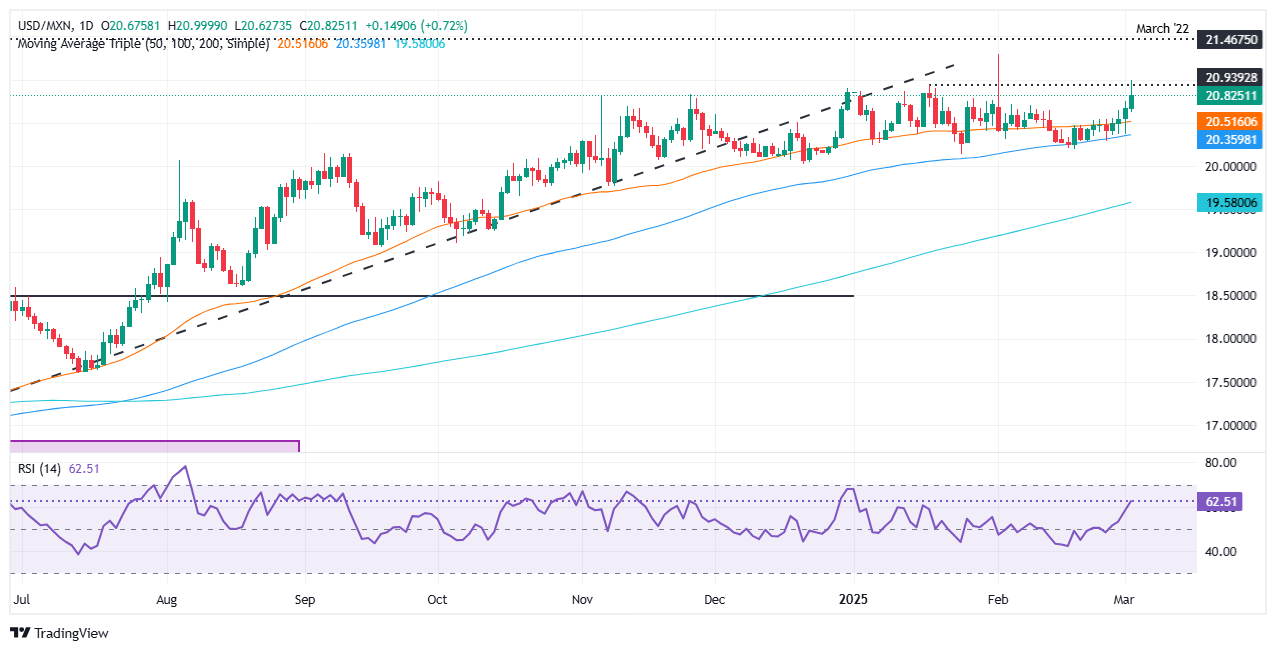
USD/MXN technical outlook: Mexican Peso edges higher as USD/MXN dives towards 20.60
The uptrend remains in place, though the USD/MXN pair has retraced the early move shy of 21.00, which if cleared, could’ve exposed the year-to-date (YTD) peak of 21.28. Nevertheless, buyers are in charge, as they surpassed the 20.50 figure, and they are gathering momentum as depicted in the Relative Strength Index (RSI).
With that said, USD/MXN first resistance would be today’s peak at 20.99. On further strength, the YTD high is up next at 21.28, followed by last year’s high of 21.46.
For a bearish continuation, USD/MXN must clear the 20.50 figure, ahead of the 50-day Simple Moving Average (SMA) at 20.48. If cleared, up next is the 100-day SMA at 20.32, followed by the 20.00 figure.
Banxico FAQs
The Bank of Mexico, also known as Banxico, is the country’s central bank. Its mission is to preserve the value of Mexico’s currency, the Mexican Peso (MXN), and to set the monetary policy. To this end, its main objective is to maintain low and stable inflation within target levels – at or close to its target of 3%, the midpoint in a tolerance band of between 2% and 4%.
The main tool of the Banxico to guide monetary policy is by setting interest rates. When inflation is above target, the bank will attempt to tame it by raising rates, making it more expensive for households and businesses to borrow money and thus cooling the economy. Higher interest rates are generally positive for the Mexican Peso (MXN) as they lead to higher yields, making the country a more attractive place for investors. On the contrary, lower interest rates tend to weaken MXN. The rate differential with the USD, or how the Banxico is expected to set interest rates compared with the US Federal Reserve (Fed), is a key factor.
Banxico meets eight times a year, and its monetary policy is greatly influenced by decisions of the US Federal Reserve (Fed). Therefore, the central bank’s decision-making committee usually gathers a week after the Fed. In doing so, Banxico reacts and sometimes anticipates monetary policy measures set by the Federal Reserve. For example, after the Covid-19 pandemic, before the Fed raised rates, Banxico did it first in an attempt to diminish the chances of a substantial depreciation of the Mexican Peso (MXN) and to prevent capital outflows that could destabilize the country.
Author

Christian Borjon Valencia
FXStreet
Markets analyst, news editor, and trading instructor with over 14 years of experience across FX, commodities, US equity indices, and global macro markets.