Mexican Peso rises as political risk impacts counterparts
- The Mexican Peso rises in its most-traded pairs as political risk impacts counterparts.
- The Greenback strengthens as a result of a higher probability of Trump winning the election.
- A strong showing by the far-left in France’s elections raises concerns about the fiscal outlook impacting the Euro.

The Mexican Peso (MXN) trades higher in its key pairs on Monday amid a subdued market mood. Carry flows continue to favor the Mexican Peso due to the attractiveness to foreign investors of the relatively high interest rates on offer in Mexico.
The Peso especially rises against the Euro (EUR), which is falling amid renewed political concerns following the final results of the French legislative elections on Sunday. Although the center and left parties managed to prevent the far-right National Rally (RN) from winning a majority, no one party has enough seats to govern, suggesting the risk of long-term policy paralysis, according to Reuters.
The US Dollar, meanwhile, finds some support from the increasing likelihood of former President Donald Trump winning the November Presidential elections as President Joe Biden is seen as likely to step down amid concerns about his fitness for office. Trump’s tax-cuts-and-spend policies are viewed as inflationary and therefore likely to keep interest rates in the US elevated.
At the time of writing, one US Dollar (USD) buys 18.00 Mexican Pesos, EUR/MXN trades at 19.50, and GBP/MXN at 23.11.
Mexican Peso trades higher amid elevated political risk
The Mexican Peso trades higher against the Euro on Monday as the shared currency weakens after the results of the French election raised concerns about France’s future fiscal position. Tactical voting means the far-left Nouveau Front Popullaire (NFP) won the most seats (182), followed by the centrist alliance Ensemble (168) and the far-right National Rally (143) coming third, as per Reuters.
Since no one party got more than the 289 minimum necessary to form a government an uneasy coalition will be necessary – probably between Macron’s centrists and the NFP, which will probably take a long time to agree, leading to policy paralysis, according to Reuters.
Although the greater concern of a far-right victory has been averted, markets are now fretting anew about the impact of the future far-left-dominated government on the economy.
Trump factor keeps US Dollar supported
The Mexican Peso continues rising against the US Dollar but at a much more muted pace, as political risk supports the US currency despite a run of weak US data bringing forward expectations of the Federal Reserve (Fed) cutting interest rates.
The increasing probability that Donald Trump will become the next president of the US is leading to a rise in US Treasury bond yields, which are positively correlated with the US Dollar. Given his inflationary policies, interest rates might remain high in the US, fueling continued foreign capital inflows and supporting USD.
The US Dollar had been weakening after a string of US data releases indicated the economy is cooling down. The June ISM Services Purchasing Managers Index (PMI) fell into contractionary territory, and labor market data has also been below par.
Although US Nonfarm Payrolls for June on Friday showed a higher-than-expected 206K workers joined the economy, the result of the previous month was revised down considerably and the Unemployment Rate rose to 4.1% when economists had expected it to remain at 4.0%. It was the third consecutive rise in unemployment in as many months.
Technical Analysis: USD/MXN plateaus
USD/MXN drifts lower towards the key June 24 swing low at 17.87.
More broadly, it is possible the pair is entering a sideways trend, with the floor at the aforesaid June 24 low and a ceiling at the 18.50 level, although it is still a little too early to be sure.
USD/MXN 4-hour Chart
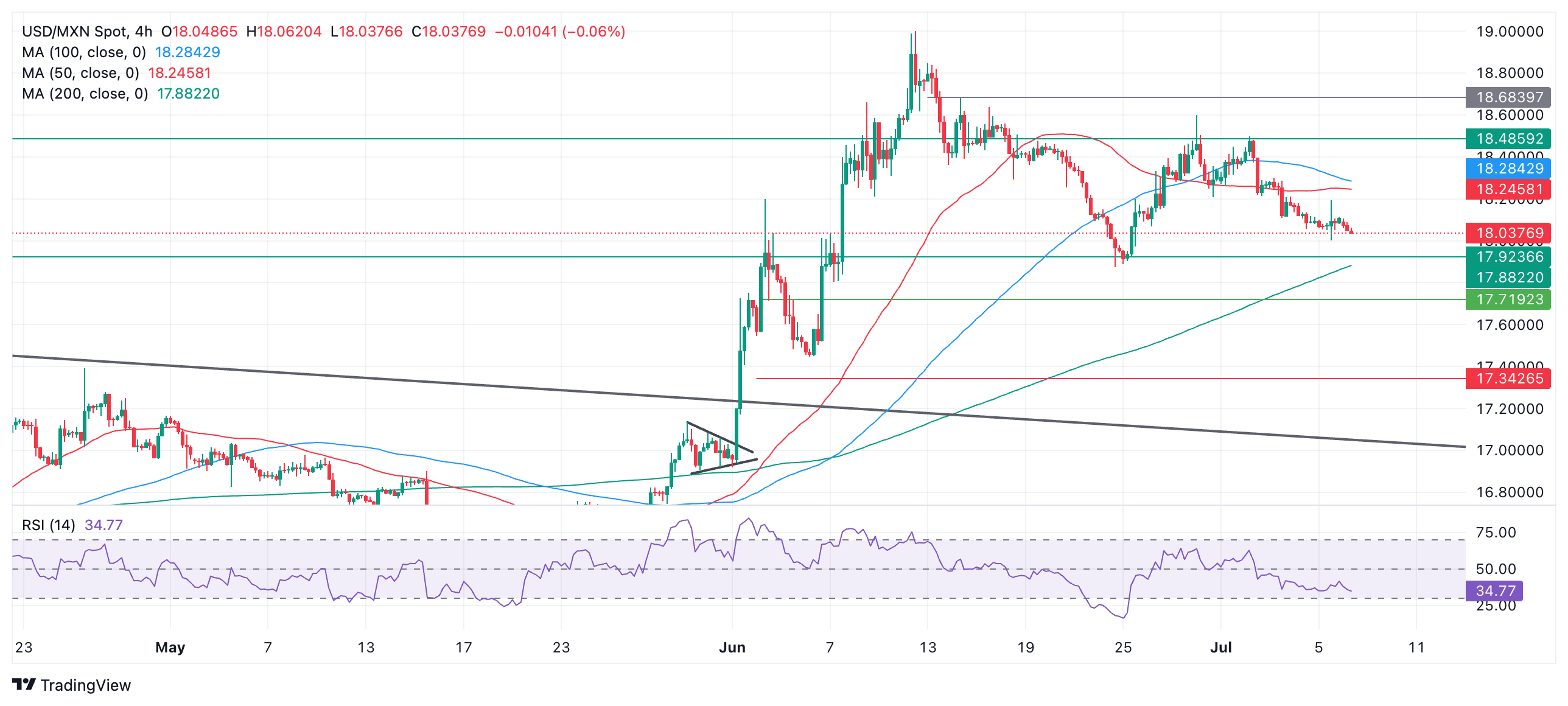
The pair is likely to encounter support at the June 24 low, but a decisive break below 17.87 would suggest a new downtrend was beginning, with the next target lying at 17.50 (50-day Simple Moving Average).
A rally back above 18.59, however, would indicate a continuation up to 18.68 (June 14 high), followed by 19.00 (June 12 high). A break above 19.00 would provide strong confirmation of a resumption of the short-and-intermediate term uptrends.
The direction of the long-term trend remains in doubt.
Economic Indicator
Nonfarm Payrolls
The Nonfarm Payrolls release presents the number of new jobs created in the US during the previous month in all non-agricultural businesses; it is released by the US Bureau of Labor Statistics (BLS). The monthly changes in payrolls can be extremely volatile. The number is also subject to strong reviews, which can also trigger volatility in the Forex board. Generally speaking, a high reading is seen as bullish for the US Dollar (USD), while a low reading is seen as bearish, although previous months' reviews and the Unemployment Rate are as relevant as the headline figure. The market's reaction, therefore, depends on how the market assesses all the data contained in the BLS report as a whole.
Read more.Last release: Fri Jul 05, 2024 12:30
Frequency: Monthly
Actual: 206K
Consensus: 190K
Previous: 272K
Source: US Bureau of Labor Statistics
America’s monthly jobs report is considered the most important economic indicator for forex traders. Released on the first Friday following the reported month, the change in the number of positions is closely correlated with the overall performance of the economy and is monitored by policymakers. Full employment is one of the Federal Reserve’s mandates and it considers developments in the labor market when setting its policies, thus impacting currencies. Despite several leading indicators shaping estimates, Nonfarm Payrolls tend to surprise markets and trigger substantial volatility. Actual figures beating the consensus tend to be USD bullish.
Author

Joaquin Monfort
FXStreet
Joaquin Monfort is a financial writer and analyst with over 10 years experience writing about financial markets and alt data. He holds a degree in Anthropology from London University and a Diploma in Technical analysis.

















