Mexican Peso edges down as market sentiment ebbs, volatility falls
- The Mexican Peso dips on Tuesday as market sentiment dips on a variable global interest-rate outlook.
- Israel’s bombing of a tent camp in Rafah continues to keep geopolitical tensions fraught.
- MXN maintains a bullish long-term trend on the back of a higher interest-rate outlook.

The Mexican Peso (MXN) edges lower in its most heavily traded pairs on Tuesday as market sentiment ebbs on continuing uncertainty regarding the global interest-rate outlook whilst Israel’s actions in Rafah keep tensions alive in the Middle East. Asian stock markets closed lower, with the Shanghai Composite down 0.46%, the Nikkei 0.11% lower and the ASX200 closing 0.28% in the red.
USD/MXN is exchanging hands at 16.68 at the time of writing, EUR/MXN is trading at 18.14 and GBP/MXN at 21.30.
Mexican Peso edges lower as sentiment dips
The Mexican Peso trades marginally lower in its key pairs on Tuesday as the low volatility trading environment endures. Traders are mostly in waiting-and-see mode ahead of the week’s key release: April’s US Personal Consumption Expenditure (PCE) data – the US Federal Reserve's (Fed) preferred gauge of inflation – out on Friday.
Mexican Unemployment data for April is scheduled on Thursday and the Mexican Presidential elections are on Sunday. At the moment the Morena party candidate Claudia Sheinbaum is expected to succeed Manuel Lopez Obrador as President, maintaining the status quo.
Mexican Peso supported by interest rate differential
The Mexican Peso is in an overall bullish trend in its key pairs, helped by the interest rate differential between Mexico and its major counterparts. High interest rates of 11.00% in Mexico continue to favor the Peso, which benefits from investor inflows.
A recent Citibanamex survey showed most economists expected Banxico to cut interest rates in June. However, Banxico Deputy Governor Irene Espinosa recently said that interest rates should remain at their current level because of continued inflationary pressures. Mid-month May headline inflation in Mexico showed a rise to 4.78%, surpassing the previous month’s 4.63%, confirming persistent inflationary pressures, and backing up Espinosa’s hawkish views.
Technical Analysis: USD/MXN trades in a holding pattern
USD/MXN – or the number of Pesos that can be bought with one US Dollar – trades flat after breaking below the grey trendline of the recovery from the May 21 low. Despite the break, the new short-term uptrend remains intact and still favors longs over shorts.
USD/MXN 4-hour Chart
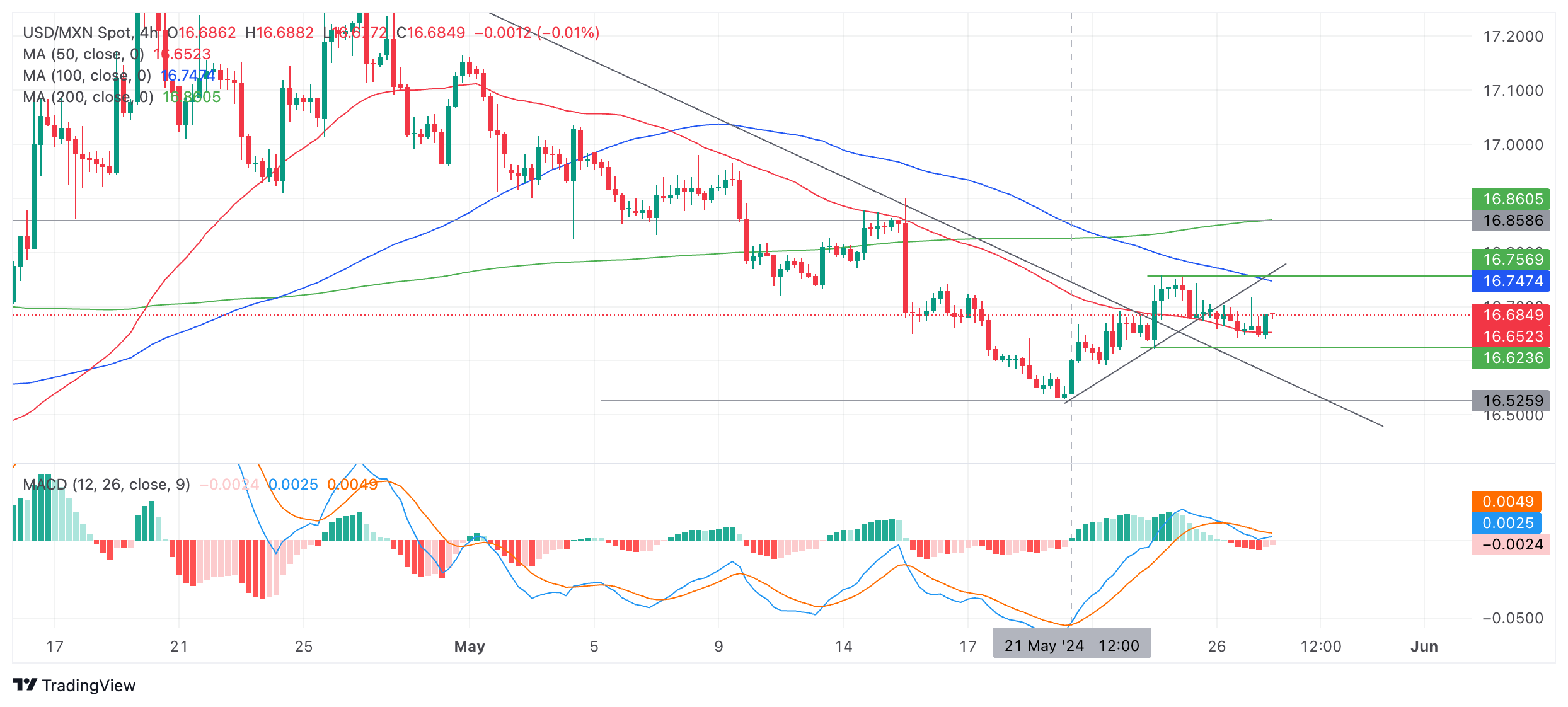
A break above the 16.76 (May 23 high) would probably confirm a continuation of the young uptrend to a possible target at the previous range lows around 16.85.
The Moving Average Convergence Divergence (MACD) indicator has crossed below its red signal line, giving a sell signal and possibly indicating further weakness. A break below the swing low at 16.62 could indicate a possible continuation down to the low of May 21 at 16.52.
Given that the medium and long-term trends are bearish, there also remains a risk of the pair continuing lower due to longer-term currents.
Interest rates FAQs
Interest rates are charged by financial institutions on loans to borrowers and are paid as interest to savers and depositors. They are influenced by base lending rates, which are set by central banks in response to changes in the economy. Central banks normally have a mandate to ensure price stability, which in most cases means targeting a core inflation rate of around 2%. If inflation falls below target the central bank may cut base lending rates, with a view to stimulating lending and boosting the economy. If inflation rises substantially above 2% it normally results in the central bank raising base lending rates in an attempt to lower inflation.
Higher interest rates generally help strengthen a country’s currency as they make it a more attractive place for global investors to park their money.
Higher interest rates overall weigh on the price of Gold because they increase the opportunity cost of holding Gold instead of investing in an interest-bearing asset or placing cash in the bank. If interest rates are high that usually pushes up the price of the US Dollar (USD), and since Gold is priced in Dollars, this has the effect of lowering the price of Gold.
The Fed funds rate is the overnight rate at which US banks lend to each other. It is the oft-quoted headline rate set by the Federal Reserve at its FOMC meetings. It is set as a range, for example 4.75%-5.00%, though the upper limit (in that case 5.00%) is the quoted figure. Market expectations for future Fed funds rate are tracked by the CME FedWatch tool, which shapes how many financial markets behave in anticipation of future Federal Reserve monetary policy decisions.
Author
Joaquin Monfort
FXStreet
Joaquin Monfort is a financial writer and analyst with over 10 years experience writing about financial markets and alt data. He holds a degree in Anthropology from London University and a Diploma in Technical analysis.