Mexican Peso advances against US Dollar despite elevated US yields
- Mexican Peso is virtually unchanged at around 16.67 against US Dollar during the North American session.
- US Initial Jobless Claims rise above forecasts, mixed housing data with Building Permits down and Housing Starts up.
- Fed officials signal patience on inflation target amid potential rate cuts in 2024.


The Mexican Peso erased some earlier losses against the US Dollar and rose during the North American session on Thursday. The Mexican currency capitalized on a United States (US) inflation report that increased the possibility of rate cuts by the Federal Reserve (Fed) in 2024. At the time of writing, the USD/MXN trades at 16.67, down 0.06%.
For the latest news on the Mexican Peso click here.
The USD/MXN continued to lean on US economic data amid an absent Mexican economic docket. The US Bureau of Labor Statistics (BLS) revealed that the number of Americans filing for unemployment insurance grew above the previous reading and exceeded forecasts.
At the same time, housing data revealed mixed figures. Building Permits missed the mark, while Housing Stars recovered in April after posting disappointing figures in March.
In the meantime, the Philadelphia Fed Manufacturing Index clung to expansionary levels but continued to deteriorate, while Industrial Production remained unchanged.
Recently, Fed officials crossed the wires. Richmond Fed President Thomas Barkin stated that inflation is coming down, but that it will “take more time,” to hit the Fed’s target. Cleveland Fed President Loretta Mester welcomed the latest CPI data, adding that monetary policy is well-positioned as the Fed reviews upcoming data.
Daily digest market movers: Mexican Peso resurges amid mixed US data
- Mexico’s economic docket will be absent during the current week. The next economic data release is expected to be Retail Sales on May 20, followed by the Gross Domestic Product (GDP), inflation figures and Banxico’s minutes on May 23.
- April's data show that Mexico’s headline inflation is reaccelerating. However, core prices are falling. This spurred Banxico’s revision to its inflation projections, with the bank expected to hit its 3% target toward the last quarter of 2025, later than March’s estimates for Q2 2025. Core inflation is projected to hit 3% in Q2 2025.
- The US Department of Labor revealed the labor market is cooling as Initial Jobless Claims for the latest week came in above forecasts at 222K in the week ending May 11, below the previous reading of 232K but exceeding forecasts of 220K.
- US Housing Starts increased to 1.36 million or 5.7% YoY in April, revealed government data. Building Permits, a proxy for future construction, dropped 3% to a 1.44 million rate.
- Investors have become optimistic that the Fed may cut rates this year after US inflation data showed the downtrend is resuming, while Retail Sales remained unchanged.
- Data from the CME FedWatch Tool shows odds for a 25 bps rate cut at the September meeting remain at 87%, higher than Tuesday's 83%.
Technical analysis: Mexican Peso counterattacks as USD/MXN tumbles below 16.70
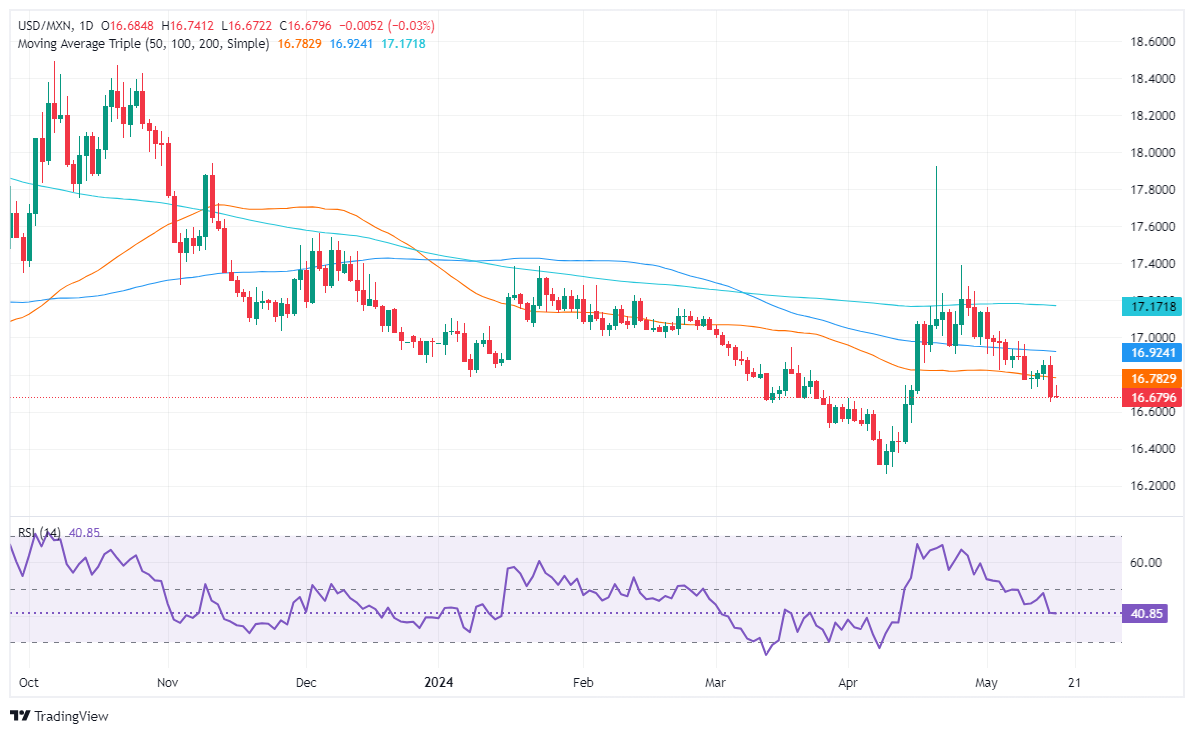
The USD/MXN downtrend continues even though buyers pushed the exchange rate past close to the 50-day Simple Moving Average (SMA) near 16.78. Momentum is on the side of the Mexican Peso as the Relative Strength Index (RSI) remains in bearish territory, aiming toward oversold territory.
If USD/MXN extends its losses beneath last year’s low of 16.62, that could exacerbate a 16.50 test ahead of the current year-to-date low of 16.25.
Conversely, if buyers reclaim the 50-day SMA at 16.78, it could exacerbate a rally toward the 100-day Simple Moving Average (SMA) at 16.92. Once cleared, the next supply zone would be the 17.00 psychological level. In that event, the next stop would be the 200-day SMA at 17.17.
Inflation FAQs
Inflation measures the rise in the price of a representative basket of goods and services. Headline inflation is usually expressed as a percentage change on a month-on-month (MoM) and year-on-year (YoY) basis. Core inflation excludes more volatile elements such as food and fuel which can fluctuate because of geopolitical and seasonal factors. Core inflation is the figure economists focus on and is the level targeted by central banks, which are mandated to keep inflation at a manageable level, usually around 2%.
The Consumer Price Index (CPI) measures the change in prices of a basket of goods and services over a period of time. It is usually expressed as a percentage change on a month-on-month (MoM) and year-on-year (YoY) basis. Core CPI is the figure targeted by central banks as it excludes volatile food and fuel inputs. When Core CPI rises above 2% it usually results in higher interest rates and vice versa when it falls below 2%. Since higher interest rates are positive for a currency, higher inflation usually results in a stronger currency. The opposite is true when inflation falls.
Although it may seem counter-intuitive, high inflation in a country pushes up the value of its currency and vice versa for lower inflation. This is because the central bank will normally raise interest rates to combat the higher inflation, which attract more global capital inflows from investors looking for a lucrative place to park their money.
Formerly, Gold was the asset investors turned to in times of high inflation because it preserved its value, and whilst investors will often still buy Gold for its safe-haven properties in times of extreme market turmoil, this is not the case most of the time. This is because when inflation is high, central banks will put up interest rates to combat it. Higher interest rates are negative for Gold because they increase the opportunity-cost of holding Gold vis-a-vis an interest-bearing asset or placing the money in a cash deposit account. On the flipside, lower inflation tends to be positive for Gold as it brings interest rates down, making the bright metal a more viable investment alternative.
Author
Christian Borjon Valencia
FXStreet
Markets analyst, news editor, and trading instructor with over 14 years of experience across FX, commodities, US equity indices, and global macro markets.