Mexican Peso rebound stalls due to political risks
- The Mexican Peso stalls in its recovery amid rising chances of Donald Trump winning the US presidential election.
- Further attempts by deputies to limit the power of the Mexican judiciary also weigh on the Peso.
- USD/MXN pauses in its recent pullback and looks technically poised to begin a new leg higher, piercing the 20.00 level.

The Mexican Peso’s (MXN) recovery grinds to a halt on Friday as political risk in the form of US presidential election uncertainty and a new development in Mexico’s judicial-reform saga takes the wind out of bulls’ sails.
This adds to any weakness already caused by recent below-par macroeconomic data and any positive effects from a potential revival of the carry trade due to the depreciating Japanese Yen (JPY).
Mexican Peso falls foul to rise in political risk premia
The Mexican Peso is feeling the heat from the increasing chances that Republican nominee Donald Trump could win the US presidential election on November 5.
“Polls in the battleground states have remained very tight and within the margin of error,” says Jim Reid, Global Head of Macro Research at Deutsche Bank on Friday. “For instance, an Emerson poll of several swing states yesterday had Trump very marginally ahead, including a 1pt lead in Pennsylvania and Wisconsin, and a 2pt lead in North Carolina," adds Reid.
Further, according to the model of leading US election website FiveThirtyEight, Trump now has a slightly higher 51% chance of winning. That said, the website’s master poll, which aggregates, averages, and weights polls according to recency, shows Harris still in the lead with 48.1% versus Trump’s 46.4%. Most betting websites also offer better odds of Trump succeeding.
A Trump win would spell trouble for the Mexican Peso. Trump has repeatedly said he will put higher tariffs on foreign imports and singled out the many cars manufactured and imported from Mexico for special treatment. Trump once said, in one interview with Bloomberg News, that he would slap tariffs of 100%, 200% or even 300% on Mexican autos.
Such a move, if Trump were to win, would cause a body blow to the Mexican economy, which has become heavily reliant on nearshoring manufacturing goods, especially autos, for the North American market. This is largely due to its free trade agreement with the US and Canada (up for renegotiation in 2026). It would also directly hit demand for the Mexican Peso from US importers.
Mexican Senate debates law to limit power of judiciary to block reforms
Investors in the West will probably also take a dim view of events taking place in the Mexican parliament, which could add further bearish pressure on the Mexican Peso. On Thursday, Mexican senators debated a possible ruling that would curtail the powers of the judiciary to impede reforms made by lawmakers in parliament.
“The Mexican Senate began the discussion of a ruling that seeks to establish the inadmissibility of appeals and controversies against reforms to the Constitution,” said Mexican financial news website El Financiero.
After a heated debate, in which opposition senators held up placards saying “NO A LA DICTADORA EN MEXICO,” the Senate voted by a majority of 85 for and 41 against to approve “in general and particular the opinion”.
“Although the opinion has the majority support of Morena and its allies the Labor Party (PT) and the Green Ecologist Party of Mexico (PVEM), the debate promises to be extended due to the resistance of the opposition parties, which insist that the measure puts at risk the balance of powers in the country,” said El Financiero.
If the ruling is approved, it would curtail the power of the judiciary to block laws made by parliament. Critics argue this would upset the balance of power in Mexico, whilst proponents argue the judiciary is biased and vulnerable to corruption.
Such a move would crystallize Western investors’ negative views regarding the reforms proposed by the left-leaning Morena government. This could risk stymying investment in the country, leading to softer growth and lower capital inflows into the Peso.
Technical Analysis: USD/MXN looks poised to begin new up leg
USD/MXN has stalled in its most recent pullback from the 20.00 barrier and looks poised to begin a fresh leg higher.
USD/MXN Daily Chart
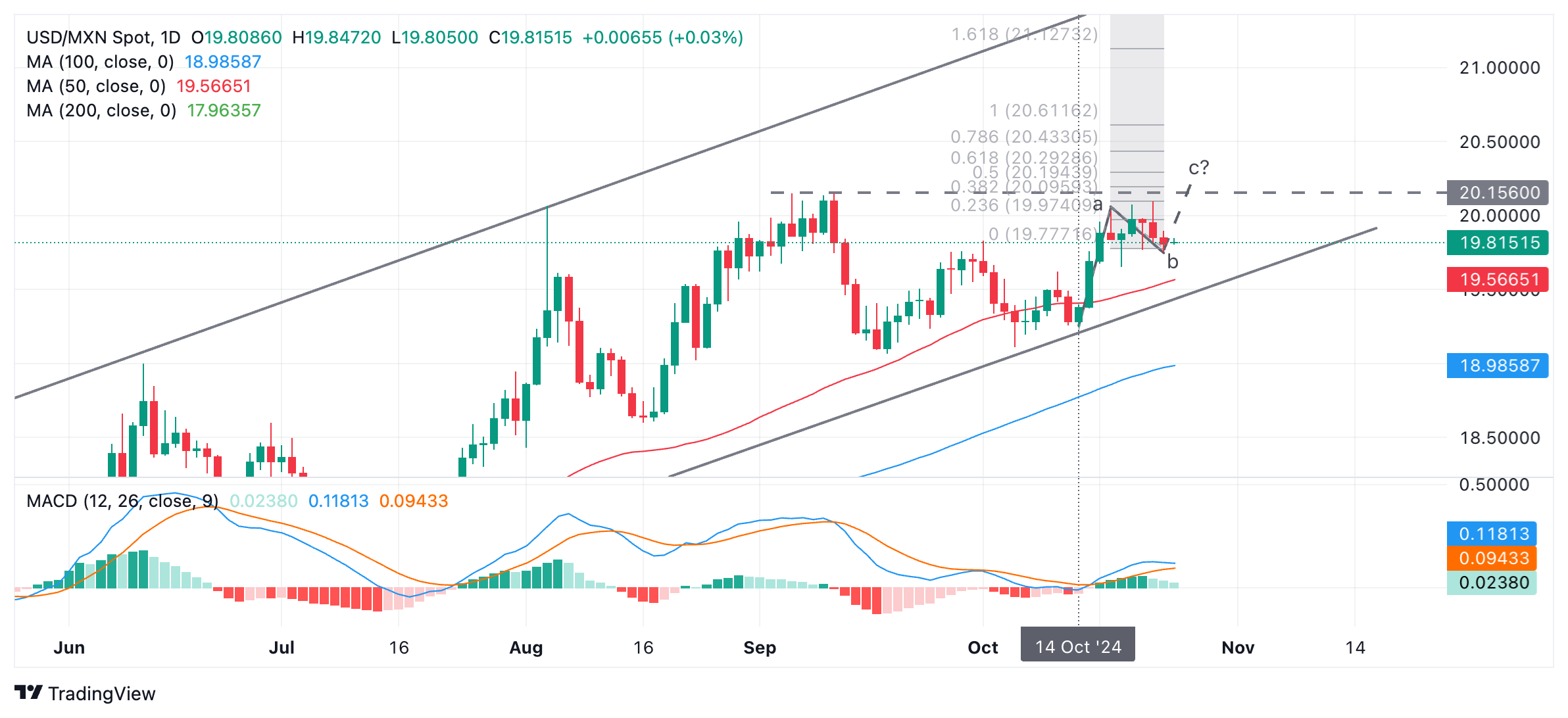
Further supporting the bullish view is the strong evidence that USD/MXN is in an uptrend on a short, medium and long-term basis and is trading in a rising channel. Given the technical dictum “the trend is your friend,” the odds favor a continuation higher.
The pair may also be tracing out a bullish “abc” pattern since the October 14 swing low, with the “c wave” about to extend higher (see chart). If so, wave c would be expected to reach a length of a Fibonacci 61.8% of wave a, giving an upside target of 20.29. Such a move would gain confirmation from a break above the high of wave b at 20.09.
In addition, the original break above 19.83 (October 1 high) has confirmed a probable move up and a further target in the vicinity of the September 10 high at 20.13.
Banxico FAQs
The Bank of Mexico, also known as Banxico, is the country’s central bank. Its mission is to preserve the value of Mexico’s currency, the Mexican Peso (MXN), and to set the monetary policy. To this end, its main objective is to maintain low and stable inflation within target levels – at or close to its target of 3%, the midpoint in a tolerance band of between 2% and 4%.
The main tool of the Banxico to guide monetary policy is by setting interest rates. When inflation is above target, the bank will attempt to tame it by raising rates, making it more expensive for households and businesses to borrow money and thus cooling the economy. Higher interest rates are generally positive for the Mexican Peso (MXN) as they lead to higher yields, making the country a more attractive place for investors. On the contrary, lower interest rates tend to weaken MXN. The rate differential with the USD, or how the Banxico is expected to set interest rates compared with the US Federal Reserve (Fed), is a key factor.
Banxico meets eight times a year, and its monetary policy is greatly influenced by decisions of the US Federal Reserve (Fed). Therefore, the central bank’s decision-making committee usually gathers a week after the Fed. In doing so, Banxico reacts and sometimes anticipates monetary policy measures set by the Federal Reserve. For example, after the Covid-19 pandemic, before the Fed raised rates, Banxico did it first in an attempt to diminish the chances of a substantial depreciation of the Mexican Peso (MXN) and to prevent capital outflows that could destabilize the country.
Author

Joaquin Monfort
FXStreet
Joaquin Monfort is a financial writer and analyst with over 10 years experience writing about financial markets and alt data. He holds a degree in Anthropology from London University and a Diploma in Technical analysis.