Mexican Peso posts minuscule gains remains almost flat against US Dollar
- Mexican Peso recovers ground against the US Dollar, trading at 16.64, down 0.09%.
- Mexican economic data reveals an April trade deficit and a Q1 2024 Current Account deficit totaling $-12,582 million.
- Traders await US core PCE Price Index, softer results may increase prospects for 2024 rate cuts.

The Mexican Peso recovered ground against the US Dollar on Monday amid thin volume conditions as Wall Street remained closed in observance of Memorial Day. A scarce Mexican economic docket during the week leaves traders awaiting the release of the core Personal Consumption Expenditures Price Index (PCE) on Friday, the Federal Reserve’s preferred inflation gauge. If it comes in softer than expected, it would increase hopes for a rate cut in 2024.
The USD/MXN trades at 16.64, down 0.09%. The market sentiment in Europe is positive, yet volume conditions remain tight as American traders take the day off. Last week, Mexico’s National Statistics Agency revealed a trade deficit in April after registering a surplus of $2.098 billion in March.
Meanwhile, the Bank of Mexico (Banxico) registered a Current Account deficit of $-12,582 million in Q1 2024, down from the surplus of $11,817 million achieved in the previous reading.
Across the border, the US economy continues to fare well following the release of last week's S&P Global PMIs highlighting its strength as business activity picked up. Yet a worse-than-expected US Durable Goods Orders report on Friday kept investors uncertain about the economic outlook.
Daily digest market movers: Mexican Peso capitalizes on US Dollar weakness despite turning uncertain
- Last week’s data showed that Mexico’s economic outlook is turning uncertain as the Mid-month headline inflation for May rose as underlying prices dipped.
- Alongside that, Mexico’s economic slowdown, as shown by the last Gross Domestic Product (GDP) report and a widening trade deficit, could exert pressure on Mexican Peso.
- May’s Citibanamex poll showed that most economists estimate Banxico will cut rates on June 27 from 11% to 10.75%. The median expects headline inflation at 4.21% and core at 4.07% in 2024.
- In the week ahead, the US economic docket will feature further Fedspeak, housing data, the Conference Board (CB) Consumer Confidence, economic growth data, and the release of core PCE.
- Despite that, fed funds rate futures estimated just 25 basis points of easing toward the end of the year after S&P Global revealed that US business activity is gathering steam.
Technical analysis: Mexican Peso trims losses as USD/MXN tumbles below 16.70
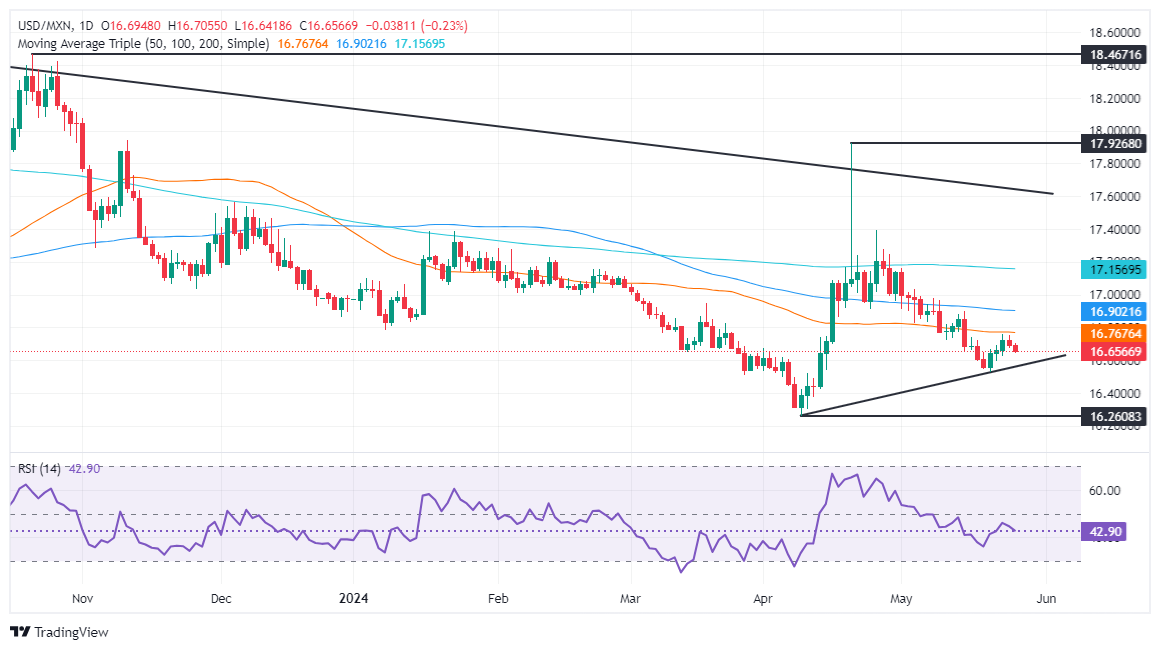
The USD/MXN downtrend extended after buyers failed to overcome the 100-day SMA at 16.76 with the pair subsequently dropping below the psychological 16.70 mark. Momentum favors sellers as the Relative Strength Index (RSI) points downward into bearish territory.
Given the current seller strength, the path of least resistance is downward. The pair's next support is at 16.62, the 2023 low, followed by the May 21 cycle low at 16.52 and the year-to-date low of 16.25.
On the flip side, if buyers reclaim 16.70, they will need to surpass the 100-day SMA at 16.76 to extend gains. In that scenario, key resistance levels include the 50-day SMA at 16.89, the psychological figure of 17.00, and the 200-day SMA at 17.14.
Mexican Peso FAQs
The Mexican Peso (MXN) is the most traded currency among its Latin American peers. Its value is broadly determined by the performance of the Mexican economy, the country’s central bank’s policy, the amount of foreign investment in the country and even the levels of remittances sent by Mexicans who live abroad, particularly in the United States. Geopolitical trends can also move MXN: for example, the process of nearshoring – or the decision by some firms to relocate manufacturing capacity and supply chains closer to their home countries – is also seen as a catalyst for the Mexican currency as the country is considered a key manufacturing hub in the American continent. Another catalyst for MXN is Oil prices as Mexico is a key exporter of the commodity.
The main objective of Mexico’s central bank, also known as Banxico, is to maintain inflation at low and stable levels (at or close to its target of 3%, the midpoint in a tolerance band of between 2% and 4%). To this end, the bank sets an appropriate level of interest rates. When inflation is too high, Banxico will attempt to tame it by raising interest rates, making it more expensive for households and businesses to borrow money, thus cooling demand and the overall economy. Higher interest rates are generally positive for the Mexican Peso (MXN) as they lead to higher yields, making the country a more attractive place for investors. On the contrary, lower interest rates tend to weaken MXN.
Macroeconomic data releases are key to assess the state of the economy and can have an impact on the Mexican Peso (MXN) valuation. A strong Mexican economy, based on high economic growth, low unemployment and high confidence is good for MXN. Not only does it attract more foreign investment but it may encourage the Bank of Mexico (Banxico) to increase interest rates, particularly if this strength comes together with elevated inflation. However, if economic data is weak, MXN is likely to depreciate.
As an emerging-market currency, the Mexican Peso (MXN) tends to strive during risk-on periods, or when investors perceive that broader market risks are low and thus are eager to engage with investments that carry a higher risk. Conversely, MXN tends to weaken at times of market turbulence or economic uncertainty as investors tend to sell higher-risk assets and flee to the more-stable safe havens.
Author
Christian Borjon Valencia
FXStreet
Markets analyst, news editor, and trading instructor with over 14 years of experience across FX, commodities, US equity indices, and global macro markets.