Mexican Peso depreciates as Trump elected US president
- The Mexican Peso plunges several percentage points against its major pairs after Donald Trump secures 267 electoral votes, three away from victory.
- Trump’s threats of whacking huge tariffs on Mexican imports is wreaking havoc with the Peso.
- USD/MXN closes an open chart gap and extends its established uptrend within a rising channel.

The Mexican Peso (MXN) plummets in its most-heavily traded pairs on Wednesday, especially versus the US Dollar (USD), against which it is down almost three percent after it was announced Republican nominee Donald Trump has been voted the next President of the United States (US).
The Peso’s massive drop against the USD is due to Trump’s threat to place punitive tariffs on Mexican imports as well as the overall uplift to USD from his Dollar-positive economic policies.
Trump's victory was part of a clean sweep for the Republicans who also won a majority of 42/51 in the US Senate and of 179/197 in the US Congress. Trump's won the presidential race with 277 electoral votes over Kamala Harris' 224.
Mexican Peso could see more weakness due to Republican clean sweep
The Mexican Peso is currently trading in the 20.60s to the US Dollar, however, it may experience further weakness due to the Republican majority in Congress, according to Mexican financial news website El Financiero.
If Trump wins with a Republican majority in Congress, the Peso is likely to fall to between 21.14 and 22.26 against the US Dollar, said the website in a multi-scenario article prior to election day.
Mexican Peso also rattled by domestic woes
The Mexican Peso faces further negative pressure after the Mexican Supreme Court rejected proposals to alter a controversial new law allowing the election of judges by popular vote on Tuesday, according to El Financiero.
The Mexican Supreme Court decided to reject the arguments of one of its own judges, Juan Luis González Alcántara, that the reform was partially unconstitutional because aspects of the new law undermines the independence of the judiciary.
Instead, Alcántara, a known critic of the reforms, had proposed a modification to the law, only allowing the election of Supreme Court judges not all judges, which include thousands of lower court justices as well.
Critics argue the reform could increase concerns among foreign investors regarding the rule of law in Mexico and reduce inbound investment.
Technical Analysis: USD/MXN closes gap and surges higher
USD/MXN shoots higher and closes the gap opened on Monday (red-shaded rectangle on the chart below).
USD/MXN 4-hour Chart
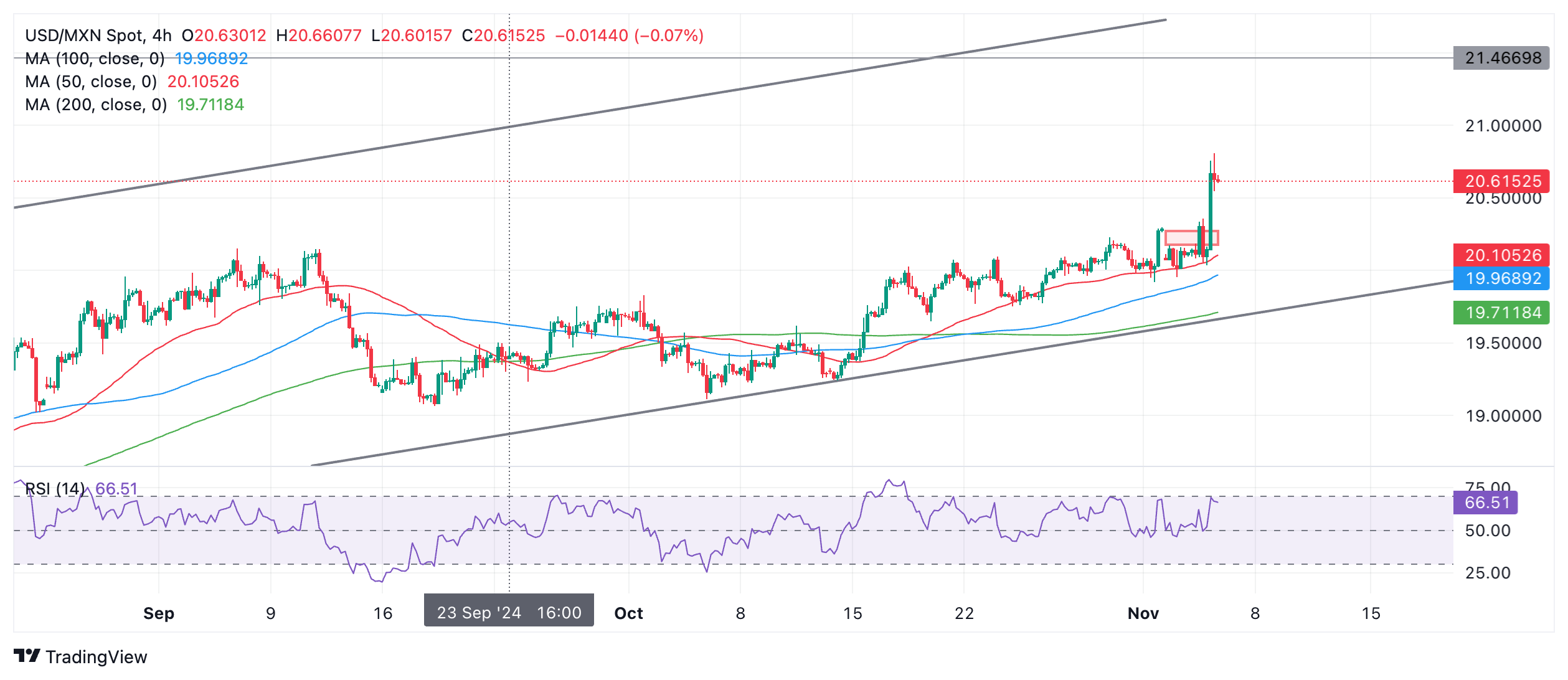
USD/MXN is in an overall uptrend on a short, medium and long-term basis. Further, it is trading in a bullish rising channel. Given the technical dictum “the trend is your friend,” the odds, therefore, favor a continuation higher.
The Relative Strength Index (RSI) remains just below the overbought level of 70, suggesting there is still scope for further upside.
A break above the 20.80 high would probably confirm more gains, with 21.00 coming into view as the next key target and resistance level (round number, psychological support).
US Dollar FAQs
The US Dollar (USD) is the official currency of the United States of America, and the ‘de facto’ currency of a significant number of other countries where it is found in circulation alongside local notes. It is the most heavily traded currency in the world, accounting for over 88% of all global foreign exchange turnover, or an average of $6.6 trillion in transactions per day, according to data from 2022. Following the second world war, the USD took over from the British Pound as the world’s reserve currency. For most of its history, the US Dollar was backed by Gold, until the Bretton Woods Agreement in 1971 when the Gold Standard went away.
The most important single factor impacting on the value of the US Dollar is monetary policy, which is shaped by the Federal Reserve (Fed). The Fed has two mandates: to achieve price stability (control inflation) and foster full employment. Its primary tool to achieve these two goals is by adjusting interest rates. When prices are rising too quickly and inflation is above the Fed’s 2% target, the Fed will raise rates, which helps the USD value. When inflation falls below 2% or the Unemployment Rate is too high, the Fed may lower interest rates, which weighs on the Greenback.
In extreme situations, the Federal Reserve can also print more Dollars and enact quantitative easing (QE). QE is the process by which the Fed substantially increases the flow of credit in a stuck financial system. It is a non-standard policy measure used when credit has dried up because banks will not lend to each other (out of the fear of counterparty default). It is a last resort when simply lowering interest rates is unlikely to achieve the necessary result. It was the Fed’s weapon of choice to combat the credit crunch that occurred during the Great Financial Crisis in 2008. It involves the Fed printing more Dollars and using them to buy US government bonds predominantly from financial institutions. QE usually leads to a weaker US Dollar.
Quantitative tightening (QT) is the reverse process whereby the Federal Reserve stops buying bonds from financial institutions and does not reinvest the principal from the bonds it holds maturing in new purchases. It is usually positive for the US Dollar.
Author

Joaquin Monfort
FXStreet
Joaquin Monfort is a financial writer and analyst with over 10 years experience writing about financial markets and alt data. He holds a degree in Anthropology from London University and a Diploma in Technical analysis.