Mexican Peso rises on favorable interest-rate outlook

Most recent article: Mexican Peso weakens as Banxico’s Governor hints potential rate cuts
- The Mexican Peso edges higher as interest rates in Mexico are expected to remain elevated.
- Relatively higher interest rates attract higher inflows of foreign capital.
- USD/MXN consolidates in its downtrend after a breakout. More downside is expected.
The Mexican Peso (MXN) trades higher in its major pairs on Monday, continuing to benefit from relatively higher interest rate expectations in Mexico following last week’s central bank decision.
USD/MXN is exchanging hands at 16.74, EUR/MXN at 18.05 and GBP/MXN at 20.99, at the time of publication.
Mexican Peso edges higher on interest rate expectations
The Mexican Peso trades higher, on the back of favorable interest rate expectations – a major driver of FX, where funds tend to flow to countries with higher interest rates.
At the Bank of Mexico (Banxico) meeting last Thursday, the central bank decided to leave its policy rate unchanged at 11.00% after cutting by 0.25% in March. It cited persistent inflation as the reason for not cutting again, leading to a rebound in the Peso.
The central bank also upwardly revised its inflation forecasts for the next six quarters, which indicates it sees an environment of sustained inflationary pressures ahead. This makes it less likely to lower interest rates in the short-term, further supporting the Mexican Peso.
Technical Analysis: USD/MXN consolidates within a down trend
USD/MXN – the value of one US Dollar in Mexican Pesos – decisively broke below the bottom of a short-term range at 16.86 last week, reflecting the continued strengthening of the Mexican Peso.
The breakout of the range – which could also possibly be interpreted as a descending triangle pattern – was a decisive technical development that suggests a protracted move lower.
USD/MXN 4-hour Chart
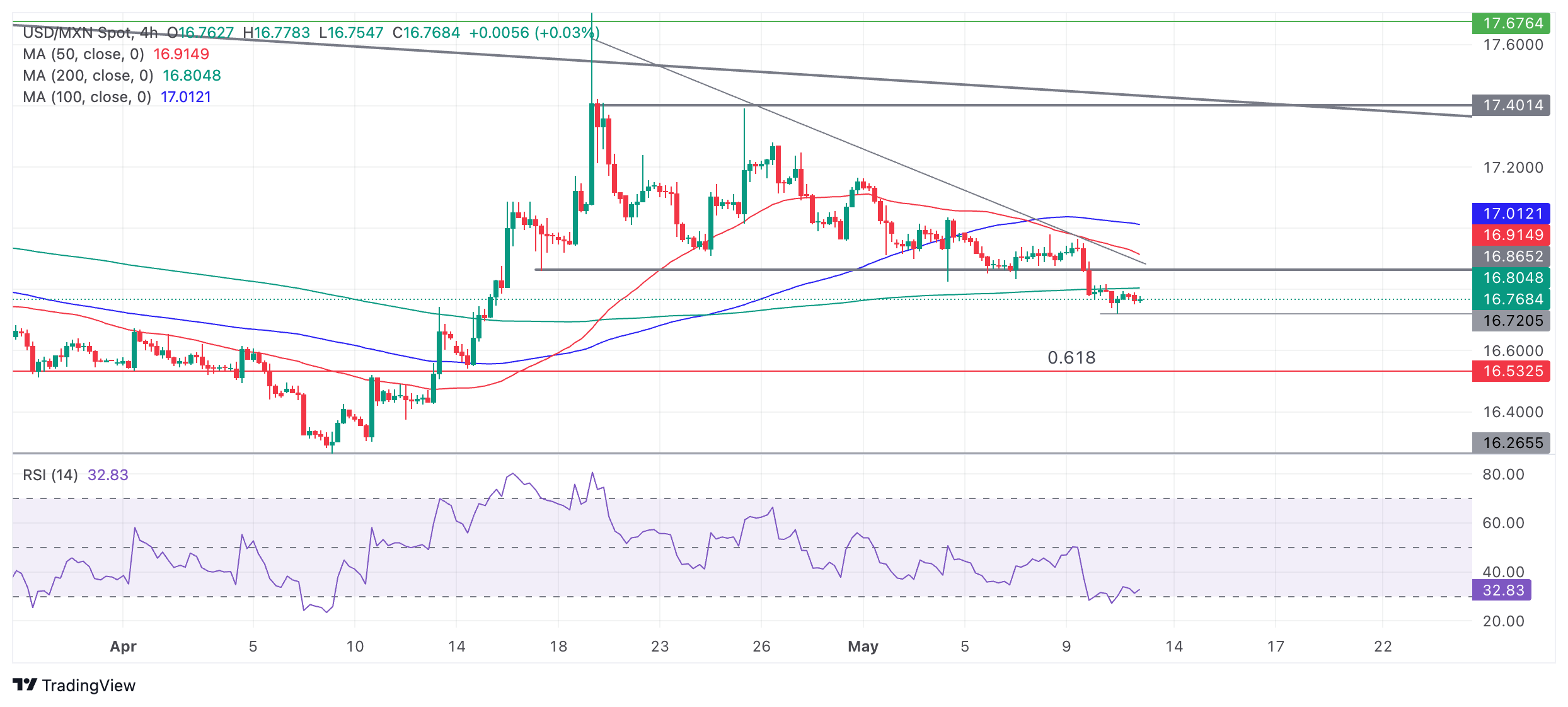
A conservative target for the breakout lies at 16.54, the 0.681 Fibonacci ratio of the height of the range extrapolated lower. This is followed by 16.34, the full height of the range extrapolated lower.
The short-term trend is now probably bearish following the breakdown from the range, which, given the old adage that the “trend is your friend”, suggests the odds favor continued downside.
However, the current move is temporarily oversold according to the Relative Strength Index (RSI). The RSI dipped into oversold territory on Friday and has since risen back out. This gives a short-term buy signal and suggests a pull back or sideways consolidation could be underway.
However, the pair is expected to eventually continue its march lower given the breakout from the range and the dominant downtrend. A break below 16.72 would confirm a continuation south.
Given the medium and long-term trends are bearish, the odds further favor more downside for the pair in line with those trends.
Economic Indicator
Central Bank Interest Rate
The Bank of Mexico announces a key interest rate which affects the whole range of interest rates set by commercial banks, building societies and other institutions for their own savers and borrowers. Generally speaking, if the central bank is hawkish about the inflationary outlook of the economy and rises the interest rates it is positive, or bullish, for the Mexican Peso.
Read more.Last release: Thu May 09, 2024 19:00
Frequency: Irregular
Actual: 11%
Consensus: 11%
Previous: 11%
Source: Banxico
Author

Joaquin Monfort
FXStreet
Joaquin Monfort is a financial writer and analyst with over 10 years experience writing about financial markets and alt data. He holds a degree in Anthropology from London University and a Diploma in Technical analysis.

















