Mexican Peso edges up in trade on Thursday
- The Mexican Peso trades marginally higher on Thursday after a strong start due to global risk appetite.
- The Peso weakened across the board on Wednesday after the Fed announced a mega 0.50% rate cut.
- USD/MXN is consolidating at the base of a rising channel and the 50-day SMA.

The Mexican Peso (MXN) edges higher in its most heavily-traded pairs during on Thursday, after a stronger start in which it rose as global stocks rallied amid an upbeat risk tone, that is generally positive for emerging market FX.
GBP/MXN is trading flat at the time of writing after the Bank of England (BoE) decided to keep interest rates unchanged at its September meeting. This is supporting GBP pairs as it it keeps UK interest rates relatively elevated compared to its peers. Higher interest rates tend to attract more foreign capital inflows from investors seeking a return.
On Wednesday the Peso lost ground following the US Federal Reserve’s (Fed) decision to cut interest rates by a larger 0.50% at its meeting. MXN weakened by an average of 1.1% against the US Dollar (USD), Euro (EUR), and Pound Sterling (GBP) on the day.
The Mexican Peso was probably not helped by comments from Victor Manuel Herrera, President of the National Economic Research Committee at Instituto Mexicano de Ejecutivos de Finanzas (IMEF) on Wednesday. Herrera said that the Mexican government’s controversial judicial reforms and the scrapping of independent industry regulatory bodies might harm the Mexican economy by reducing its attractiveness to foreign investors, especially from the US.
Mexican Peso still overvalued – Capital Economics
The Mexican Peso remains overpriced, according to London-based advisory service Capital Economics, and given the state of Mexico's precarious public finances, is, therefore, set for further declines in the future.
Well-publicized concerns about the left-leaning government’s radical constitutional reform plans aside, the country's public finances are in poor shape, and Mexico's indebtedness puts the economy at risk.
“President-elect Sheinbaum, protégé of the outgoing President Amlo, will inherit a myriad of economic issues. Most notably, the deteriorating public finances that are compounded by the heavily indebted state oil firm, Pemex, and could threaten Mexico’s investment grade sovereign credit rating,” says Joe Maher, Assistant Economist at Capital Economics.
Another factor weighing on the Peso is the unwinding of the so-called “carry trade,” in which investors borrow in a currency where interest rates are low, such as the Japanese Yen (JPY), and use the loan to buy a currency where interest rates are high, like the Peso. As long as the Peso does not depreciate against the Yen, those investors stand to earn the difference in the interest repayments on the Yen loan and the interest earned by being in Pesos. However, since the Yen has begun appreciating on the back of expectations that the Bank of Japan (BoJ) will raise interest rates, the carry trade has lost its luster.
Maher sees further downside pressure on the Peso from being overvalued on a Price Purchasing Parity (PPP) basis.
“The Peso has room to weaken further. For example, it is still somewhat stronger than what is implied by relative price levels in the US and Mexico,” says the Assistant Economist
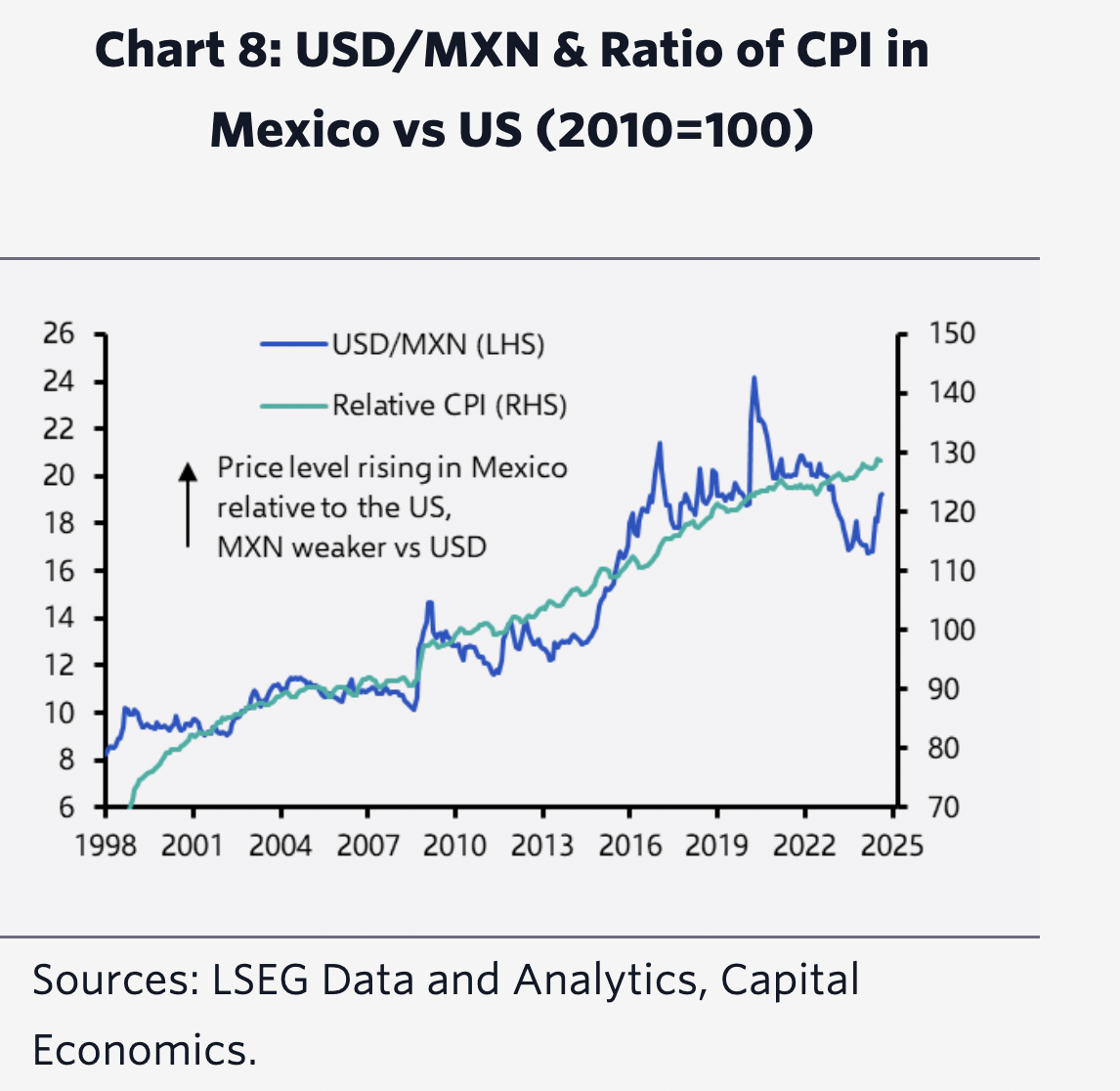
That said, the Mexican currency will gain some support from upbeat risk appetite. Capital Economics’s base case is that the US economy will avoid a recession, and if this holds true then the Peso should see gains.
“If we are correct in thinking that the US economy will avoid a recession, global risk appetite will probably stay strong, which would support Mexican assets and the peso,” he adds.
Nevertheless, Capital Economics revises down its forecasts, expecting the Peso to weaken to USD/MXN 20.00 by the end of 2024 and 21.00 by the end of 2025.
Technical Analysis: USD/MXN consolidates near bottom of channel
USD/MXN is consolidating near the bottom of a long-term rising channel.
The pair declined last week after forming a Three Black Crows Japanese candlestick pattern (shaded rectangle in the chart below). The pattern indicates prices could fall even further in the short term. Key support from the base of the channel and the 50-day Simple Moving Average at 19.02, however, stand in the way.
USD/MXN Daily Chart
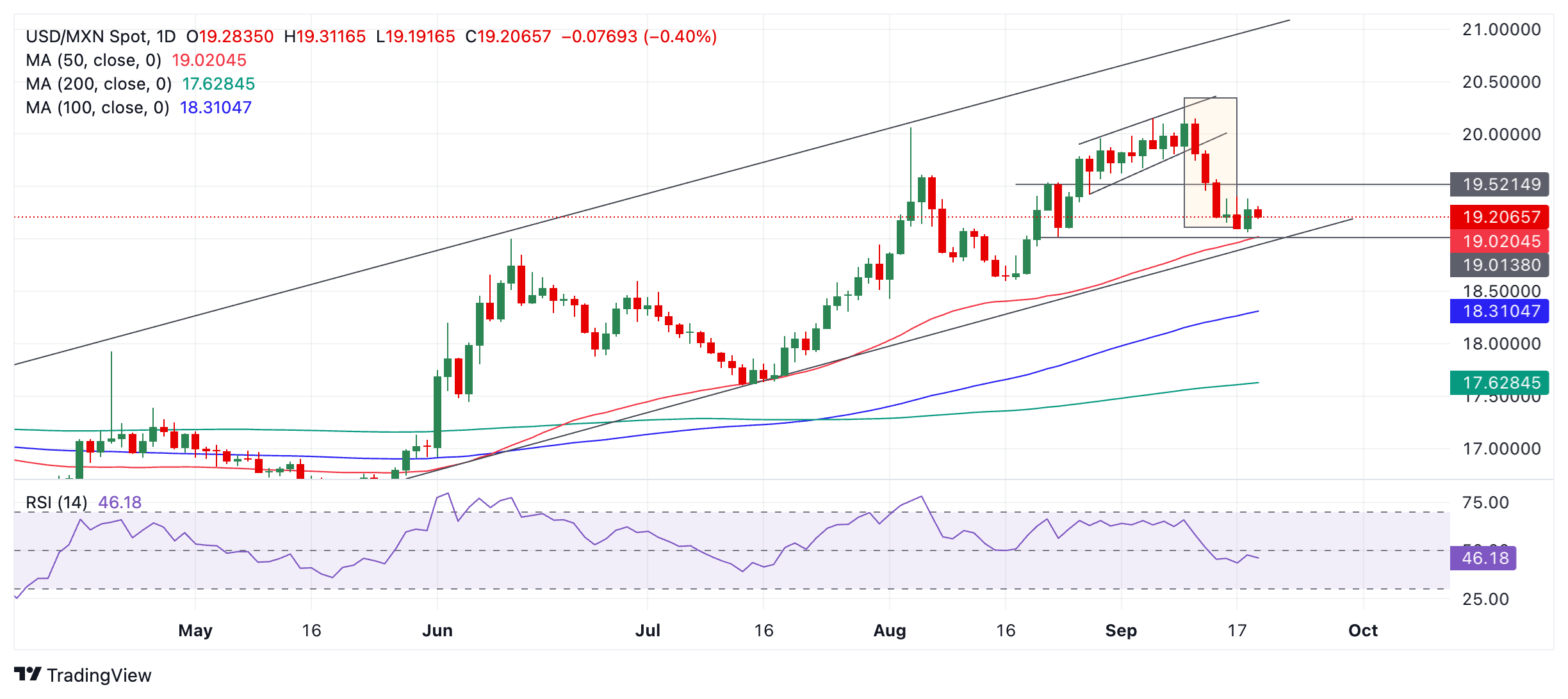
USD/MXN could extend weakness a little to the lower channel line at around 19.01 and the 50 SMA nearby. Despite being in a short-term downtrend, these firm support levels will be tough nuts for bears to crack. There is a risk that USD/MXN will simply stabilize and use the support shelf to launch a recovery within the channel, thereby extending the medium and long-term uptrends.
A decisive break below the lower channel line and 50 SMA would be required to alter the outlook and indicate a continuation of the down move.
A decisive break would be one accompanied by a long red candle that pierced well below the channel line and closed near its low, or three down days in a row that broke clearly below the line.
Economic Indicator
BoE Interest Rate Decision
The Bank of England (BoE) announces its interest rate decision at the end of its eight scheduled meetings per year. If the BoE is hawkish about the inflationary outlook of the economy and raises interest rates it is usually bullish for the Pound Sterling (GBP). Likewise, if the BoE adopts a dovish view on the UK economy and keeps interest rates unchanged, or cuts them, it is seen as bearish for GBP.
Read more.Last release: Thu Sep 19, 2024 11:00
Frequency: Irregular
Actual: 5%
Consensus: 5%
Previous: 5%
Source: Bank of England
Author

Joaquin Monfort
FXStreet
Joaquin Monfort is a financial writer and analyst with over 10 years experience writing about financial markets and alt data. He holds a degree in Anthropology from London University and a Diploma in Technical analysis.















