Mexican Peso wraps week stronger against US Dollar, glued to 17.00
- Mexican Peso strengthens with USD/MXN targeting 17.00 level following divergent US manufacturing reports.
- Mexico's Business Confidence slightly falls, yet solid US business activity could impact Banxico's easing timeline.
- Analysts predict inflation pressure and economic slowdown in Mexico amidst election campaign developments.

Mexican Peso begins Friday’s session with solid gains against the US Dollar after economic data from the United States (US) was mixed. Business activity in the manufacturing sector was reported positively by S&P Global, while the Institute for Supply Management (ISM) suggests the economy is contracting. The USD/MXN is falling 0.24%, trading at 17.01, with sellers eyeing the 17.00 figure.
Mexico’s economic docket revealed that Business Confidence in February dipped a tenth lower than in January, though market participants ignored it. S&P Global revealed that business activity remains solid, which could deter Bank of Mexico (Banxico) officials from easing policy as soon as the March meeting.
Banxico’s poll shows that private sector analysts expect headline and core inflation will remain above the Central Bank’s target. They estimate a slowdown in the economy and foresee 175 basis points of monetary policy easing toward the end of 2024.
Meanwhile, Mexico’s General Elections campaign started on March 1. Polls suggest the ruling party’s nominee, Claudia Sheinbaum, maintains her lead over Xochitl Galvez. Parametria’s poll sees Sheinbaum's support at 49%, while Galvez, the candidate of the opposition, stands at 29%.
Aside from this, the US docket reveals a deceleration in business activity after a slew of Federal Reserve speakers crossed the wires.
Daily digest market movers: Mexican Peso boosted by broad US Dollar weakness
- Mexico’s Business Confidence in February was 54.3, down from 54.4, the National Statistics Agency (INEGI) revealed.
- Mexico’s S&P Global February Manufacturing PMI rises to 52.3 from 50.0 in January.
- Banxico’s February private analysts poll projections for 2024:
- General inflation is foreseen at 4.10%, while underlying is expected at 4.06%.
- The economy is expected to grow 2.40%, unchanged from January.
- The USD/MXN exchange rate would end the year at 18.31, down from 18.50.
- Interest rates are expected to be lowered from 11.25% to 9.50%.
- During Banxico’s quarterly report, policymakers acknowledged the progress on inflation and urged caution against premature interest rate cuts. Governor Victoria Rodriguez Ceja said adjustments would be gradual, while Deputy Governors Galia Borja and Jonathan Heath called for prudence. The latter specifically warned against the risks of an early rate cut.
- Banxico updated its economic growth projections for 2024 from 3.0% to 2.8% YoY and maintained 1.5% for 2025.
- Mexico’s economy is expected to slow down due to higher interest rates set by Banxico at 11.25%. That’s the main reason that sparked a shift in three of the five governors of the Mexican Central Bank, who are eyeing the first rate cut at the March 21 meeting.
- The latest inflation report in Mexico showed that headline and underlying inflation continued to dip toward Banxico’s goal of 3%, plus or minus 1%, while economic growth exceeded estimates but finished below Q3’s 3.3%.
- Mexico’s economic data released during the week thus far:
- The Unemployment Rate rose from 2.6% to 2.9% YoY in January, exceeding estimates of 2.8%.
- The Balance of Trade for January revealed the country posted a trade deficit of $302 million.
- Mexico’s Consumer Price Index (CPI) in the first half of February was 4.45%, down from 4.9% YoY.
- Mexico’s Core CPI slowed from 4.78% to 4.63% on an annual basis.
- Mexico’s GDP for Q4 2023 exceeded estimates of 2.4% YoY and hit 2.5%, less than Q3 2023 print of 3.3%.
- Economic trade issues between Mexico and the US could depreciate the Mexican currency if the Mexican government fails to resolve its steel and aluminum dispute with the United States. US Trade Representative Katherine Tai warned the US could reimpose tariffs on the commodities.
- S&P Global revealed that manufacturing activity in February in the United States *US( expanded sharply, with the PMI edging up from 50.7 to 52.2. Later, the Institute for Supply Management (ISM) reported that February Manufacturing PMI came at 47.8, below estimates of 49.5 and January’s 49.1.
Technical analysis: Mexican Peso climbs as USD/MXN hovers below 50-day SMA
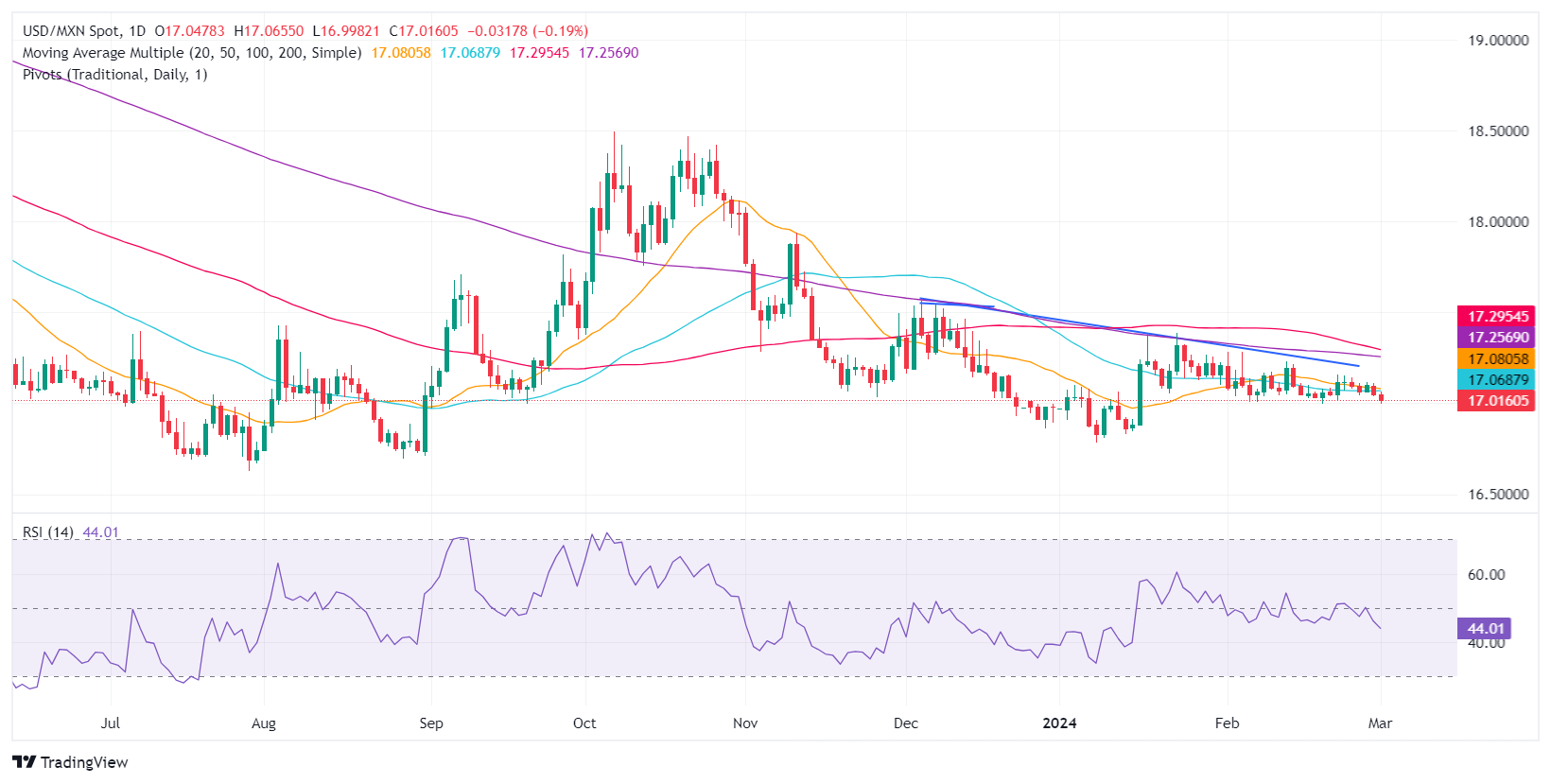
The USD/MXN has edged lower and hovers around the 17.00 figure, threatening to extend its losses below the latter. Momentum favors sellers, as depicted by the Relative Strength Index (RSI) standing in bearish territory. If they reclaim 17.00, the first support would be the year-to-date low of 16.78, followed by the 2023 low of 16.62.
Conversely, if buyers keep the exchange rate above 17.00, that will keep them hopeful for higher prices, though they must reclaim the 50-day Simple Moving Average (SMA) standing at 17.06. A breach of the latter will expose the 17.20 area, followed by the 200-day SMA at 17.25 and the 100-day SMA at 17.30.
USD/MXN Price Action – Daily Chart
Mexican Peso FAQs
What key factors drive the Mexican Peso?
The Mexican Peso (MXN) is the most traded currency among its Latin American peers. Its value is broadly determined by the performance of the Mexican economy, the country’s central bank’s policy, the amount of foreign investment in the country and even the levels of remittances sent by Mexicans who live abroad, particularly in the United States. Geopolitical trends can also move MXN: for example, the process of nearshoring – or the decision by some firms to relocate manufacturing capacity and supply chains closer to their home countries – is also seen as a catalyst for the Mexican currency as the country is considered a key manufacturing hub in the American continent. Another catalyst for MXN is Oil prices as Mexico is a key exporter of the commodity.
How do decisions of the Banxico impact the Mexican Peso?
The main objective of Mexico’s central bank, also known as Banxico, is to maintain inflation at low and stable levels (at or close to its target of 3%, the midpoint in a tolerance band of between 2% and 4%). To this end, the bank sets an appropriate level of interest rates. When inflation is too high, Banxico will attempt to tame it by raising interest rates, making it more expensive for households and businesses to borrow money, thus cooling demand and the overall economy. Higher interest rates are generally positive for the Mexican Peso (MXN) as they lead to higher yields, making the country a more attractive place for investors. On the contrary, lower interest rates tend to weaken MXN.
How does economic data influence the value of the Mexican Peso?
Macroeconomic data releases are key to assess the state of the economy and can have an impact on the Mexican Peso (MXN) valuation. A strong Mexican economy, based on high economic growth, low unemployment and high confidence is good for MXN. Not only does it attract more foreign investment but it may encourage the Bank of Mexico (Banxico) to increase interest rates, particularly if this strength comes together with elevated inflation. However, if economic data is weak, MXN is likely to depreciate.
How does broader risk sentiment impact the Mexican Peso?
As an emerging-market currency, the Mexican Peso (MXN) tends to strive during risk-on periods, or when investors perceive that broader market risks are low and thus are eager to engage with investments that carry a higher risk. Conversely, MXN tends to weaken at times of market turbulence or economic uncertainty as investors tend to sell higher-risk assets and flee to the more-stable safe havens.
Author
Christian Borjon Valencia
FXStreet
Markets analyst, news editor, and trading instructor with over 14 years of experience across FX, commodities, US equity indices, and global macro markets.