Japanese Yen keeps the red amid quiet trade ahead of Tokyo inflation data on Friday
- The Japanese Yen retreats from over a one-month high touched against the USD on Wednesday.
- Rebounding US bond yields revive the USD demand and undermine the lower-yielding JPY.
- December BoJ rate hike bets, trade war jitters and geopolitical risks help limit losses for the JPY.


The Japanese Yen (JPY) remains depressed against its American counterpart heading into the European session amid a modest uptick in the US Treasury bond yields. Wednesday's US macro data pointed to a still resilient economy and stalling inflation progress, suggesting that the Federal Reserve (Fed) might be cautious about further policy easing. This, in turn, triggers a modest bounce in the US bond yields, which helps revive the US Dollar (USD) demand and is seen undermining the lower-yielding JPY.
Apart from this, a generally positive risk tone turns out to be another factor that contributes to driving flows away from the safe-haven JPY. That said, concerns about US President-elect Donald Trump's tariff plans, geopolitical risks stemming from the Russia-Ukraine war and speculation that the Bank of Japan (BoJ) may hike interest rates again in December seem to act as a tailwind for the JPY. Traders also seem reluctant and look to Tokyo consumer inflation figures on Friday before placing fresh bets.
Japanese Yen bulls remain on the sidelines amid rebounding US bond yields, modest USD strength
- Japan’s stronger Consumer Price Index and steady corporate service inflation reaffirmed Bank of Japan Governor Kazuo Ueda's view that the economy was progressing towards sustained wages-driven inflation.
- This keeps the door open for another BoJ interest rate hike in December, which, along with trade war jitters, lifted the safe-haven Japanese Yen to a five-week high against its American counterpart on Wednesday.
- Japan's parliament convened an extraordinary session, with Prime Minister Shigeru Ishiba's minority government seeking to enact a supplementary budget to help inflation-hit households and revise a political funds law.
- The flight to safety and expectations that Scott Bessent – Trump's US Treasury secretary nominee – will restrain budget deficits dragged the benchmark 10-year US Treasury yields to a level not seen in a month.
- The US Dollar recovers from a two-week low touched on Wednesday amid a pickup in the US bond yields, bolstered by Wednesday's US macro data, which underscored the US economic resilience and a solid labor market.
- The Bureau of Economic Analysis reported that the economy expanded steadily in the third quarter, by a 2.8% annualized pace – matching the first estimate – and consumer spending rose 3.5% – the most this year.
- Meanwhile, data released by the US Department of Labor showed that the number of individuals filing new applications for unemployment insurance fell to 213K for the week ending November 22 from 215K prior.
- Separately, Durable Goods Orders climbed 0.2% in October as compared to the 0.4% decline (revised from -0.8%) recorded in the previous month and was worse than the consensus estimates for an increase of 0.5%.
- Furthermore, the Personal Consumption Expenditures (PCE) Price Index rose to 2.3% on a yearly basis in October from 2.1% in September and the core gauge edged higher from 2.7% to 2.8% during the reported month.
- The data did little to bolster the case for the Federal Reserve to ease again next month, although market participants are pricing in over a 65% chance of another 25-basis points rate cut at the December FOMC meeting.
- However, expectations that Trump's expansionary policies will boost inflation and limit the scope for the Fed to cut rates further lend support to the USD and contribute to the USD/JPY pair's move up on Thursday.
- Trading volumes are expected to remain thin on the back of the Thanksgiving Day holiday in the US, warranting some caution for aggressive traders ahead of the Tokyo consumer inflation figures on Friday.
USD/JPY remains below 200-day SMA pivotal support breakpoint; not out of the woods yet
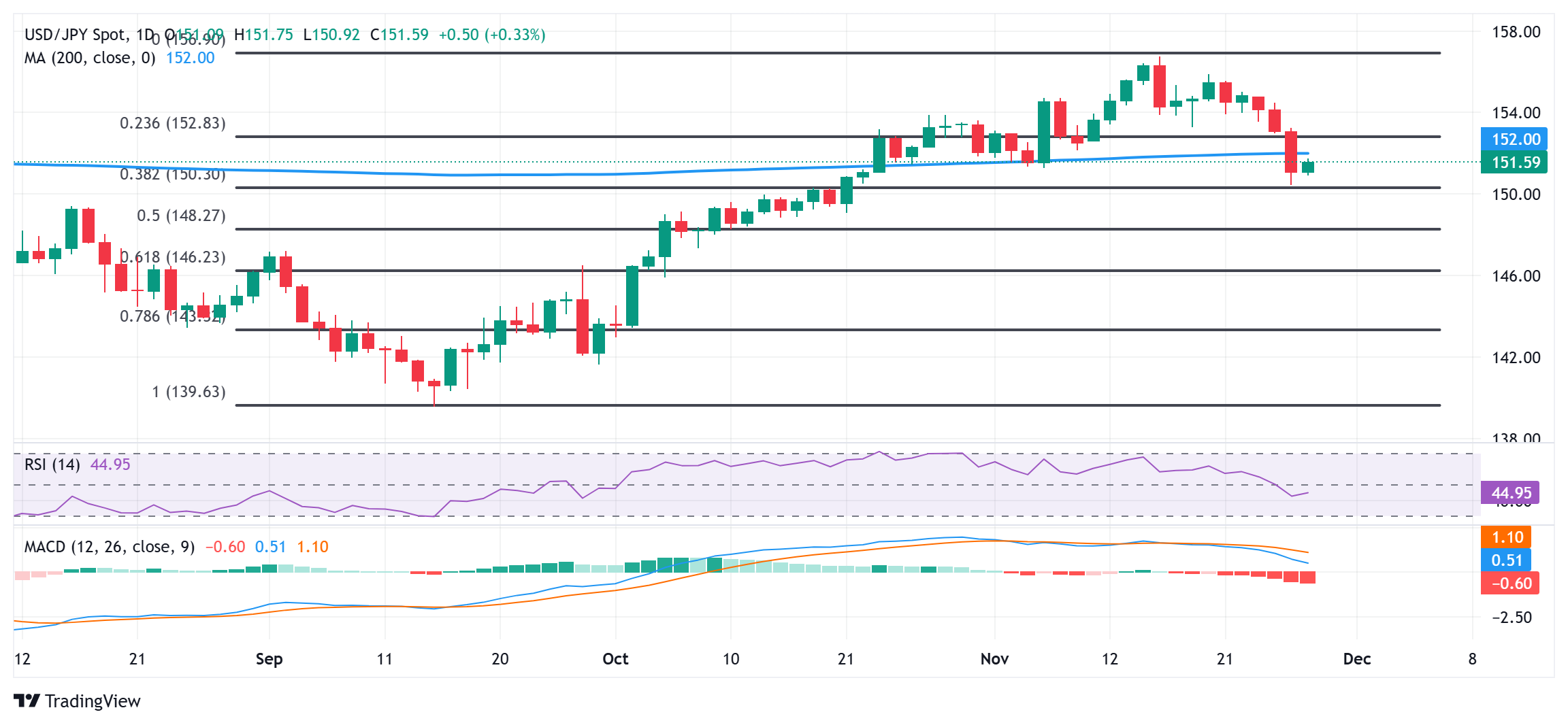
The overnight breakdown below the very important 200-day Simple Moving Average (SMA) could be seen as a key trigger for bearish traders. Moreover, oscillators on the daily chart have just started gaining negative traction and support prospects for further USD/JPY depreciation. That said, a modest recovery from the vicinity of the 38.2% Fibonacci retracement level of the September-November rally warrants some caution. Any further move up, however, is more likely to remain capped near the 152.00 mark (200-day SMA), above which spot prices could climb to the 152.60 area, en route to the 153.00 mark and the 153.30 horizontal barrier.
On the flip side, the overnight swing low, around the 150.45 area, closely followed by the 150.20-150.15 region (38.2% Fibo. level) and the 150.00 psychological mark now seem to act as immediate support levels. A convincing break below the latter has the potential to drag the USD/JPY pair to the 149.40-149.35 intermediate support en route to the 149.00 round figure and the 50% retracement level, around the 148.25-148.20 zone.
Fed FAQs
Monetary policy in the US is shaped by the Federal Reserve (Fed). The Fed has two mandates: to achieve price stability and foster full employment. Its primary tool to achieve these goals is by adjusting interest rates. When prices are rising too quickly and inflation is above the Fed’s 2% target, it raises interest rates, increasing borrowing costs throughout the economy. This results in a stronger US Dollar (USD) as it makes the US a more attractive place for international investors to park their money. When inflation falls below 2% or the Unemployment Rate is too high, the Fed may lower interest rates to encourage borrowing, which weighs on the Greenback.
The Federal Reserve (Fed) holds eight policy meetings a year, where the Federal Open Market Committee (FOMC) assesses economic conditions and makes monetary policy decisions. The FOMC is attended by twelve Fed officials – the seven members of the Board of Governors, the president of the Federal Reserve Bank of New York, and four of the remaining eleven regional Reserve Bank presidents, who serve one-year terms on a rotating basis.
In extreme situations, the Federal Reserve may resort to a policy named Quantitative Easing (QE). QE is the process by which the Fed substantially increases the flow of credit in a stuck financial system. It is a non-standard policy measure used during crises or when inflation is extremely low. It was the Fed’s weapon of choice during the Great Financial Crisis in 2008. It involves the Fed printing more Dollars and using them to buy high grade bonds from financial institutions. QE usually weakens the US Dollar.
Quantitative tightening (QT) is the reverse process of QE, whereby the Federal Reserve stops buying bonds from financial institutions and does not reinvest the principal from the bonds it holds maturing, to purchase new bonds. It is usually positive for the value of the US Dollar.
Author
Haresh Menghani
FXStreet
Haresh Menghani is a detail-oriented professional with 10+ years of extensive experience in analysing the global financial markets.