Japanese Yen sticks to negative bias against USD; lacks bearish conviction ahead of US data
- The Japanese Yen attracts fresh sellers and stalls its recovery from a one-month low against the USD.
- BoJ rate hike ambiguity, domestic political uncertainty, and positive risk tone undermine the JPY.
- Rising Fed rate cut bets might keep a lid on the USD strength and USD/JPY ahead of the US NFP.

The Japanese Yen (JPY) remains on the back foot against its American counterpart through the early European session on Thursday amid a combination of negative factors. Market participants remain divided over the likely timing and pace of Bank of Japan (BoJ) rate hikes amid tariff-related uncertainties. Moreover, concerns about rising debt levels across major economies, including Japan, along with domestic political uncertainty, seem to undermine the JPY.
Apart from this, a stable performance around the equity markets is seen denting the JPY's safe-haven status. Investors, however, seem convinced that the BoJ will stick to its policy normalization path amid firm wage growth, still sticky inflation, and a brighter economic outlook. This could act as a tailwind for the JPY. Furthermore, bets that the Federal Reserve (Fed) will cut rates later this month should cap the upside for the US Dollar (USD) and the USD/JPY pair.
Japanese Yen remains on the back foot amid a combination of negative factors
- Bank of Japan Deputy Governor Ryozo Himino warned on Tuesday that global economic uncertainty remains high, suggesting that the central bank is in no rush to push up still-low borrowing costs. However, BoJ Governor Kazuo Ueda on Wednesday showed readiness to continue raising interest rates if the economy and prices move in line with the central bank's projections.
- Meanwhile, investors continue to bet that the BoJ could raise rates before year-end on the back of firm wage growth, still sticky inflation, and a brighter economic outlook. This, in turn, acts as a tailwind for the Japanese Yen during the Asian session on Thursday, though domestic political uncertainty caps the overnight recovery from a one-month low touched the previous day.
- The Japanese ruling party's secretary general Hiroshi Moriyama's intention to resign have stoked uncertainty around Prime Minister Shigeru Ishiba’s leadership. The announcement revived worries about Japan's fiscal position and contributed to the recent surge in Japan's 30-year government bond yield to a record high, well above the 3% mark, touched earlier this week.
- The US Bureau of Labor Statistics (BLS) published the Job Openings and Labor Turnover Survey (JOLTS) on Wednesday, which showed that the number of job openings on the last business day of July stood at 7.18 million. This followed the previous month's downwardly revised reading of 7.35 million and came in well below the market expectation of 7.4 million.
- Nevertheless, the softer data increased the likelihood of the Federal Reserve cutting interest rates at the end of a two-day policy meeting on September 17. Moreover, traders are pricing in at least two 25 basis points rate cuts by the year-end, which, in turn, fails to assist the US Dollar to attract any meaningful buyers and should act as a headwind for the USD/JPY pair.
- Traders now look forward to Thursday's US economic docket – featuring the ADP report on private-sector employment and ISM Services PMI. The focus, however, will remain glued to the official US monthly employment details – popularly known as the Nonfarm Payrolls (NFP) report – on Friday, which will drive the USD and provide a fresh impetus to the USD/JPY pair.
USD/JPY might struggle to find acceptance above 200-day SMA; 149.00 holds the key for bulls
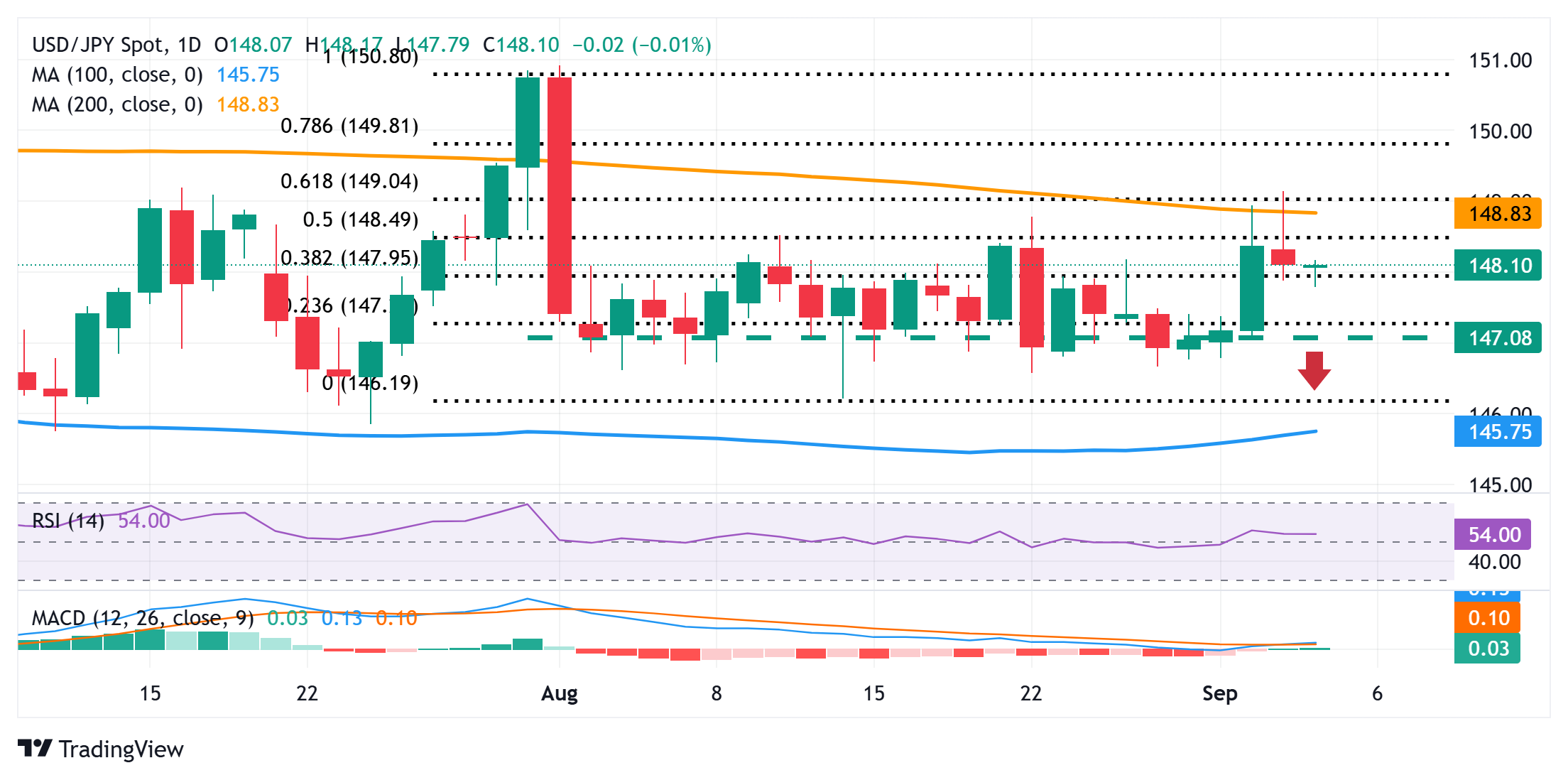
The overnight failure to build on momentum beyond the 200-day Simple Moving Average (SMA) and a sharp pullback from the 61.8% Fibonacci retracement level of the downfall from the August monthly swing high favour the USD/JPY bears. That said, positive oscillators on the daily chart make it prudent to wait for acceptance below the 148.00 mark before positioning for deeper losses. Spot prices might then accelerate the fall to the 147.40 intermediate support en route to the 147.00 mark and the 146.70 horizontal zone. A convincing break below the latter would expose the August swing low, around the 146.20 region, before spot prices eventually test the 146.00 mark.
On the flip side, a positive move back above the 148.30-148.25 static barrier could lift the USD/JPY pair back towards the 200-day SMA, currently pegged near the 148.75-148.80 region. Some follow-through buying, leading to a subsequent strength beyond the 149.00 mark and the 149.20 area, or the 61.8% Fibo. retracement level, will be seen as a fresh trigger for bulls. Spot prices might then aim to reclaim the 150.00 psychological mark. The momentum could extend further towards challenging the August monthly swing high, around the 151.00 neighborhood.
Economic Indicator
ADP Employment Change
The ADP Employment Change is a gauge of employment in the private sector released by the largest payroll processor in the US, Automatic Data Processing Inc. It measures the change in the number of people privately employed in the US. Generally speaking, a rise in the indicator has positive implications for consumer spending and is stimulative of economic growth. So a high reading is traditionally seen as bullish for the US Dollar (USD), while a low reading is seen as bearish.
Read more.Next release: Thu Sep 04, 2025 12:15
Frequency: Monthly
Consensus: 65K
Previous: 104K
Source: ADP Research Institute
Traders often consider employment figures from ADP, America’s largest payrolls provider, report as the harbinger of the Bureau of Labor Statistics release on Nonfarm Payrolls (usually published two days later), because of the correlation between the two. The overlaying of both series is quite high, but on individual months, the discrepancy can be substantial. Another reason FX traders follow this report is the same as with the NFP – a persistent vigorous growth in employment figures increases inflationary pressures, and with it, the likelihood that the Fed will raise interest rates. Actual figures beating consensus tend to be USD bullish.
Author

Haresh Menghani
FXStreet
Haresh Menghani is a detail-oriented professional with 10+ years of extensive experience in analysing the global financial markets.