Japanese Yen stands firm near multi-month peak against bearish USD, ahead of US NFP
- The Japanese Yen continues to be underpinned by increasing bets for more BoJ rate hikes.
- Trade tariff jitters and the risk-off mood further underpin demand for the safe-haven JPY.
- Expectations for further policy easing by the Fed weigh on the USD and the USD/JPY pair.

The Japanese Yen (JPY) stands firm near its highest level since early October against a broadly weaker US Dollar (USD) through the early European session on Friday amid hawkish Bank of Japan (BoJ) expectations. Moreover, persistent speculation that the Bank of Japan (BoJ) will continue to raise interest rates has been exerting upward pressure on Japanese government bond (JGB) yields. The resultant narrowing of the rate differential between Japan and other countries further contributes to driving flows towards the lower-yielding JPY.
Meanwhile, the uncertainty surrounding US President Donald Trump's trade policies and their impact on the global economy continue to weigh on investors' sentiment. This is evident from a generally weaker tone around the equity markets and further benefits the JPY's relative safe-haven status. The USD, on the other hand, languishes near a multi-month low amid bets that the Federal Reserve (Fed) would cut rates several times this year and further weighs on the USD/JPY pair ahead of the crucial US Nonfarm Payrolls (NFP) report.
Japanese Yen bulls retain near-term control amid trade jitters and hawkish BoJ expectations
- Bank of Japan Deputy Governor Shinichi Uchida said earlier this week that the central bank was likely to raise interest rates at a pace in line with dominant views among financial markets and economists.
- Moreover, a global sell-off in bonds contributes to the upswing in the benchmark 10-year Japanese government bond yield, to its highest level since June 2009, and continues to underpin the Japanese Yen.
- Investors remain on the sidelines and keenly await more clarity on US President Donald Trump's trade policies, especially after another U-turn on the recently imposed tariffs on Mexico and Canada.
- Trump on Thursday exempted goods from both Canada and Mexico that comply with the US–Mexico–Canada Agreement for a month from the steep 25% tariffs that he had imposed earlier this week.
- Meanwhile, worries that Trump's trade tariffs could slow the US economic growth in the long run continue to fuel speculation that the Federal Reserve will resume cutting interest rates as soon as May.
- Philadelphia Fed President Patrick Harker said that trouble may be brewing for the US economy which is in good shape but showing signs of stress in the consumer sector and risks to the inflation outlook.
- This, to a larger extent, overshadows data showing that the US Initial Jobless Claims fell more than expected, to 221K during the week ended March 1 and dragged the US Dollar to a multi-month trough.
- Atlanta Fed President Raphael Bostic noted that the US economy is in an incredible state of flux and it’s hard to know where things will land. The central bank needs to be mindful of any changes that impact prices and employment.
- Fed Governing Board Member Christopher Waller said he leans strongly against a rate cut at the March meeting, although he reckons cuts later in the year remain on track if inflation pressures continue to abate.
- Investors currently see negligible odds of a March cut, remain divided over the May meeting, and are pricing in a rate cut at the June FOMC meeting. The Fed is expected to lower borrowing costs again in September.
- Traders now look forward to the release of the US Nonfarm Payrolls (NFP) report, which is expected to show that the economy added 160K new jobs in February and the Unemployment Rate held steady at 4%.
USD/JPY could accelerate the downfall once the 147.00 immediate support is broken decisively
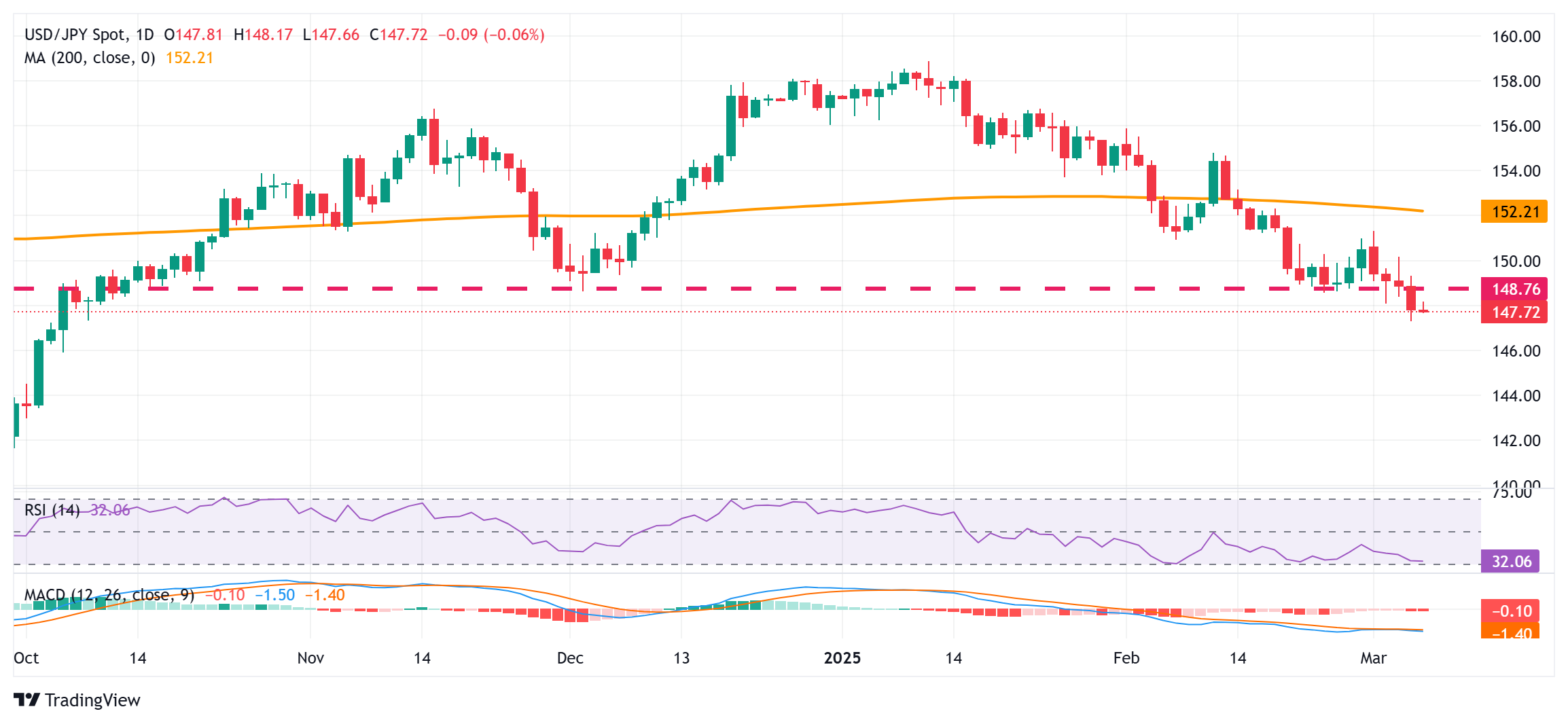
From a technical perspective, this week's breakdown below the 148.70-148.65 horizontal support is seen as a key trigger for bearish traders. That said, the Relative Strength Index (RSI) on the daily chart has moved on the verge of breaking into the oversold territory and warrants some caution. Hence, it will be prudent to wait for some near-term consolidation or a modest bounce before positioning for an extension of the USD/JPY pair's two-month-old downtrend.
In the meantime, the aforementioned support breakpoint, around the 148.65-148.70 region, could cap any attempted recovery. This is closely followed by the 149.00 round figure, above which a bout of a short-covering move has the potential to lift the USD/JPY pair towards the 150.00 psychological mark. The momentum could extend towards the 150.60 intermediate hurdle en route to the 151.00 mark, though it is likely to remain capped near the 151.30 region, or the monthly peak.
On the flip side, the multi-month low, around the 147.30 area touched on Thursday, now seems to act as immediate support ahead of the 147.00 mark. Some follow-through selling could expose the next relevant support near the 146.40 region before the USD/JPY pair eventually drops to the 146.00 round figure en route to the 145.60-145.50 zone and the 145.00 psychological mark.
Economic Indicator
Nonfarm Payrolls
The Nonfarm Payrolls release presents the number of new jobs created in the US during the previous month in all non-agricultural businesses; it is released by the US Bureau of Labor Statistics (BLS). The monthly changes in payrolls can be extremely volatile. The number is also subject to strong reviews, which can also trigger volatility in the Forex board. Generally speaking, a high reading is seen as bullish for the US Dollar (USD), while a low reading is seen as bearish, although previous months' reviews and the Unemployment Rate are as relevant as the headline figure. The market's reaction, therefore, depends on how the market assesses all the data contained in the BLS report as a whole.
Read more.Next release: Fri Mar 07, 2025 13:30
Frequency: Monthly
Consensus: 160K
Previous: 143K
Source: US Bureau of Labor Statistics
America’s monthly jobs report is considered the most important economic indicator for forex traders. Released on the first Friday following the reported month, the change in the number of positions is closely correlated with the overall performance of the economy and is monitored by policymakers. Full employment is one of the Federal Reserve’s mandates and it considers developments in the labor market when setting its policies, thus impacting currencies. Despite several leading indicators shaping estimates, Nonfarm Payrolls tend to surprise markets and trigger substantial volatility. Actual figures beating the consensus tend to be USD bullish.
Author

Haresh Menghani
FXStreet
Haresh Menghani is a detail-oriented professional with 10+ years of extensive experience in analysing the global financial markets.