Japanese Yen remains close to its highest level since July 24 against USD ahead of Fed
- The Japanese Yen bulls turn cautious amid a modest USD bounce during the Asian session.
- The divergent BoJ-Fed policy expectations and the cautious mood could benefit the JPY.
- Traders might also opt to wait for the key FOMC decision later today and the BoJ meeting.

The Japanese Yen (JPY) extends its sideways consolidative price move through the early European session and remains close to its highest level since July 24, touched against the recovering US Dollar (USD) this Wednesday. The growing acceptance that the Bank of Japan (BoJ) will stick to its policy normalization path, along with the cautious market mood, turns out to be a key factor acting as a tailwind for the safe-haven JPY. Traders also seem reluctant to place aggressive bets heading into the key central bank events.
The US Federal Reserve (Fed) is scheduled to announce its decision later today and is expected to lower borrowing costs by at least 25 basis points (bps) amid signs of a softening labor market. This marks a significant divergence as compared to hawkish BoJ expectations, and the resultant narrowing of the US-Japan rate differential also contributes to limiting losses for the lower-yielding JPY. Meanwhile, the prospects for a more aggressive policy easing by the Fed cap the attempted USD bounce and the USD/JPY pair.
Japanese Yen bulls move to the sidelines ahead of key central bank events
- A government report released earlier this Wednesday showed that Japan’s trade deficit widened sharply from ¥118.4 billion to ¥242.5 billion in August. This, however, was less than a deficit of ¥513.6 billion anticipated as exports shrank less than expected, by 0.1% compared to forecasts for a drop of 1.9% and a 2.6% fall recorded in July, as the finalization of the US-Japan trade deal offered some clarity to exporters.
- Other details of the report revealed that Japanese imports shrank far more than expected, by 5.2% during the reported month, and pointed to still weak domestic demand. Moreover, Japanese Prime Minister Shigeru Ishiba's resignation added a layer of uncertainty and could give the Bank of Japan more reasons to go slow on interest rate hikes. Hence, focus remains glued to the BoJ policy meeting starting Thursday.
- The Japanese central bank is expected to leave the benchmark interest rate unchanged at 0.5% amid domestic headwinds and global risks, including the effects of US tariffs. Investors, however, seem convinced that the BoJ will hike interest rates by the end of this year. In contrast, the US Federal Reserve is anticipated to resume its rate-cutting cycle and lower borrowing costs by 25 basis points later this Wednesday.
- Moreover, traders have been pricing in the possibility of two more rate cuts by the Fed this year amid signs of a softening labor market. This had been a key factor behind the recent US Dollar slide to its lowest level since early July touched this Thursday and dragged the USD/JPY pair to the 146.20 support zone during the Asian session. Traders, however, opt to wait for the highly anticipated FOMC decision later today.
- US President Donald Trump intensified his calls for a resolution to the Russia-Ukraine conflict, urging Ukrainian President Zelensky to make a deal to end the war and pressing Europe to immediately stop buying Russian oil. This comes after Russian forces launched a massive attack on Ukraine’s southeastern city of Zaporizhzhia, following a series of strikes by the latter against its oil infrastructure in recent weeks.
- Meanwhile, Israel launched its long-planned ground assault on Gaza City and its troops have pressed deep into the densely populated city on Tuesday, which has been subjected to intense bombardment for weeks. Moreover, an emergency summit of Arab and Islamic country leaders had condemned Israel’s attack on Hamas leaders in Qatar's capital, Doha, on September 9. This, in turn, keeps geopolitical risks in play.
USD/JPY defends the 100-day SMA, 146.20 support holds the key for bullish traders
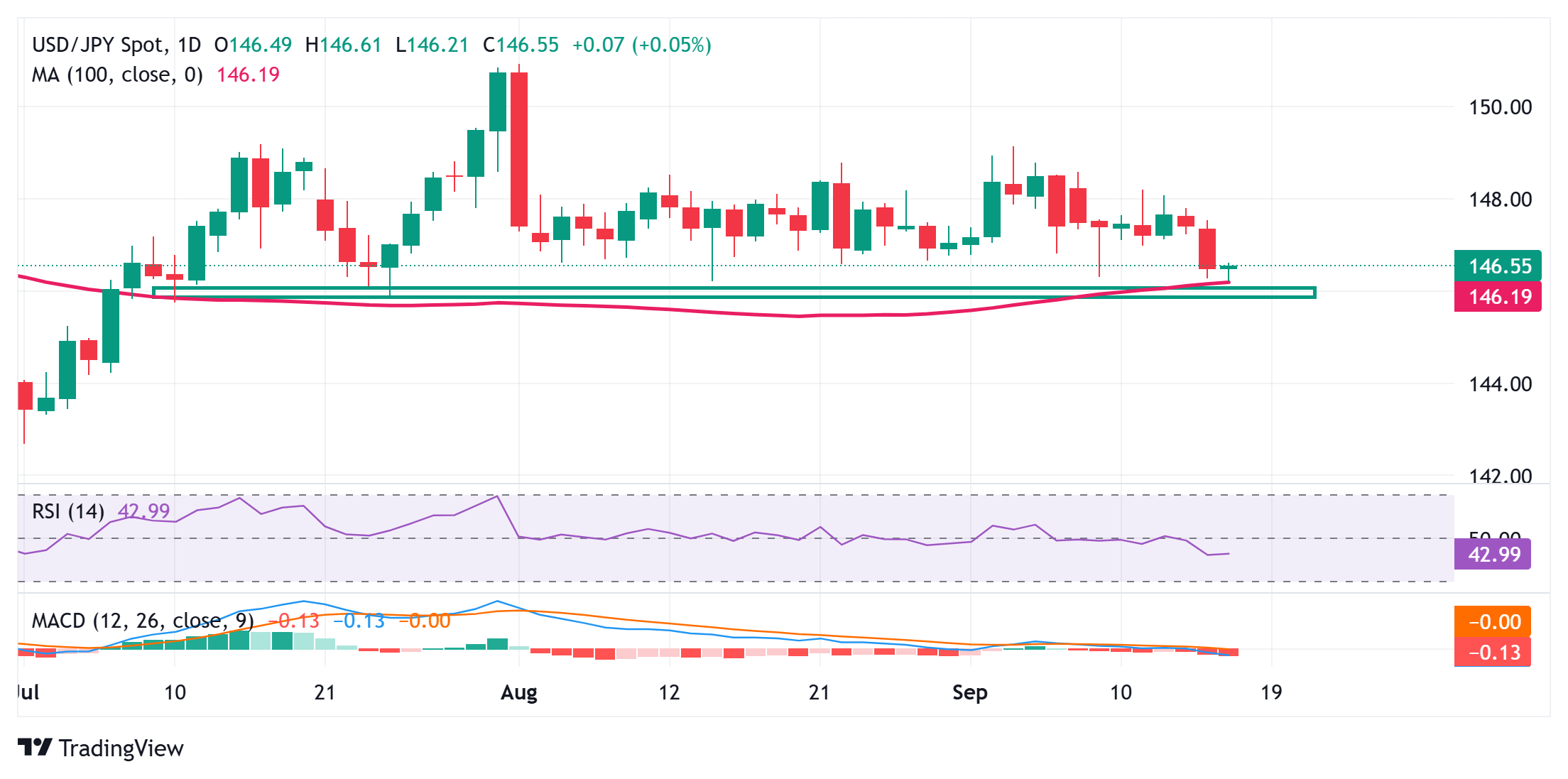
From a technical perspective, the overnight breakdown and acceptance below the 147.00 mark was seen as a fresh trigger for the USD/JPY bears. Moreover, oscillators on the daily chart have again started gaining negative traction, suggesting that the path of least resistance for spot prices remains to the downside. That said, a modest bounce from the 146.20 horizontal support, also representing the 100-day Simple Moving Average (SMA), warrants some caution. Hence, it will be prudent to wait for some follow-through selling below the said area and the 146.00 mark, before positioning for any further losses. The pair might then accelerate the downfall towards the 145.35 intermediate support en route to the 145.00 psychological mark.
On the flip side, any subsequent recovery beyond the 146.70 immediate hurdle is likely to attract fresh sellers and remain capped near the 147.00 round figure. Some follow-through buying beyond the 147.15-147.20 region, however, could lift the USD/JPY pair beyond the 147.55 hurdle, towards the 148.00 mark. A sustained strength beyond the latter might trigger a short-covering move towards the 200-day Simple Moving Average (SMA), currently pegged near the 148.75 zone. This is followed by the 149.00 mark and the monthly high, around the 149.15 region, which, if cleared decisively, would shift the near-term bias in favor of bullish traders.
Japanese Yen FAQs
The Japanese Yen (JPY) is one of the world’s most traded currencies. Its value is broadly determined by the performance of the Japanese economy, but more specifically by the Bank of Japan’s policy, the differential between Japanese and US bond yields, or risk sentiment among traders, among other factors.
One of the Bank of Japan’s mandates is currency control, so its moves are key for the Yen. The BoJ has directly intervened in currency markets sometimes, generally to lower the value of the Yen, although it refrains from doing it often due to political concerns of its main trading partners. The BoJ ultra-loose monetary policy between 2013 and 2024 caused the Yen to depreciate against its main currency peers due to an increasing policy divergence between the Bank of Japan and other main central banks. More recently, the gradually unwinding of this ultra-loose policy has given some support to the Yen.
Over the last decade, the BoJ’s stance of sticking to ultra-loose monetary policy has led to a widening policy divergence with other central banks, particularly with the US Federal Reserve. This supported a widening of the differential between the 10-year US and Japanese bonds, which favored the US Dollar against the Japanese Yen. The BoJ decision in 2024 to gradually abandon the ultra-loose policy, coupled with interest-rate cuts in other major central banks, is narrowing this differential.
The Japanese Yen is often seen as a safe-haven investment. This means that in times of market stress, investors are more likely to put their money in the Japanese currency due to its supposed reliability and stability. Turbulent times are likely to strengthen the Yen’s value against other currencies seen as more risky to invest in.
Author

Haresh Menghani
FXStreet
Haresh Menghani is a detail-oriented professional with 10+ years of extensive experience in analysing the global financial markets.