Japanese Yen sticks to intraday losses; bears lack conviction amid hawkish BoJ expectations
- The Japanese Yen weakened after Japan's Finance Minister Katsunobu Kato’s comments on Friday.
- Japan’s strong National CPI print reaffirms BoJ rate hike bets and helps limit losses for the JPY.
- The underlying USD bearish sentiment further contributes to keeping a lid on the USD/JPY pair.

The Japanese Yen (JPY) maintains its offered tone during the early European session, though it lacks bearish conviction amid the growing acceptance that the Bank of Japan (BoJ) will hike interest rates further. The bets were reaffirmed by Japan's stronger National Consumer Price Index (CPI) released earlier this Friday, which remains supportive of elevated Japanese government bond (JGB) yields. The resultant narrowing of the rate differential between Japan and other countries acts as a tailwind for the lower-yielding JPY.
Meanwhile, comments from Japan's Finance Minister, Katsunobu Kato, and BoJ Governor Kazuo Ueda fuel speculations about a possible intervention in the bond market to bring down JGB yields. This weighed heavily on the JPY on Friday and assisted the USD/JPY pair to stage a goodish intraday recovery from the 149.30-149.25 region, or its lowest level since early December. Traders now look forward to the release of flash global PMIs, which, along with speeches by influential FOMC members, will drive the USD and provide some impetus.
Japanese Yen bulls remain on the defensive as policymakers talk JGB yields down
- Japan's Finance Minister, Katsunobu Kato, warned this Friday that higher Japanese government bond yields will increase debt-servicing costs, which, in turn, may impact Japan's finances. This overshadows the stronger-than-expected release of Japan's National Consumer Price Index (CPI) and prompts some intraday selling around the Japanese Yen.
- BoJ Governor Kazuo Ueda noted that a rise in long-term interest rates will push up corporate funding costs, but also need to take into account how the improving economy will underpin their profits. If markets make abnormal moves, we stand ready to respond nimbly, such as through market operations to smooth market moves, Ueda added further.
- The latest data released by the Statistics Bureau of Japan showed that the headline National CPI climbed to a two-year high of 4.0% YoY in January from 3.6% in the previous month. Meanwhile, the Core CPI, which excludes volatile fresh food items, grew 3.2% from the previous year, compared to 3.0% recorded in December and touching a 19-month high.
- Furthermore, a core CPI reading that excludes both fresh food and fuel costs rose 2.5% in January from a year earlier, marking the fastest pace since March 2024. The data underscores rising inflationary pressure in Japan that has drawn hawkish remarks from several BoJ policymakers, which, in turn, should limit any meaningful depreciating move for the JPY.
- Moreover, expectations that sustained wage gains could spur consumer spending suggest that the BoJ could hike interest rates more aggressively than initially thought. This keeps the benchmark 10-year JGB yield elevated near its highest level since November 2009 and should continue to act as a tailwind for the lower-yielding JPY in the near term.
- A private-sector survey showed that Japan's factory activity extended declines for an eighth straight month in February but at a slower pace. The au Jibun Bank Japan flash Manufacturing Purchasing Managers' Index (PMI) rebounded to 48.9 from a 10-month low of 48.7 in January. In contrast, the gauge for the services sector improved to 53.1 from 53.0.
- The US Dollar touched its lowest level since December 10 on Thursday as a softer-than-anticipated sales forecast from Walmart raised doubt over US consumer health. This comes on top of worries that US President Donald Trump's tariff plans and protectionist policies would boost inflation, which could further dent consumer spending.
- Meanwhile, Federal Reserve officials remain wary of future interest rate cuts amid sticky inflation and the uncertainty over Trump's policy moves. In fact, St. Louis Fed President Alberto Musalem warned on Thursday that rising inflation expectations combined with the risk of stubborn stagflation could create a double challenge for the US economy.
- Earlier, Fed Board Governor Adriana Kugler said that US inflation still has some way to go to reach the 2% target and that its path toward that goal continues to be bumpy. However, Atlanta Fed president Raphael Bostic struck a dovish tone and sees room for two more rate cuts this year, though much depends on the evolving economic conditions.
- Traders now look forward to the release of flash US PMIs for fresh insight into the economic health. Friday's US economic docket also features the Existing Home Sales data and the revised Michigan Consumer Sentiment Index. This, along with speeches from FOMC members will drive the USD demand and provide some impetus to the USD/JPY pair.
USD/JPY remains below 150.90-151.00 support breakpoint; not out of the woods yet
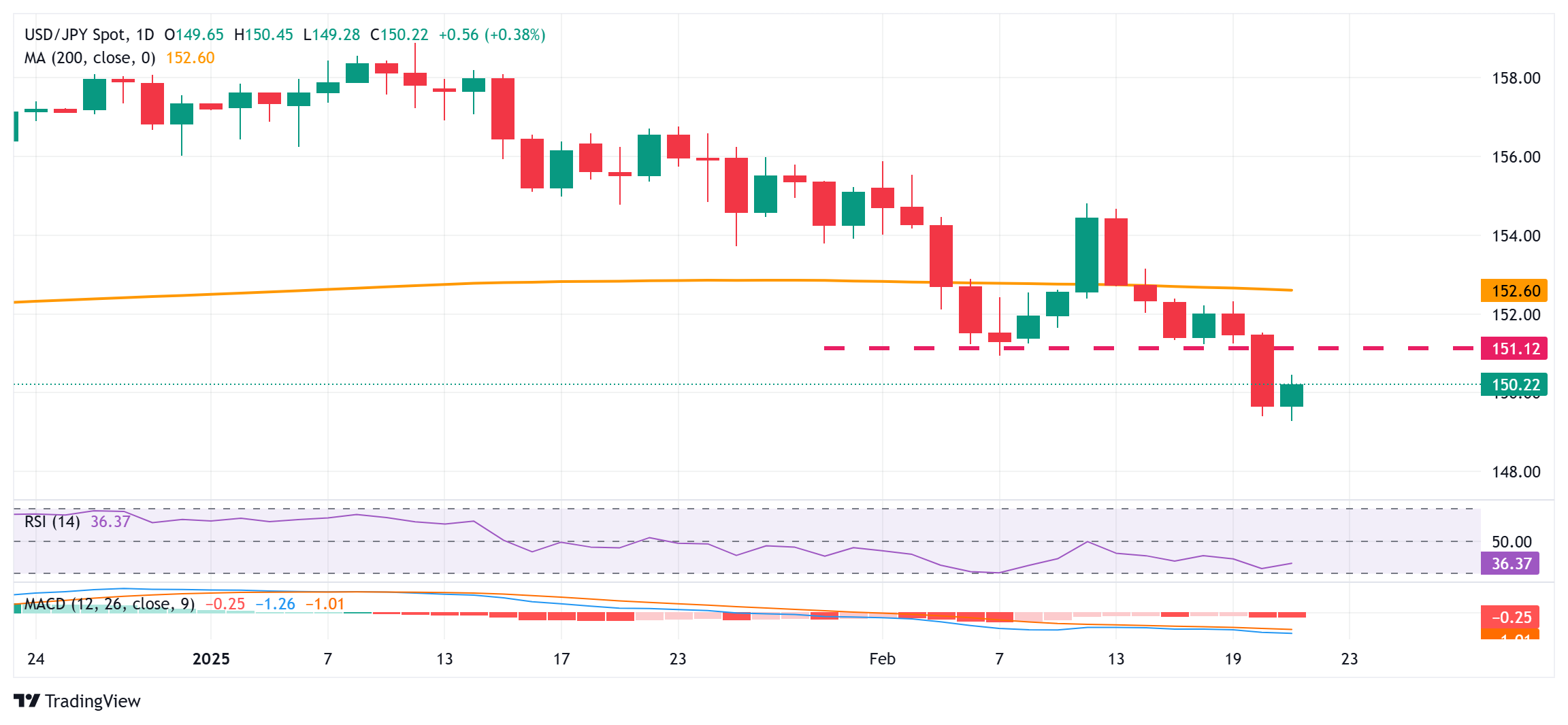
From a technical perspective, the overnight breakdown through the 151.00-150.90 horizontal support and a subsequent fall below the 150.00 psychological mark was seen as a fresh trigger for bearish traders. Moreover, oscillators on the daily chart are holding deep in negative territory and are still away from being in the oversold zone. This, in turn, suggests that the path of least resistance for the USD/JPY pair is to the downside and any further move up could be seen as a selling opportunity near the 151.00 round figure.
Some follow-through buying, however, could trigger a short-covering rally and lift the USD/JPY pair to the 151.40 hurdle en route to the 152.00 round-figure mark. The recovery momentum, however, runs the risk of fizzling out rather quickly near the 152.65 area. The said barrier represents the very important 200-day Simple Moving Average (SMA), which if cleared decisively might shift the near-term bias in favor of bullish traders.
On the flip side, the 150.00 mark now seems to act as an immediate support ahead of the 149.30-149.25 region, or a multi-month low touched during the Asian session. This is closely followed by the 149.00 mark, below which the USD/JPY pair could slide further towards testing the December 2024 swing low, around the 148.65 region.
Japanese Yen PRICE Today
The table below shows the percentage change of Japanese Yen (JPY) against listed major currencies today. Japanese Yen was the strongest against the Australian Dollar.
| USD | EUR | GBP | JPY | CAD | AUD | NZD | CHF | |
|---|---|---|---|---|---|---|---|---|
| USD | 0.10% | -0.02% | 0.57% | 0.05% | 0.24% | 0.11% | 0.13% | |
| EUR | -0.10% | -0.12% | 0.49% | -0.04% | 0.15% | 0.02% | 0.03% | |
| GBP | 0.02% | 0.12% | 0.61% | 0.07% | 0.26% | 0.14% | 0.15% | |
| JPY | -0.57% | -0.49% | -0.61% | -0.51% | -0.34% | -0.47% | -0.46% | |
| CAD | -0.05% | 0.04% | -0.07% | 0.51% | 0.18% | 0.06% | 0.07% | |
| AUD | -0.24% | -0.15% | -0.26% | 0.34% | -0.18% | -0.12% | -0.12% | |
| NZD | -0.11% | -0.02% | -0.14% | 0.47% | -0.06% | 0.12% | 0.00% | |
| CHF | -0.13% | -0.03% | -0.15% | 0.46% | -0.07% | 0.12% | -0.01% |
The heat map shows percentage changes of major currencies against each other. The base currency is picked from the left column, while the quote currency is picked from the top row. For example, if you pick the Japanese Yen from the left column and move along the horizontal line to the US Dollar, the percentage change displayed in the box will represent JPY (base)/USD (quote).
Author

Haresh Menghani
FXStreet
Haresh Menghani is a detail-oriented professional with 10+ years of extensive experience in analysing the global financial markets.

















