Japanese Yen recovers early lost ground, flat lines against a broadly firmer USD
- The Japanese Yen attracts some dip-buyers and reverses the softer Tokyo CPI-led slide.
- The US-Japan trade deal optimism and the BoJ rate hike act as a tailwind for the JPY.
- A modest USD uptick lends support to the USD/JPY pair and limits the downside.

The Japanese Yen (JPY) recovers early lost ground against a broadly stronger US Dollar (USD), though it lacks follow-through buying and trades nearly unchanged for the day heading into the European session on Friday. The Japan-US trade deal seems to have reduced economic uncertainty and keeps the door open for an imminent interest rate hike by the Bank of Japan (BoJ) later this year, which, in turn, acts as a tailwind for the JPY.
Meanwhile, data released earlier this Friday showed that consumer inflation in Japan's capital city, Tokyo. This comes on top of domestic political uncertainty and could complicate the BoJ's policy normalization path, which, along with a positive risk tone, caps the safe-haven JPY. Traders also seem reluctant to place aggressive bets ahead of the BoJ meeting next week. Apart from this, a modest US Dollar (USD) uptick lends support to the USD/JPY pair.
Japanese Yen traders seem non-committed amid mixed BoJ rate hike cues
- The Statistics Bureau of Japan reported this Friday that the headline Tokyo Consumer Price Index (CPI) rose 2.9% YoY in July as compared to 3.1% in the prior month. Adding to this, a core gauge, which excludes volatile Fresh Food prices, grew 2.9% against expectations of 3.0%, and the 3.1% in June.
- Meanwhile, core CPI that excludes both Fresh Food and Energy prices, and is closely watched by the Bank of Japan as a gauge of domestic demand-driven inflation, eased to the 2.9% YoY rate in July from 3.1% in the previous month. The data provides evidence that inflation in Japan is cooling.
- Furthermore, rising political risks, following the ruling coalition's bruising defeat in the upper house election, might keep the Bank of Japan on the sidelines. This suggests that prospects for rate hikes could be delayed for a little bit longer and undermines the Japanese Yen for the second straight day.
- The US Dollar, on the other hand, builds on the overnight bounce from a multi-week low and turns out to be another factor that pushes the USD/JPY pair closer to mid-147.00s during the Asian session. However, the uncertainty over the Federal Reserve's rate-cut path could cap gains for the Greenback.
- Data released on Thursday showed that US Initial Jobless Claims fell from 221K in the previous week to 217,000 for the week ending July 19, below the 227,000 expected and the lowest level since mid-April. However, Continuing Claims held steady at 1.96 million — near the highest levels since 2021.
- Moreover, a first look at S&P Global's PMI showed that business activity in the manufacturing sector lost momentum, while demand in the services sector picked up in July. That said, a gauge measuring the overall business activity – Composite PMI – increased to 54.6 from the previous month’s 52.9.
- Nevertheless, the resilient US labor market reinforced the view that the Federal Reserve will hold interest rates next week. US President Donald Trump, however, continued to dial up the pressure on Jerome Powell and expressed his desire for lower interest rates during a rare visit to the Fed.
- Meanwhile, Japan's trade deal with the US, announced earlier this week, has reduced economic uncertainty and raised the possibility that the BoJ will resume its tightening cycle later this year. This, in turn, could act as a tailwind for the JPY and keep a lid on any further gains for the USD/JPY pair.
- Friday's US economic docket highlights the release of Durable Goods Orders later during the North American session, which could influence the USD price dynamics. Apart from this, the broader risk sentiment would drive demand for the safe-haven JPY and produce short-term opportunities.
USD/JPY bulls seem to have upper hand while above 100-day SMA pivotal support
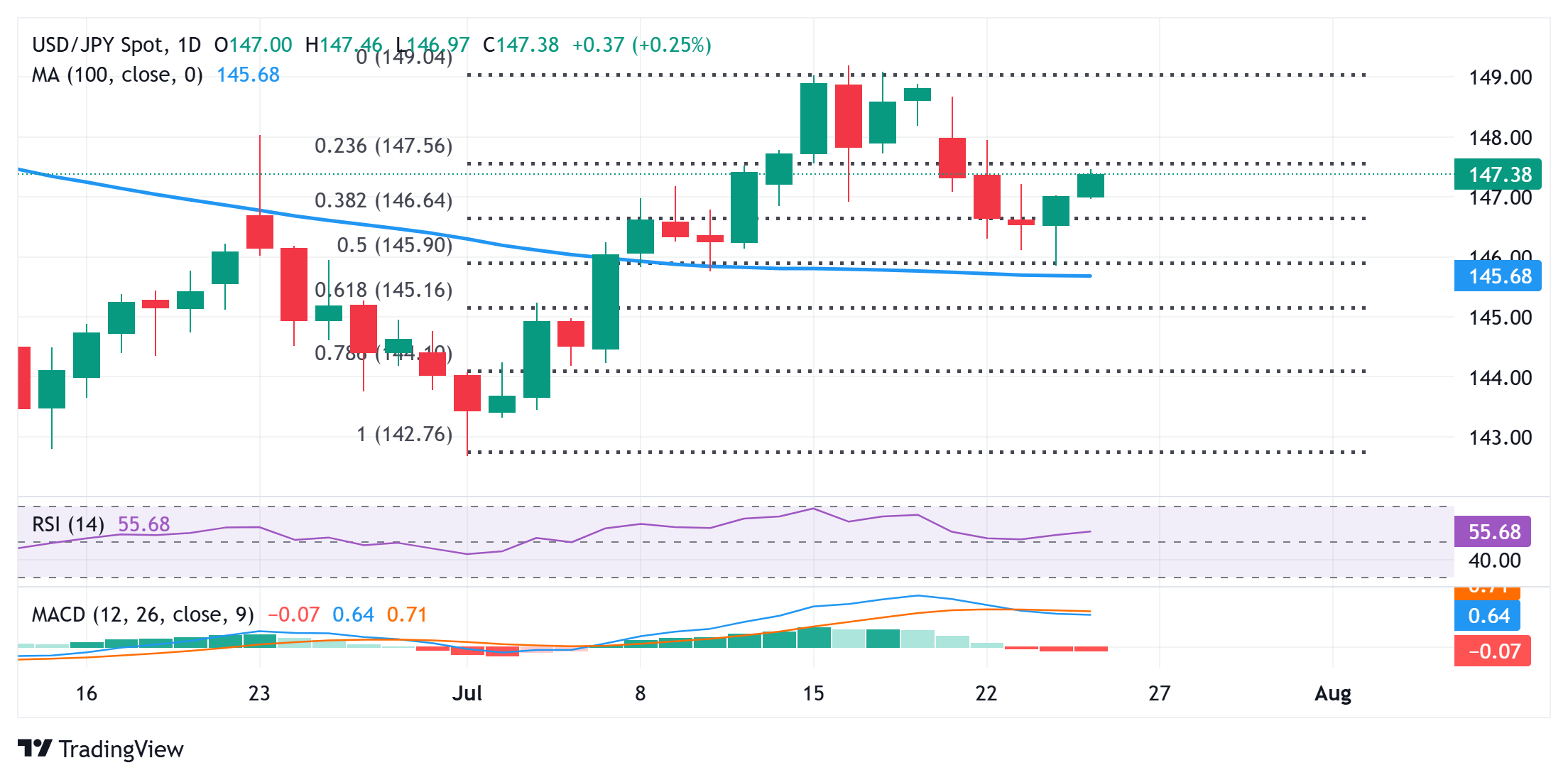
From a technical perspective, the USD/JPY pair on Thursday bounced off the 145.85 confluence – comprising the 100-day Simple Moving Average (SMA) and the 50% retracement level of the monthly upswing. The subsequent move up, along with positive oscillators on the daily chart, backs the case for a further appreciating move. Some follow-through buying beyond the 147.60 area will reaffirm the positive outlook and allow spot prices to reclaim the 148.00 round figure. The momentum could extend further towards the weekly top, around the 148.65 region, above which the currency pair could make a fresh attempt to conquer the 149.00 mark.
On the flip side, the 147.00 round figure now seems to protect the immediate downside ahead of the 146.70-146.65 region, or the 38.2% Fibonacci retracement level. This is closely followed by the 100-day SMA, around the 146.55 area, below which the USD/JPY pair could slide to retest sub-146.00 levels. Some follow-through selling below the 145.75 area (July 10 low) might then drag spot prices to the 145.20-145.15 region, or the 61.8% Fibo. retracement level, en route to the 145.00 psychological mark.
Tariffs FAQs
Tariffs are customs duties levied on certain merchandise imports or a category of products. Tariffs are designed to help local producers and manufacturers be more competitive in the market by providing a price advantage over similar goods that can be imported. Tariffs are widely used as tools of protectionism, along with trade barriers and import quotas.
Although tariffs and taxes both generate government revenue to fund public goods and services, they have several distinctions. Tariffs are prepaid at the port of entry, while taxes are paid at the time of purchase. Taxes are imposed on individual taxpayers and businesses, while tariffs are paid by importers.
There are two schools of thought among economists regarding the usage of tariffs. While some argue that tariffs are necessary to protect domestic industries and address trade imbalances, others see them as a harmful tool that could potentially drive prices higher over the long term and lead to a damaging trade war by encouraging tit-for-tat tariffs.
During the run-up to the presidential election in November 2024, Donald Trump made it clear that he intends to use tariffs to support the US economy and American producers. In 2024, Mexico, China and Canada accounted for 42% of total US imports. In this period, Mexico stood out as the top exporter with $466.6 billion, according to the US Census Bureau. Hence, Trump wants to focus on these three nations when imposing tariffs. He also plans to use the revenue generated through tariffs to lower personal income taxes.
Author

Haresh Menghani
FXStreet
Haresh Menghani is a detail-oriented professional with 10+ years of extensive experience in analysing the global financial markets.

















