Japanese Yen adds to intraday losses; USD/JPY climbs to 148.80 amid broad-based USD strength
- The Japanese Yen meets with a fresh supply in reaction to disappointing Trade Balance data.
- Reduced bets for an immediate BoJ rate hike and a positive risk tone further weigh on the JPY.
- Renewed USD buying further supports the USD/JPY pair and contributes to the move higher.

The Japanese Yen (JPY) selling remains unabated through the early European session on Thursday, which, along with a goodish pickup in the US Dollar (USD) demand, lifts the USD/JPY pair to the 148.80 region in the last hour. Data released earlier today showed that Japan clocked a smaller-than-expected trade surplus in June. This comes amid persistent headwinds from US trade tariffs, slowing economic growth in Japan, declining real wages, and signs of cooling inflation. Adding to this, domestic political uncertainty could complicate the Bank of Japan's (BoJ) policy normalization path, which, in turn, is seen undermining the JPY.
Meanwhile, most Asian equity markets tracked the overnight positive turnaround on Wall Street that followed US President Donald Trump's denial of reports that he was close to firing Federal Reserve (Fed) Chairman Jerome Powell. This turns out to be another factor driving flows away from traditional safe-haven assets, including the JPY. The USD, on the other hand, moves back closer to its highest level since June 23 amid the growing conviction that the Fed would delay cutting interest rates. This further contributes to the USD/JPY pair's intraday move higher and backs the case for a further near-term appreciating move.
Japanese Yen continues to lose ground amid growing acceptance that BoJ will not hike rates
- Government data released earlier this Thursday showed that Japan's trade surplus stood at ¥153.1 billion in June, marking a notable improvement from the ¥638.6 billion deficit seen in the prior month. The reading, however, fell short of expectations for a surplus of ¥353.9 billion as exports fell for the second straight month.
- Japan's exports declined 0.5% YoY amid sluggish overseas demand, especially in the top market, China, reflecting the sustained impact of US tariffs. Imports, however, improved substantially following a 7.7% fall in May and grew 0.2% YoY vs. expectations for a 1.6% drop, indicating signs of recovery in domestic demand.
- Meanwhile, recent polls indicate that Japan’s ruling coalition – the Liberal Democratic Party (LDP) and Komeito – might lose its majority in the Upper House election on July 20. The outcome could further heighten both fiscal and political risks in Japan and also complicate trade negotiations amid the looming US trade tariffs.
- In fact, US President Donald Trump issued tariff notices to over 20 trading partners, including Japan, which faces a 25% tariff on all exports to America amid stalled US-Japan trade talks. This comes on top of declining real wages and signs of cooling inflation in Japan, which warrants the Bank of Japan's caution in the near term.
- Investors now seem convinced that the BoJ will forgo raising interest rates this year. Furthermore, traders have been scaling back their expectations for an immediate interest rate cut by the Federal Reserve amid signs that the Trump administration's increasing import taxes are passing through to consumer prices.
- New York Fed President John Williams warned on Wednesday that the impact of trade tariffs is only just starting to hit the economy. Williams further added that the current modestly restrictive monetary policy is in the right place to allow central bankers to monitor the economy before taking their next steps.
- Separately, Dallas Fed President Lorie Logan said that the US central bank will probably need to leave interest rates for a while longer to ensure inflation stays low. Logan further noted that tariff increases appear likely to create inflationary pressure, and the Fed wants to see low inflation continue to be convinced.
- Trump contradicted media reports that he was planning to oust Fed Chair Jerome Powell and acknowledged that many have said that such a move would disrupt the markets. Trump, however, said that he would love for Powell to resign and unleashed fresh criticism against the Fed chief for keeping rates high.
- Traders now look to the US macro data – monthly Retail Sales figures, the usual Weekly Initial Jobless Claims, and the Philly Fed Manufacturing Index – for some impetus. Furthermore, speeches from influential FOMC members will drive the USD/JPY pair ahead of Japan's National CPI report on Friday.
USD/JPY seems poised to surpass 149.00 and retest multi-month peak touched on Wednesday
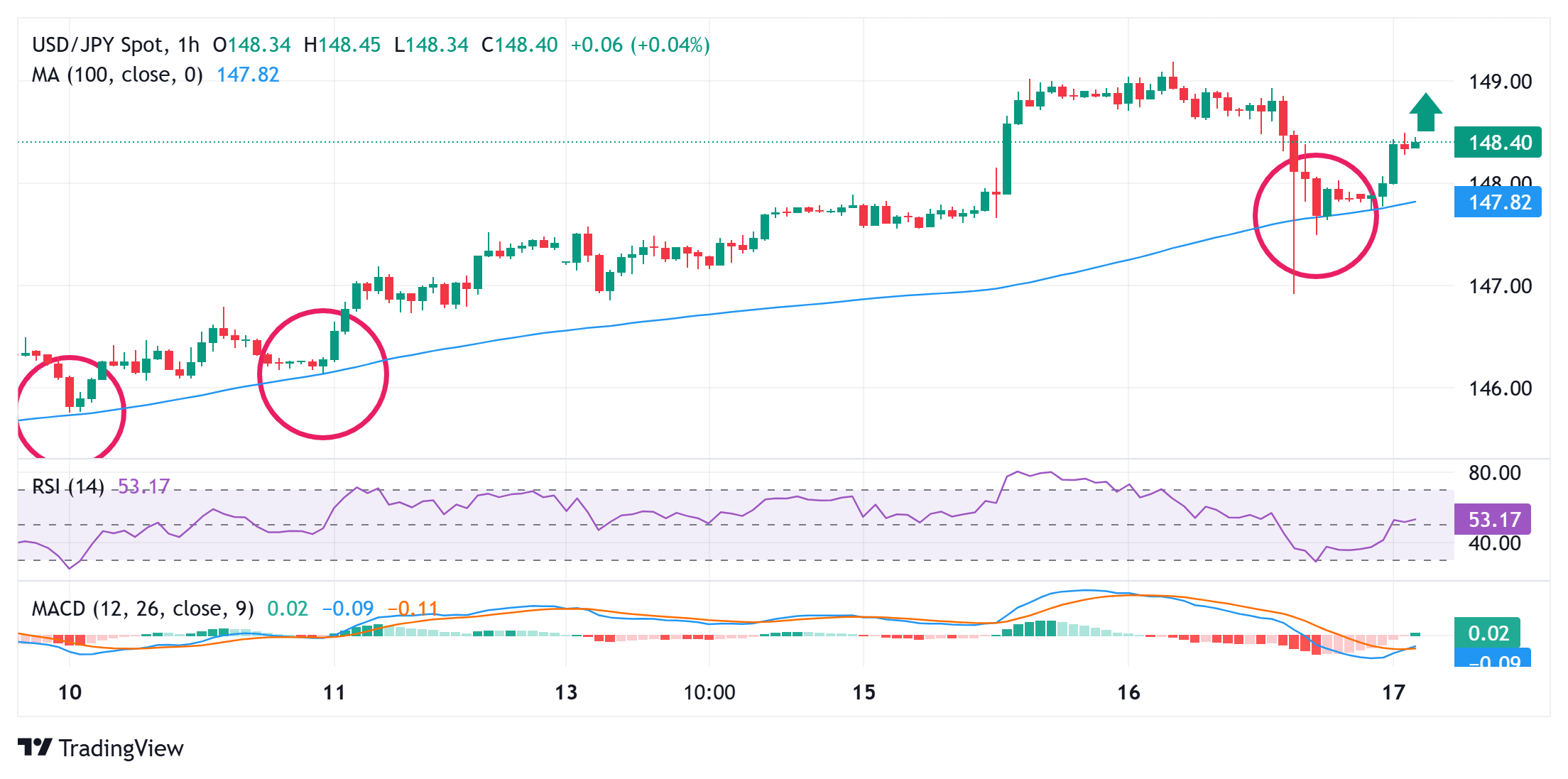
From a technical perspective, the USD/JPY pair showed some resilience below the 100-hour Simple Moving Average (SMA) on Wednesday, and the subsequent move up favors bullish traders. Moreover, oscillators are holding comfortably in positive territory and are still away from being in the overbought zone, suggesting that the path of least resistance for spot prices is to the upside. Hence, some follow-through strength back towards the 149.00 mark, en route to the overnight swing high near the 149.15-149.20 region, looks like a distinct possibility. The upward trajectory could extend further towards reclaiming the 150.00 psychological mark for the first time since late March.
On the flip side, the 148.00 round figure now seems to protect the immediate downside ahead of the Asian session low, around the 147.70 region. The latter nears the 100-hour SMA, below which the USD/JPY pair could retest sub-147.00 levels. Some follow-through selling might shift the bias in favor of bearish trades and drag spot prices to the 146.60 intermediate support en route to the 146.20 area, the 146.00 mark, and the 100-day SMA support, currently pegged near the 145.80 region.
Fed FAQs
Monetary policy in the US is shaped by the Federal Reserve (Fed). The Fed has two mandates: to achieve price stability and foster full employment. Its primary tool to achieve these goals is by adjusting interest rates. When prices are rising too quickly and inflation is above the Fed’s 2% target, it raises interest rates, increasing borrowing costs throughout the economy. This results in a stronger US Dollar (USD) as it makes the US a more attractive place for international investors to park their money. When inflation falls below 2% or the Unemployment Rate is too high, the Fed may lower interest rates to encourage borrowing, which weighs on the Greenback.
The Federal Reserve (Fed) holds eight policy meetings a year, where the Federal Open Market Committee (FOMC) assesses economic conditions and makes monetary policy decisions. The FOMC is attended by twelve Fed officials – the seven members of the Board of Governors, the president of the Federal Reserve Bank of New York, and four of the remaining eleven regional Reserve Bank presidents, who serve one-year terms on a rotating basis.
In extreme situations, the Federal Reserve may resort to a policy named Quantitative Easing (QE). QE is the process by which the Fed substantially increases the flow of credit in a stuck financial system. It is a non-standard policy measure used during crises or when inflation is extremely low. It was the Fed’s weapon of choice during the Great Financial Crisis in 2008. It involves the Fed printing more Dollars and using them to buy high grade bonds from financial institutions. QE usually weakens the US Dollar.
Quantitative tightening (QT) is the reverse process of QE, whereby the Federal Reserve stops buying bonds from financial institutions and does not reinvest the principal from the bonds it holds maturing, to purchase new bonds. It is usually positive for the value of the US Dollar.
Author

Haresh Menghani
FXStreet
Haresh Menghani is a detail-oriented professional with 10+ years of extensive experience in analysing the global financial markets.