Japanese Yen surrenders a major part of intraday gains as BoJ Ueda's presser gets underway
- The Japanese Yen attracts some buyers amid the BoJ's hawkish on-hold interest rate decision.
- BoJ Governor Kazuo Ueda's remarks reaffirm rate hike bets and further underpin the JPY.
- The USD preserves the post-FOMC recovery gains and offers support to the USD/JPY pair.

The Japanese Yen (JPY) trims a part of its strong intraday gains as the Bank of Japan (BoJ) Governor Kazuo Ueda's post-meeting press conference gets underway. Speaking to reporters, Ueda reiterated that the central bank will continue to raise the policy rate if the economy and prices move in line with forecasts. This follows BoJ's decision earlier this Friday to keep rates unchanged for the fifth straight meeting, albeit with hawkish dissents.
The supportive backdrop, to a larger extent, offsets domestic political uncertainty, and data showing that Japan's core consumer prices rose at the slowest pace in nine months during August. This, in turn, assists the JPY to stick to its positive bias heading into the European session. The US Dollar (USD), on the other hand, looks to build on the post-FOMC recovery from its lowest level since February 2022 and acts as a tailwind for the USD/JPY pair.
Japanese Yen bulls seem non-committed despite BoJ's hawkish outlook
- The Bank of Japan decided to leave the short-term interest rate target unchanged in the range of 0.4%- 0.5% after concluding its two-day monetary policy review meeting this Friday. There were two dissents to the on-hold decision, both wanting a rate hike, which, in turn, provides a modest lift to the Japanese Yen (JPY) during the Asian session.
- In the post-meeting press conference, BoJ Governor Kazuo Ueda noted that economic growth likely to moderate as trade policies lead to slowdown in overseas economies and added that easy monetary conditions will support the economy. Ueda, however, showed readiness to hike interest rates further if economy and prices move in line with forecasts.
- The yield on the 2-year and the 5-year Japanese government bonds (JGB) shot to their highest level since 2008. The resultant narrowing of the yield differential between Japan and other major economies further underpins the lower-yielding JPY.
- Earlier the Ministry of Internal Affairs and Communications reported this Friday that Japan's consumer prices excluding fresh food rose 2.7% in the year to August. This marks a notable deceleration from a 3.1% increase recorded the previous month and the slowest pace since November 2024.
- Further details of the report revealed that the core Consumer Price Index (CPI), which excludes fresh food, slowed from a 3.1% year-on-year rise seen in July to 2.7%. Moreover, a gauge stripping away both volatile and fresh food and fuel costs rose 3.3% compared to a 3.4% increase in July.
- This comes on top of domestic political uncertainty and economic headwinds stemming from US tariffs, which tempers market expectations for an immediate BoJ rate hike move.
- Investors, however, are still pricing in the possibility of a 25-basis-point BoJ rate hike in October amid signs of economic resilience. Hence, the focus will be on the accompanying policy statement and BoJ Governor Kazuo Ueda’s forward guidance at the post-meeting press conference.
- A hawkish assessment of Federal Reserve Chair Jerome Powell's comments on Wednesday assists the US Dollar to preserve its strong recovery gains registered over the past two days, from the lowest level since February 2022. This, in turn, keeps the USD/JPY pair close to the weekly high.
- Powell told reporters that risks to inflation are tilted to the upside and the move to lower interest rates was a risk management cut. Powell added that he doesn't feel the need to move quickly on rates and that the Fed is in a meeting-by-meeting situation regarding the outlook for interest rates.
- Nevertheless, the US central bank is still expected to deliver two more rate cuts in 2025. This marks a significant divergence in comparison to relatively hawkish BoJ expectations, which could support the lower-yielding JPY and keep a lid on any further appreciation for the USD/JPY pair.
USD/JPY might struggle to build on the momentum beyond the 148.00 round figure
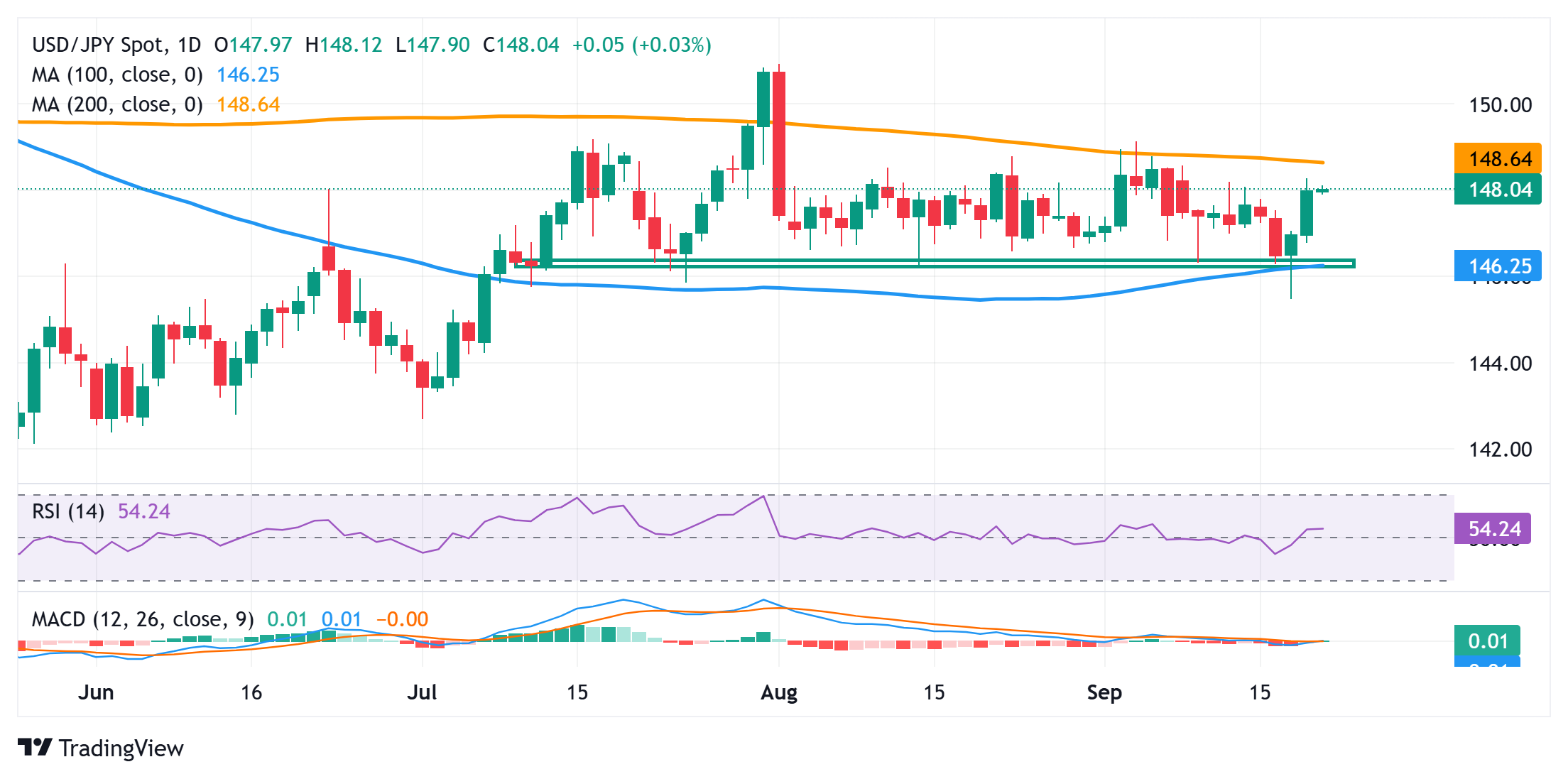
The overnight move beyond the 147.50-147.60 horizontal resistance and the 148.00 mark favors the USD/JPY bulls. Moreover, oscillators on the daily chart have just started gaining positive traction and back the case for additional gains. Any subsequent move up, however, is likely to confront stiff resistance near the 200-day Simple Moving Average (SMA), currently pegged near the 148.55-148.60 region. A sustained strength beyond might then allow spot prices to reclaim the 149.00 round figure and test the monthly swing high, around the 149.20 zone.
On the flip side, the 147.60-147.50 area now seems to protect the immediate downside, below which the USD/JPY pair could accelerate the slide towards the 147.00 mark. A convincing break below the latter would expose the 146.20 horizontal support before spot prices extend the downward trajectory towards the 145.50-145.45 region, or the lowest level since July 7, touched earlier this week.
Japanese Yen Price Today
The table below shows the percentage change of Japanese Yen (JPY) against listed major currencies today. Japanese Yen was the strongest against the New Zealand Dollar.
| USD | EUR | GBP | JPY | CAD | AUD | NZD | CHF | |
|---|---|---|---|---|---|---|---|---|
| USD | 0.15% | 0.31% | -0.06% | 0.12% | 0.28% | 0.46% | 0.31% | |
| EUR | -0.15% | 0.18% | -0.30% | -0.03% | 0.10% | 0.31% | 0.17% | |
| GBP | -0.31% | -0.18% | -0.42% | -0.21% | -0.08% | 0.04% | -0.02% | |
| JPY | 0.06% | 0.30% | 0.42% | 0.19% | 0.49% | 0.61% | 0.25% | |
| CAD | -0.12% | 0.03% | 0.21% | -0.19% | 0.16% | 0.34% | 0.19% | |
| AUD | -0.28% | -0.10% | 0.08% | -0.49% | -0.16% | 0.20% | 0.06% | |
| NZD | -0.46% | -0.31% | -0.04% | -0.61% | -0.34% | -0.20% | -0.14% | |
| CHF | -0.31% | -0.17% | 0.02% | -0.25% | -0.19% | -0.06% | 0.14% |
The heat map shows percentage changes of major currencies against each other. The base currency is picked from the left column, while the quote currency is picked from the top row. For example, if you pick the Japanese Yen from the left column and move along the horizontal line to the US Dollar, the percentage change displayed in the box will represent JPY (base)/USD (quote).
Author

Haresh Menghani
FXStreet
Haresh Menghani is a detail-oriented professional with 10+ years of extensive experience in analysing the global financial markets.

















