Japanese Yen remains stronger due to hawkish BoJ, US PMI eyed
- The Japanese Yen appreciates due to the hawkish sentiment surrounding the BoJ’s policy stance ahead of next week's meeting.
- Japan's Manufacturing PMI fell to 49.2 in July from a 50.0 reading; Services PMI surged to 53.9 from the prior 49.4.
- CME Group’s FedWatch Tool indicates an increase to 93.6% odds of a 25-basis point rate cut in September.

The Japanese Yen (JPY) extends its gains for the third consecutive session on Wednesday, likely due to a return of risk-off flows. The Bank of Japan (BoJ) is anticipated to raise interest rates at next week’s policy meeting, prompting short-sellers to exit their positions and providing support to the JPY.
A senior official in the ruling party, Toshimitsu Motegi urged the Bank of Japan (BoJ) to more clearly communicate its plan to normalize monetary policy through gradual interest rate hikes, according to Reuters. Prime Minister Fumio Kishida added that normalizing the central bank’s monetary policy would support Japan's transition to a growth-driven economy.
The US Dollar (USD) faces challenges due to rising bets on a Federal Reserve (Fed) rate cut in September, which put pressure on the USD/JPY pair. According to CME Group’s FedWatch Tool, markets now indicate a 93.6% probability of a 25-basis point rate cut at the September Fed meeting, up from 88.5% a day earlier.
Traders await the data release of the US Purchasing Managers Index (PMI) data on Wednesday and the Gross Domestic Product (GDP) Annualized (Q2) figures on Thursday. These figures are expected to provide new insights into the economic conditions of the United States.
Daily Digest Market Movers: Japanese Yen improves due to the return of the risk-off flows
- The Jibun Bank Japan Manufacturing PMI unexpectedly fell to 49.2 in July from 50.0 in the previous month, missing market forecasts of 50.5 and indicating the first decline in factory activity since April, according to preliminary estimates. In contrast, the Services PMI surged to 53.9 in July from a final reading of 49.4 in the prior month. This marks the sixth increase in the service sector this year and the steepest pace since April.
- Media reports say that Vice President Kamala Harris has just passed 1,976 Democratic delegates to secure the party's presidential nomination. Harris is now the Democratic Party’s Presumptive Nominee for November’s Presidential Election.
- Federal Reserve Bank of New York President John Williams stated on Friday that the long-term trends that caused declines in neutral interest rates before the pandemic continue to prevail. Williams noted, "My own Holston-Laubach-Williams estimates for r-star in the United States, Canada, and the Euro area are about the same level as they were before the pandemic," according to Bloomberg.
- Japan's National Consumer Price Index (CPI) for June held steady at 2.8%, matching the previous month's figure and remaining at the highest level since February. Meanwhile, Core CPI inflation rose to 2.6%, slightly above the previous reading of 2.5% but just below the consensus estimate of 2.7%.
- JP Morgan has anticipated no rate hike from the Bank of Japan (BoJ) in July or at any point in 2024. A July rate increase is not their base case, and they do not expect any hikes for the remainder of 2024. They believe it is too early to adopt a bullish stance on the Yen.
- Kazushige Kamiyama, a senior Bank of Japan (BoJ) official and the central bank’s Osaka branch manager, said on Thursday that the BoJ wants to maintain an accommodative monetary environment as much as possible, per Jiji News Agency.
- Last week, BoJ data suggested that authorities may have intervened by purchasing nearly ¥6 trillion on July 11-12. Additionally, data revealed that Japan sold approximately $22 billion in US Treasuries in May to raise dollars, bolstering its reserves for potential foreign exchange market operations, according to Reuters.
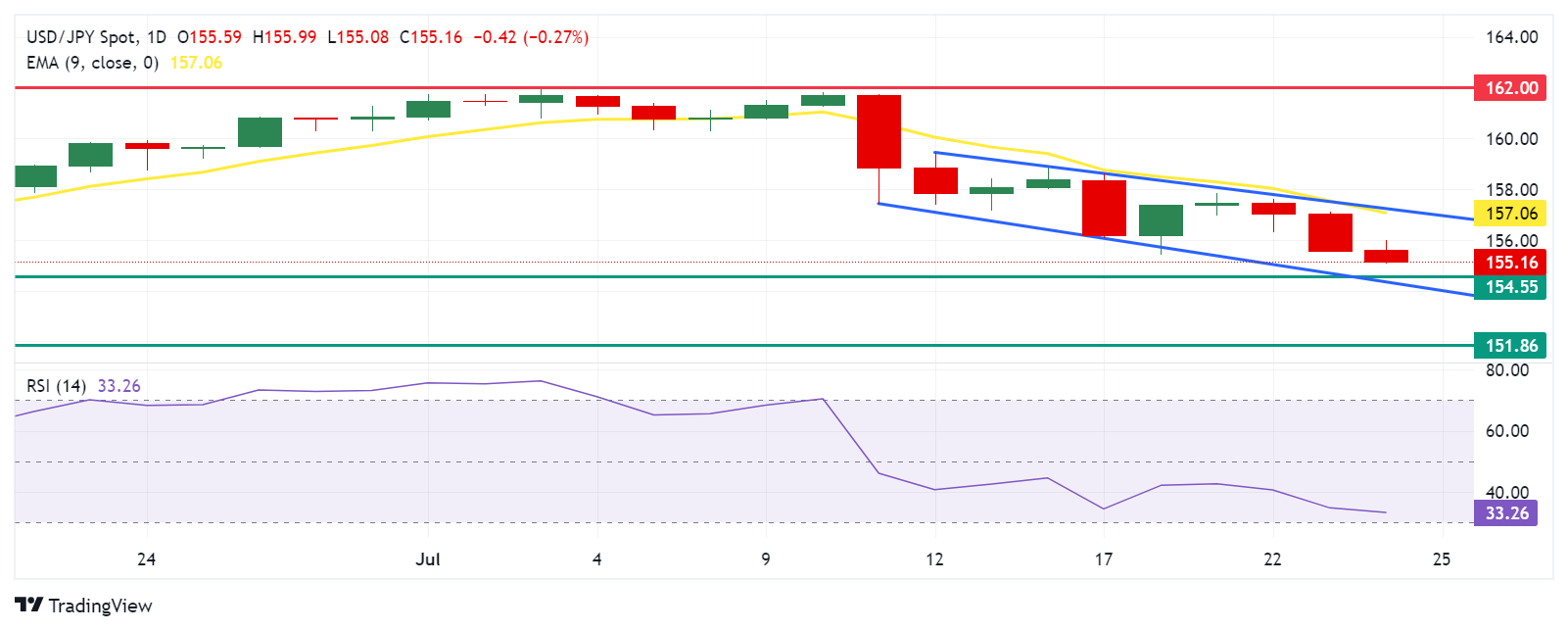
Technical Analysis: USD/JPY falls toward 155.00
USD/JPY trades around 155.20 on Wednesday. The daily chart analysis shows that the USD/JPY pair is within an ascending channel, indicating a dovish bias. Additionally, the 14-day Relative Strength Index (RSI) is below 50, reinforcing a bearish outlook. If the RSI breaks below the 30 level, it could indicate an oversold situation and a potential short-term rebound.
The USD/JPY pair may find significant support near June's low of 154.55, followed by the lower boundary of the ascending channel. A decline below this level could lead to a further drop toward May's low of 151.86.
On the upside, immediate resistance is at the nine-day EMA of 157.07, which aligns with the upper boundary of the ascending channel. A breakout above this level could push the USD/JPY pair toward the pullback resistance around the psychological level of 162.00.
USD/JPY: Daily Chart
Japanese Yen PRICE Today
The table below shows the percentage change of Japanese Yen (JPY) against listed major currencies today. Japanese Yen was the strongest against the New Zealand Dollar.
| USD | EUR | GBP | JPY | CAD | AUD | NZD | CHF | |
|---|---|---|---|---|---|---|---|---|
| USD | 0.08% | 0.11% | -0.65% | 0.07% | 0.24% | 0.46% | -0.08% | |
| EUR | -0.08% | 0.03% | -0.75% | -0.01% | 0.17% | 0.37% | -0.16% | |
| GBP | -0.11% | -0.03% | -0.76% | -0.04% | 0.14% | 0.34% | -0.21% | |
| JPY | 0.65% | 0.75% | 0.76% | 0.73% | 0.89% | 1.08% | 0.55% | |
| CAD | -0.07% | 0.01% | 0.04% | -0.73% | 0.17% | 0.39% | -0.17% | |
| AUD | -0.24% | -0.17% | -0.14% | -0.89% | -0.17% | 0.20% | -0.34% | |
| NZD | -0.46% | -0.37% | -0.34% | -1.08% | -0.39% | -0.20% | -0.54% | |
| CHF | 0.08% | 0.16% | 0.21% | -0.55% | 0.17% | 0.34% | 0.54% |
The heat map shows percentage changes of major currencies against each other. The base currency is picked from the left column, while the quote currency is picked from the top row. For example, if you pick the Japanese Yen from the left column and move along the horizontal line to the US Dollar, the percentage change displayed in the box will represent JPY (base)/USD (quote).
Japanese Yen FAQs
The Japanese Yen (JPY) is one of the world’s most traded currencies. Its value is broadly determined by the performance of the Japanese economy, but more specifically by the Bank of Japan’s policy, the differential between Japanese and US bond yields, or risk sentiment among traders, among other factors.
One of the Bank of Japan’s mandates is currency control, so its moves are key for the Yen. The BoJ has directly intervened in currency markets sometimes, generally to lower the value of the Yen, although it refrains from doing it often due to political concerns of its main trading partners. The current BoJ ultra-loose monetary policy, based on massive stimulus to the economy, has caused the Yen to depreciate against its main currency peers. This process has exacerbated more recently due to an increasing policy divergence between the Bank of Japan and other main central banks, which have opted to increase interest rates sharply to fight decades-high levels of inflation.
The BoJ’s stance of sticking to ultra-loose monetary policy has led to a widening policy divergence with other central banks, particularly with the US Federal Reserve. This supports a widening of the differential between the 10-year US and Japanese bonds, which favors the US Dollar against the Japanese Yen.
The Japanese Yen is often seen as a safe-haven investment. This means that in times of market stress, investors are more likely to put their money in the Japanese currency due to its supposed reliability and stability. Turbulent times are likely to strengthen the Yen’s value against other currencies seen as more risky to invest in.
Author

Akhtar Faruqui
FXStreet
Akhtar Faruqui is a Forex Analyst based in New Delhi, India. With a keen eye for market trends and a passion for dissecting complex financial dynamics, he is dedicated to delivering accurate and insightful Forex news and analysis.

















