Japanese Yen depreciates as US Dollar holds ground, ADP Employment Change awaited
- The Japanese Yen loses ground as the BoJ’s Summary of Opinions signals its intention to maintain an accommodative monetary stance.
- Japan's Economy Minister Akazawa said that PM Ishiba anticipates the BoJ to conduct economic evaluations before further rate hikes.
- The US Dollar receives support as traders adopt caution amid rising geopolitical tensions in the Middle East.

The Japanese Yen (JPY) edges lower against the US Dollar (USD) on Wednesday as rising doubts over further interest rate hikes by the Bank of Japan (BoJ). On Tuesday, BoJ’s Summary of Opinions from September’s Monetary Policy Meeting indicates no immediate plans for additional rate hikes. The central bank intends to maintain its accommodative stance but remains open to adjustments if economic conditions show significant improvement.
Japan's Economic Revitalization Minister Ryosei Akazawa stated on Wednesday that Prime Minister Shigeru Ishiba anticipates the Bank of Japan will conduct thorough economic evaluations before raising interest rates again. In his first news conference as the economy minister, Akazawa emphasized, "Our top priority is to ensure that Japan fully exits deflation," adding that "it will take some time to achieve a complete exit," according to Reuters.
The US Dollar receives support from the cautious mood in the market amid the escalating tension in the Middle East. However, the weaker-than-expected ISM Manufacturing PMI for September might have put downward pressure on the Greenback. Traders will now focus on the upcoming US ADP Employment Change and Fedspeak for further direction.
Daily Digest Market Movers: Japanese Yen depreciates due to waning odds of BoJ’s rate hikes
- The CME FedWatch Tool indicates that markets are assigning a 63.1% probability to a 25 basis point rate cut by the Federal Reserve in November, while the likelihood of a 50-basis-point cut is 36.9%, down from 58.2% a week ago.
- Iran launched over 200 ballistic missiles at Israel, prompting Prime Minister Benjamin Netanyahu to vow retaliation against Tehran for the Tuesday attack. In response, Iran warned that any counterstrike would lead to "vast destruction," heightening concerns of a broader conflict.
- US ISM Manufacturing PMI came at 47.2 for September, matching the reading with August's print but came in below the market expectation of 47.5.
- Japan’s Tankan Large Manufacturing Index showed that overall business conditions for large manufacturing companies remained steady at 13 points in the third quarter, in line with expectations. Additionally, Japan's Unemployment Rate fell to 2.5% in August, down from 2.7% in July, which was better than market forecasts of 2.6%, data showed on Tuesday.
- Federal Reserve (Fed) Chairman Jerome Powell said on Monday the central bank is not in a hurry and will lower its benchmark rate ‘over time.’ Fed Chair Powell added that the recent 50 basis point interest rate cut should not be seen as an indication of similarly aggressive future actions, noting that upcoming rate changes are likely to be more modest.
- Japan's newly elected Prime Minister Shigeru Ishiba stated that the country's monetary policy should continue to be accommodative, indicating the necessity of maintaining low borrowing costs to support a fragile economic recovery. This has put pressure on the Japanese Yen and underpinned the USD/JPY pair.
- St. Louis Federal Reserve President Alberto Musalem stated on Friday, according to the Financial Times, that the Fed should begin cutting interest rates "gradually" following a larger-than-usual half-point reduction at the September meeting. Musalem acknowledged the possibility of the economy weakening more than anticipated, saying, "If that were the case, then a faster pace of rate reductions might be appropriate."
- Last week, the BoJ Monetary Policy Meeting Minutes expressed the members’ consensus on the importance of remaining vigilant regarding the risks of inflation exceeding targets. Several members indicated that raising rates to 0.25% would be suitable as a way to adjust the level of monetary support. A few others suggested that a moderate adjustment to monetary support would also be appropriate.
Technical Analysis: USD/JPY remains above 143.50, nine-day EMA
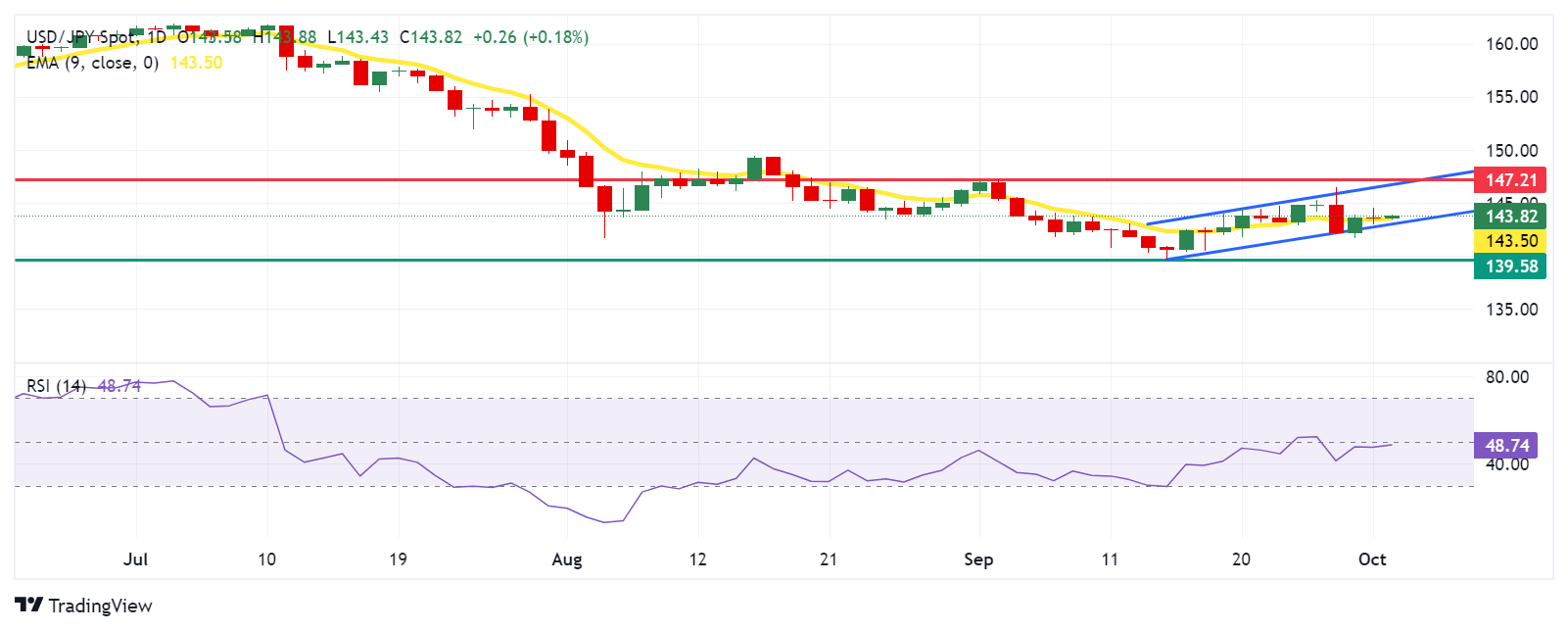
USD/JPY trades around 143.80 on Wednesday. Analysis of the daily chart indicates that the pair consolidates within an ascending channel pattern, suggesting a bullish bias. The 14-day Relative Strength Index (RSI) also hovers slightly below the 50 level. A breakout above this threshold would further confirm the bullish trend's continuation.
The USD/JPY pair may encounter resistance near the upper boundary of the ascending channel at 146.80, followed by the five-week high of 147.21, last reached on September 3.
On the downside, immediate support appears at the nine-day Exponential Moving Average (EMA) around 143.50, followed by the lower boundary of the ascending channel at 143.00. A break below this level could push the USD/JPY pair toward the 139.58 level, marking the lowest since June 2023.
USD/JPY: Daily Chart
Japanese Yen PRICE Today
The table below shows the percentage change of Japanese Yen (JPY) against listed major currencies today. Japanese Yen was the weakest against the Australian Dollar.
| USD | EUR | GBP | JPY | CAD | AUD | NZD | CHF | |
|---|---|---|---|---|---|---|---|---|
| USD | -0.01% | -0.05% | 0.37% | -0.04% | -0.22% | -0.17% | -0.14% | |
| EUR | 0.01% | -0.04% | 0.41% | -0.05% | -0.21% | -0.16% | -0.12% | |
| GBP | 0.05% | 0.04% | 0.40% | -0.02% | -0.18% | -0.15% | -0.08% | |
| JPY | -0.37% | -0.41% | -0.40% | -0.35% | -0.58% | -0.55% | -0.50% | |
| CAD | 0.04% | 0.05% | 0.02% | 0.35% | -0.18% | -0.13% | -0.09% | |
| AUD | 0.22% | 0.21% | 0.18% | 0.58% | 0.18% | 0.04% | 0.09% | |
| NZD | 0.17% | 0.16% | 0.15% | 0.55% | 0.13% | -0.04% | 0.04% | |
| CHF | 0.14% | 0.12% | 0.08% | 0.50% | 0.09% | -0.09% | -0.04% |
The heat map shows percentage changes of major currencies against each other. The base currency is picked from the left column, while the quote currency is picked from the top row. For example, if you pick the Japanese Yen from the left column and move along the horizontal line to the US Dollar, the percentage change displayed in the box will represent JPY (base)/USD (quote).
Economic Indicator
ADP Employment Change
The ADP Employment Change is a gauge of employment in the private sector released by the largest payroll processor in the US, Automatic Data Processing Inc. It measures the change in the number of people privately employed in the US. Generally speaking, a rise in the indicator has positive implications for consumer spending and is stimulative of economic growth. So a high reading is traditionally seen as bullish for the US Dollar (USD), while a low reading is seen as bearish.
Read more.Next release: Wed Oct 02, 2024 12:15
Frequency: Monthly
Consensus: 120K
Previous: 99K
Source: ADP Research Institute
Traders often consider employment figures from ADP, America’s largest payrolls provider, report as the harbinger of the Bureau of Labor Statistics release on Nonfarm Payrolls (usually published two days later), because of the correlation between the two. The overlaying of both series is quite high, but on individual months, the discrepancy can be substantial. Another reason FX traders follow this report is the same as with the NFP – a persistent vigorous growth in employment figures increases inflationary pressures, and with it, the likelihood that the Fed will raise interest rates. Actual figures beating consensus tend to be USD bullish.
Author

Akhtar Faruqui
FXStreet
Akhtar Faruqui is a Forex Analyst based in New Delhi, India. With a keen eye for market trends and a passion for dissecting complex financial dynamics, he is dedicated to delivering accurate and insightful Forex news and analysis.

















