Japanese Yen trims intraday losses against weaker USD amid divergent BoJ-Fed policy bets
- The Japanese Yen drifts lower against the USD for the third successive day on Monday.
- Weaker Japanese PMIs and a positive risk tone seem to weigh on the safe-haven JPY.
- The divergent BoJ-Fed policy expectations could cap any further gains for USD/JPY.


The Japanese Yen (JPY) attracts some sellers on the first day of a new week following the release of Japan's weaker Purchasing Managers' Index (PMI). Furthermore, reports that US President Donald Trump's reciprocal tariffs would be narrower, and less strict than initially feared, boost investors' confidence and turn out to be another factor undermining the safe-haven JPY. That said, the growing acceptance that the Bank of Japan (BoJ) will keep raising interest rates, amid hopes that strong wage growth could filter into broader inflation trends, limits deeper JPY losses.
Meanwhile, hawkish BoJ expectations mark a big divergence in comparison to the Federal Reserve's (Fed) forecast for two 25 basis points rate cuts by the end of this year. This keeps the US Dollar (USD) bulls on the defensive and further lends support to the lower-yielding JPY, which, in turn, caps the USD/JPY pair's intraday move up near the 150.00 psychological mark. Traders now look to the flash US PMIs for some impetus, though the focus will remain on the release of the Tokyo CPI and the US Personal Consumption Expenditure (PCE) Price Index on Friday.
Japanese Yen draws some support from rising BoJ rate hike bets
- According to the preliminary estimates released earlier this Monday, the Au Jibun Bank Japan Manufacturing PMI declined from 49.0 in the previous month to 48.3 in March 2025. This marks the lowest reading since March 2024 and a ninth straight month of contraction.
- Adding to this, the service sector, which had been a bright spot in Japan’s economy, also lost momentum and contracted for the first time in five months. Furthermore, the overall business outlook slipped to the lowest since August 2020, which is seen weighing on the Japanese Yen.
- Reports over the weekend indicated that Trump is planning a narrower, more targeted agenda for the so-called reciprocal tariffs set to take effect on April 2. This fuels hopes for less disruptive Trump tariffs and boosts investors' confidence, further undermining the safe-haven JPY.
- Results from Japan's annual spring labor negotiations revealed that firms agreed to union demands for strong wage growth for the third straight year. Moreover, inflation in Japan remains above the central bank's 2% target and keeps the door open for more rate hikes by the Bank of Japan.
- BoJ Governor Kazuo Ueda, speaking in the Japanese parliament this Monday, reiterated that the central bank will adjust the degree of monetary easing if the 2% inflation target is likely to be achieved. Ueda added that our policy purpose is to achieve stable prices, won't be disturbed by consideration for our finances.
- BoJ Deputy Governor Shinichi Uchida echoed the view and said that the central bank will adjust the degree of monetary easing by raising policy rates if the economic and price outlooks are to be achieved. The BoJ will continue to assess economic and financial market situations at home and abroad, he added.
- Meanwhile, the Federal Reserve gave a bump higher to its inflation projection, though maintained its forecast for two 25 basis points rate cuts by the end of this year. This keeps a lid on last week's US Dollar recovery from a multi-month low and caps the USD/JPY pair's intraday move up to the 150.00 neighborhood.
- Traders now look forward to the release of flash US PMIs, which, along with speeches by influential FOMC members, could provide some impetus. The focus, however, will remain glued be on the release of the Tokyo CPI and the US Personal Consumption Expenditure (PCE) Price Index on Friday.
USD/JPY repeated failures near 150.00 warrant caution for bulls
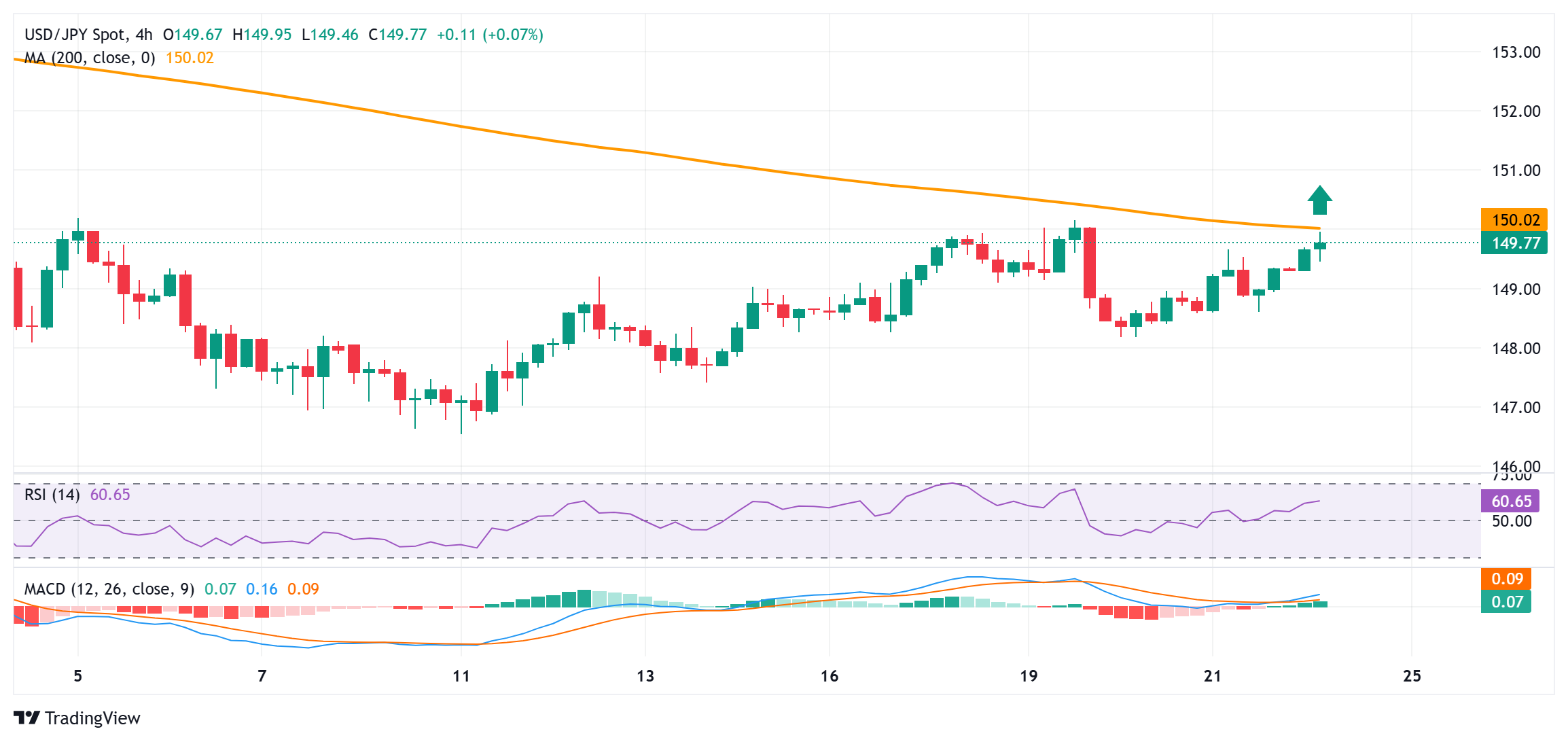
From a technical perspective, the USD/JPY pair needs to break out above the 200-period Simple Moving Average (SMA) on the 4-hour chart – levels just above the 150.00 psychological mark – for bulls to retain short-term control. Given that oscillators on the daily chart have just started gaining positive traction, the subsequent move-up might then lift spot prices to the 151.00 mark en route to the monthly peak, around the 151.30 region.
On the flip side, the Asian session low, around the 149.30 area, might now protect the immediate downside ahead of the 149.00 mark. This is followed by the 148.60-148.55 support, which if broken decisively could make the USD/JPY pair vulnerable to accelerate the fall towards last week's swing low, around the 148.28-148.15 area en route to the 148.00 mark, and the 147.75 horizontal support. Some follow-through selling could pave the way for a slide towards the 147.30 region before spot prices eventually drop to the 147.00 mark and the 146.55-146.50 area, or the lowest level since early October touched earlier this month.
Fed FAQs
Monetary policy in the US is shaped by the Federal Reserve (Fed). The Fed has two mandates: to achieve price stability and foster full employment. Its primary tool to achieve these goals is by adjusting interest rates. When prices are rising too quickly and inflation is above the Fed’s 2% target, it raises interest rates, increasing borrowing costs throughout the economy. This results in a stronger US Dollar (USD) as it makes the US a more attractive place for international investors to park their money. When inflation falls below 2% or the Unemployment Rate is too high, the Fed may lower interest rates to encourage borrowing, which weighs on the Greenback.
The Federal Reserve (Fed) holds eight policy meetings a year, where the Federal Open Market Committee (FOMC) assesses economic conditions and makes monetary policy decisions. The FOMC is attended by twelve Fed officials – the seven members of the Board of Governors, the president of the Federal Reserve Bank of New York, and four of the remaining eleven regional Reserve Bank presidents, who serve one-year terms on a rotating basis.
In extreme situations, the Federal Reserve may resort to a policy named Quantitative Easing (QE). QE is the process by which the Fed substantially increases the flow of credit in a stuck financial system. It is a non-standard policy measure used during crises or when inflation is extremely low. It was the Fed’s weapon of choice during the Great Financial Crisis in 2008. It involves the Fed printing more Dollars and using them to buy high grade bonds from financial institutions. QE usually weakens the US Dollar.
Quantitative tightening (QT) is the reverse process of QE, whereby the Federal Reserve stops buying bonds from financial institutions and does not reinvest the principal from the bonds it holds maturing, to purchase new bonds. It is usually positive for the value of the US Dollar.
Author
Haresh Menghani
FXStreet
Haresh Menghani is a detail-oriented professional with 10+ years of extensive experience in analysing the global financial markets.

















