|

Is the phrase “sell in may and go away” an urban legend?
The phrase “Sell in May and go away” originated in England in 1776, more specifically in London’s financial district. The full version of the saying was “Sell in May and go away, come back on St. Leger’s Day,” referring to the St. Leger’s Day horse race (September 15th). This adage got famous in 1930s. It is based on the historical pattern that stocks tend to underperform from May to October compared to the other half of the year. The pattern was popularized by the Stock Trader’s Almanac.

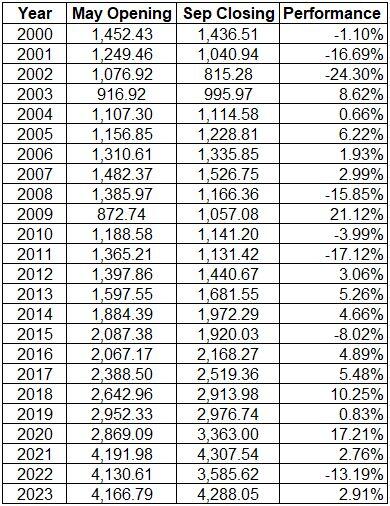
But how reliable is to sell in May each year and return at the end of September to buy? Is the market underperforming in this period of time or are we losing buying opportunities? In this article we are going to reveal if this saying remains or has become an urban legend. We are going to analyze the results of the SP500 in 21st century in the period of time from May opening to September closing.

S&P 500 performance since May to October 
 
fxsoriginal
     

We can see in the table above, the performance from 2000 to 2023 in the period of time where “sell in may” should work. In these 24 years, 8 years the SP500 underperformed and 16 years the market upperformed. Then, 33,33% of the time the market underperformed and 66.67% upperformed. It is pretty clear that the more than 200 year old adage “Sell in May and go away” is just an Urban Legend. Maybe in the past without the current technology worked, but in these times when machines trade and we can set orders in seconds do not work any more.

However, we can see that 7 year cycle is still intact. If you check the years 2001, 2008, 2015 and 2022, all those years the SP500 underperformed from May to October. Therefore, if the cycle of every 7 years is repeated, we can say that “Sell in May and go away” could be applied for 2029.

Author

Elliott Wave Forecast Team

Elliott Wave Forecast Team

ElliottWave-Forecast.com

More from Elliott Wave Forecast Team
Share:

Markets move fast. We move first.

Orange Juice Newsletter brings you expert driven insights - not headlines. Every day on your inbox.

By subscribing you agree to our Terms and conditions.

Editor's Picks

EUR/USD bounces toward 1.1750 as US Dollar loses strength

EUR/USD returned to the 1.1750 price zone in the American session on Friday, despite falling Wall Street, which indicates risk aversion. Trading conditions remain thin following the New Year holiday and ahead of the weekend, with the focus shifting to US employment and European data scheduled for next week.

GBP/USD nears 1.3500, holds within familiar levels

After testing 1.3400 on the last day of 2025, GBP/USD managed to stage a rebound. Nevertheless, the pair finds it difficult to gather momentum and trades with modest intraday gains at around 1.3490 as market participants remain in holiday mood.

Gold trims intraday gains, approaches $4,300

Gold retreated sharply from the $4,400  area and trades flat for the day in the $4,320 price zone. Choppy trading conditions exacerbated the intraday decline, although XAU/USD bearish case is out of the picture, considering growing expectations for a dovish Fed and persistent geopolitical tensions.

Cardano gains early New Year momentum, bulls target falling wedge breakout

Cardano kicks off the New Year on a positive note and is extending gains, trading above $0.36 at the time of writing on Friday. Improving on-chain and derivatives data point to growing bullish interest, while the technical outlook keeps an upside breakout in focus.

Economic outlook 2026-2027 in advanced countries: Solidity test

After a year marked by global economic resilience and ending on a note of optimism, 2026 looks promising and could be a year of solid economic performance. In our baseline scenario, we expect most of the supportive factors at work in 2025 to continue to play a role in 2026.

Crypto market outlook for 2026

Year 2025 was volatile, as crypto often is.  Among positive catalysts were favourable regulatory changes in the U.S., rise of Digital Asset Treasuries (DAT), adoption of AI and tokenization of Real-World-Assets (RWA).













