Indian Rupee falls back against US Dollar as oil prices rebound
- The Indian Rupee hits a roadblock after a four-day rally against the US Dollar.
- US forces launched “self-defense strikes” on Iranian vessels for deploying mines.
- India’s FM Sitharaman assures she will take suggestions regarding higher capital gains taxes.

The Indian Rupee’s (INR) rally against the US Dollar (USD) hits a pause after a four-day winning streak on Tuesday. The USD/INR pair rebounds to near 95.45 as the recovery move in oil prices amid fears that the United States (US)-Iran negotiations could face a setback, following Washington’s attacks on Iranian missile sites, has prompted caution among market participants.
As of writing, the WTI Oil price trades 1.5% higher to near $91.00. Currencies from economies, such as India, which rely heavily on oil imports to meet their energy needs, face pressure if oil prices rise.
US forces confirmed that strikes against Iran were "defensive"
On Monday, the US Central Command said that it conducted strikes in southern Iran, which were aimed at missile launch sites and Iranian vessels aiming to deploy mines, while clarifying that the nature of the strikes was “defensive” and not meant to end the ceasefire with Tehran.
Meanwhile, US President Donald Trump continues to express confidence that negotiations with Iran towards a permanent resolution are going very well. Trump said on Monday that negotiations toward a deal with Iran to end their conflict and reopen the Strait of Hormuz were "proceeding nicely, Bloomberg reported.
In the past few days, the Indian Rupee gained significantly on hopes of an early breakthrough in the US-Iran negotiations, which led to a sharp decline in oil prices.
India's FM Sitharaman assures to look after Capital Gains Tax
Speaking to reporters on the sidelines of the TEXPROCIL Export Awards Event on Monday, India’s Finance Minister (FM) Nirmala Sitharaman said that the centre will take suggestions from investors regarding higher Short-Term Capital Gains (STCG) and Long-Term Capital Gains (LTCG) taxes. "On this specific issue, and on any issue, we are always ready and willing to listen to the people. We will certainly take their inputs,” Sitharaman said, ANI reported.
Market experts believe that higher LTCG and STCG taxes charged by the Indian government in comparison with other nations make India a less attractive investment avenue for foreign investors.
FIIs turned out net buyers on Monday
Foreign Institutional Investors (FIIs) turned out to be net buyers in the Indian stock market on Monday after remaining net sellers in all the last four trading days. However, the amount invested by overseas investors was very low against the average selling seen during the May 19-22 period. On Monday, FIIs bought shares worth Rs. 821.75 crore, significantly lower than the four-day average selling of Rs. 2,596.63 crore.
Technical Analysis: USD/INR recovers after four-day losing streak
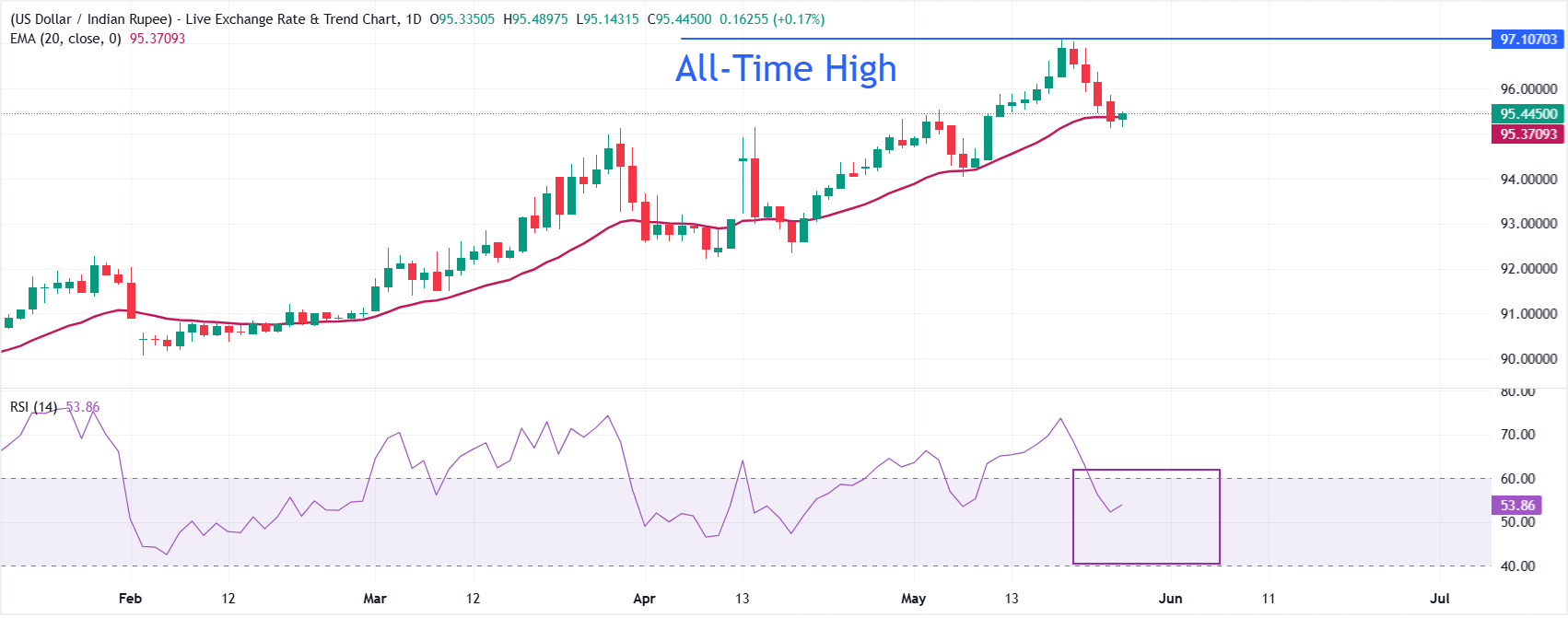
USD/INR trades marginally higher at around 95.45 in India's late trading hours on Tuesday. The near-term tone of the pair is uncertain as it wobbles around the 20-day exponential moving average (EMA), which is at 95.37.
The Relative Strength Index (RSI) cools down to 54 after failing to hold overbought levels, indicating the conclusion of the positive momentum; however, the bullish bias remains intact.
Looking down, the pair could slide to 95.00 if it fails to hold the 20-day EMA. As long as USD/INR trades above this moving average, dips are likely to find buyers, keeping the near-term bias tilted to the upside. On the upside, the pair would attempt to return to the all-time high around 97.00 if it manages to recover above the May 22 high at 96.37.
(The technical analysis of this story was written with the help of an AI tool.)
Author

Sagar Dua
FXStreet
Sagar Dua is associated with the financial markets from his college days. Along with pursuing post-graduation in Commerce in 2014, he started his markets training with chart analysis.