Indian Rupee struggles for comeback amid continued FIIs selling
- The Indian Rupee drops against the US Dollar due to consistent FII outflow.
- Oil prices fall back amid hopes of US-Iran war de-escalation.
- Iran confirms it has received proposals from several mediators.
The Indian Rupee (INR) trades slightly lower against the US Dollar (USD) in late trading hours on Monday. The USD/INR pair is mildly higher to near 96.46 at the time of writing as the consistent outflow of foreign funds from the Indian stock market is hurting the Indian currency. The pair struggles to make a comeback even as oil prices have fallen back significantly after a strong opening.
As of writing, the MCX Crude Oil contract expiring on July 20 trades flat around Rs. 7,950. The oil price opened 2.6% higher at around Rs. 8,150, the highest level seen in over a month.
Currencies of economies such as India, which rely heavily on oil imports to meet their energy needs, tend to rebound when oil prices start retreating.
Oil prices fall back on hopes of Middle East war de-escalation
During the day, Esmaeil Baghaei Hamaneh, a spokesperson for Iran's Ministry of Foreign Affairs, said that several mediators have attempted diplomatic efforts for a ceasefire with the US. This has boosted confidence among investors that the process of negotiations between the US and Iran is not dead.
Earlier in the day, the WTI Oil price opened strongly after news on the weekend that Iran's Islamic Revolutionary Guard Corps (IRGC) struck two oil tankers, which were attempting to transit the southern route of the Strait of Hormuz, a vital passage to almost one-fifth of the global energy supply. The Iranian military stated that the passage will not be safe for petrochemical products or a 'single drop of oil and gas' transit as long as US actions in the region continue. This raised fears that shipowners would be more scared of attempting transit through the Hormuz.
FIIs extend selling spree for straight fifth trading day
Foreign Institutional Investors (FIIs) have turned out to be net sellers in the past few trading days. Recent surging oil prices due to renewed Middle East conflict appear to have dented the sentiment of overseas investors toward the Indian stock market again.
Last week, FIIs remained net sellers on all trading days and offloaded their stake worth Rs. 9,119.76 crore.
Fed to leave interest rates steady next week
The US Dollar gives back its opening gains and turns lower as investors remain confident that the Federal Reserve (Fed) will hold interest rates steady in the policy meeting next week. At press time, the US Dollar Index (DXY), which gauges the Greenback’s value against six major currencies, trades slightly lower to near 100.70.
As per the CME FedWatch tool, the odds of the Fed leaving interest rates unchanged in the July meeting are 85.6%, up from 65.8% recorded last week. Soft US Consumer Price Index (CPI) data for June led traders to reconsider Fed interest rate hike expectations.
Technical Analysis: USD/INR remains firm above 20-day EMA
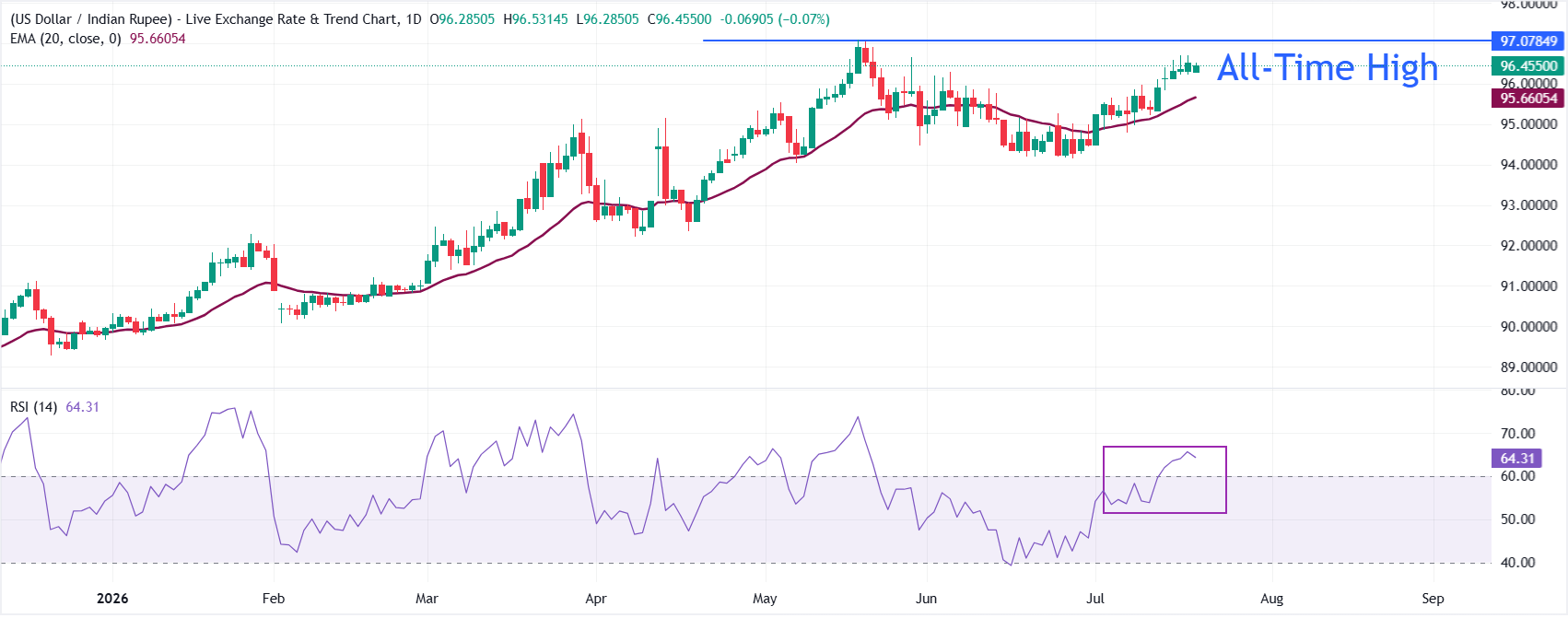
USD/INR trades higher at around 96.44, holding a bullish near-term bias as spot trades above the 20-day exponential moving average (EMA) at 95.66, keeping the recent advance technically supported.
The Relative Strength Index (RSI) at 64.31 stays in positive territory but below overbought on the daily chart, suggesting upward momentum remains constructive without signaling exhaustion yet.
On the downside, initial support is located at the 20-day EMA near 95.66, where a break would hint at a deeper corrective phase toward prior price congestion levels not visible in the current indicator set. Looking up, the pair aims to revisit the all-time high around 97.10.
(The technical analysis of this story was written with the help of an AI tool. Know more.)
Fed FAQs
Monetary policy in the US is shaped by the Federal Reserve (Fed). The Fed has two mandates: to achieve price stability and foster full employment. Its primary tool to achieve these goals is by adjusting interest rates. When prices are rising too quickly and inflation is above the Fed’s 2% target, it raises interest rates, increasing borrowing costs throughout the economy. This results in a stronger US Dollar (USD) as it makes the US a more attractive place for international investors to park their money. When inflation falls below 2% or the Unemployment Rate is too high, the Fed may lower interest rates to encourage borrowing, which weighs on the Greenback.
The Federal Reserve (Fed) holds eight policy meetings a year, where the Federal Open Market Committee (FOMC) assesses economic conditions and makes monetary policy decisions. The FOMC is attended by twelve Fed officials – the seven members of the Board of Governors, the president of the Federal Reserve Bank of New York, and four of the remaining eleven regional Reserve Bank presidents, who serve one-year terms on a rotating basis.
In extreme situations, the Federal Reserve may resort to a policy named Quantitative Easing (QE). QE is the process by which the Fed substantially increases the flow of credit in a stuck financial system. It is a non-standard policy measure used during crises or when inflation is extremely low. It was the Fed’s weapon of choice during the Great Financial Crisis in 2008. It involves the Fed printing more Dollars and using them to buy high grade bonds from financial institutions. QE usually weakens the US Dollar.
Quantitative tightening (QT) is the reverse process of QE, whereby the Federal Reserve stops buying bonds from financial institutions and does not reinvest the principal from the bonds it holds maturing, to purchase new bonds. It is usually positive for the value of the US Dollar.
Author

Sagar Dua
FXStreet
Sagar Dua is associated with the financial markets from his college days. Along with pursuing post-graduation in Commerce in 2014, he started his markets training with chart analysis.