Indian Rupee retreats from its eight-month low against US Dollar
- The Indian Rupee faces a mild correction against the US Dollar, with USD/INR rebounding to near 92.57.
- FIIs have made a cumulative investment worth Rs. 1,22,101.46 crore so far in November.
- India’s strong private economic activity boosts the case for further RBI tightening.

The Indian Rupee (INR) faces some correction against the US Dollar (USD) on Thursday after a sharp rally in the past few weeks. The USD/INR pair rebounds to near 92.57 from its eight-month low of 92.18 posted the previous day.
The corrective move in the Indian currency against the US Dollar appears to be short-lived and the upside trend might resume soon as foreign money continues to chase Indian stocks.
On Wednesday, Foreign Institutional Investors (FIIs) poured an investment worth Rs. 4,479.08 crore in the Indian stock market. So far in November, FIIs have remained net buyers on all full trading days and have made a cumulative investment worth Rs. 1,22,101.46 crore.
Will FIIs buying spree continue further?
Market experts have signaled that the interest of FIIs toward the Indian stock market has increased as overseas investors have started looking beyond the global Artificial Intelligence (AI) trade, following the defeat of Republicans in United States (US) midterm elections and Nvidia’s corporate governance issues.
Strategists at Brown Brothers Harriman (BBH) highlight that “risk appetite fades as the AI trade unwinds,” with tech‑heavy equity markets in Taiwan and South Korea coming under pressure even as “global bonds are rallying.” In parallel, they note that “India is shining,” as the Nifty’s “limited exposure to AI is a magnet for foreign buyers.”
However, signs of recovery in the global AI trade after the reinstatement of Nvidia’s CEO Jensen Huang could dent FIIs sentiment toward the Indian stock market.
On Wednesday, NASDAQ bounced back strongly after a negative opening and its futures have extended gains in the overnight session ahead of holiday in US markets due to Thanksgiving Day.
India PMI strength bolsters case for further RBI tightening
Analysts at Commerzbank note that the latest PMI readings "reinforce the resilience of India's domestic economy," with "stronger manufacturing activity providing a counterweight to moderating services activity." They highlight that "stronger factory orders and production are encouraging for industrial output and the broader manufacturing outlook," particularly as demand remains firm in "electronics, chemicals, metals and infrastructure-related industries."
Commerzbank adds that "the improvement in export orders is also consistent with the recent strength in merchandise exports," though they caution that "the contribution to real GDP will depend on export volumes and imported inputs." In their view, the PMI data "reinforce the view that RBI has room to tighten further." While "input-cost inflation remained subdued and selling-price increases were modest by historical standards," the bank stresses that "these survey indicators do not capture the full impact of higher food and energy prices," noting that "headline CPI inflation rose to 6.1% yoy in October from 5.5% in September, breaching RBI's 2-6% target range."
With "growth remaining resilient," Commerzbank argues that "the RBI has room to prioritise inflation control" following its "25bp hike to 5.50% in October" and shift to "a calibrated tightening stance." The bank says: "We look for another 25bp increase to 5.75% at the next policy decision on 4 December."
USD/INR Technical Analysis
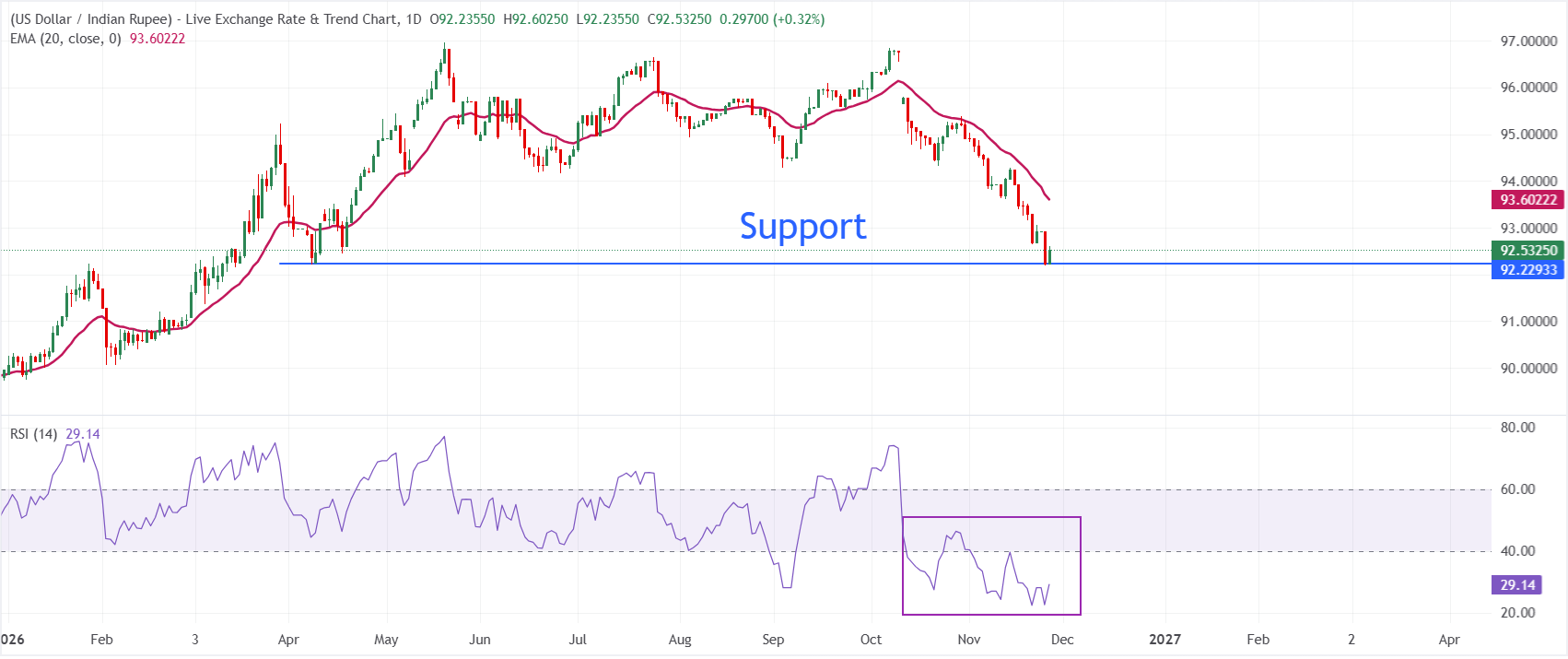
In the daily chart, USD/INR trades at 92.53, maintaining a bearish near-term bias as spot holds beneath the 20-day Exponential Moving Average (EMA) at 93.60. The pair’s inability to reclaim this dynamic barrier suggests sellers remain in control, while the Relative Strength Index (14) at 29.14 hovers near oversold territory, hinting that downside pressure persists but short-term exhaustion could start to build.
On the topside, immediate resistance is located at the 20-day EMA around 93.60, where any recovery is likely to face initial supply. On the downside, the pair could slide to 92.00.
(The technical analysis of this story was written with the help of an AI tool. Know more.)
Indian Rupee FAQs
The Indian Rupee (INR) is one of the most sensitive currencies to external factors. The price of Crude Oil (the country is highly dependent on imported Oil), the value of the US Dollar – most trade is conducted in USD – and the level of foreign investment, are all influential. Direct intervention by the Reserve Bank of India (RBI) in FX markets to keep the exchange rate stable, as well as the level of interest rates set by the RBI, are further major influencing factors on the Rupee.
The Reserve Bank of India (RBI) actively intervenes in forex markets to maintain a stable exchange rate, to help facilitate trade. In addition, the RBI tries to maintain the inflation rate at its 4% target by adjusting interest rates. Higher interest rates usually strengthen the Rupee. This is due to the role of the ‘carry trade’ in which investors borrow in countries with lower interest rates so as to place their money in countries’ offering relatively higher interest rates and profit from the difference.
Macroeconomic factors that influence the value of the Rupee include inflation, interest rates, the economic growth rate (GDP), the balance of trade, and inflows from foreign investment. A higher growth rate can lead to more overseas investment, pushing up demand for the Rupee. A less negative balance of trade will eventually lead to a stronger Rupee. Higher interest rates, especially real rates (interest rates less inflation) are also positive for the Rupee. A risk-on environment can lead to greater inflows of Foreign Direct and Indirect Investment (FDI and FII), which also benefit the Rupee.
Higher inflation, particularly, if it is comparatively higher than India’s peers, is generally negative for the currency as it reflects devaluation through oversupply. Inflation also increases the cost of exports, leading to more Rupees being sold to purchase foreign imports, which is Rupee-negative. At the same time, higher inflation usually leads to the Reserve Bank of India (RBI) raising interest rates and this can be positive for the Rupee, due to increased demand from international investors. The opposite effect is true of lower inflation.
Author
Sagar Dua
FXStreet
Sagar Dua is associated with the financial markets from his college days. Along with pursuing post-graduation in Commerce in 2014, he started his markets training with chart analysis.