Indian Rupee remains calm as investors await US-Iran talks in Oman
- The Indian Rupee trades calmly near 94.35 against the US Dollar ahead of US-Iran talks and NFP data.
- Iran stresses the recognition of its authority near the Strait of Hormuz.
- The Fed is expected to deliver at least one interest rate hike this year.
The Indian Rupee (INR) trades flat against the US Dollar (USD) after a long weekend on Monday. The USD/INR pair wobbles around 94.35 as investors await the outcome of talks between the United States (US) and Iran, scheduled on Tuesday in Oman, regarding peace near the Strait of Hormuz, a critical chokepoint to almost one-fifth of global energy supply.
US-Iran agree on a ceasefire after trading attacks over weekend
The exchange of attacks between the US and Iran near the Strait of Hormuz over the weekend renewed fears of a global energy supply disruption again. Comments from Iran’s Foreign Minister Abbas Araghchi signaled that Tehran’s attacks were meant to demonstrate its intentions to have authority over the Hormuz.
Iran’s Foreign Minister Araghchi said that responsibility for the Strait of Hormuz lies solely with Tehran and warned that any attempt to bypass its preferred route in the waterway will cause “tension and escalation”. However, both nations later agreed on a ceasefire and scheduled talks regarding the same in Oman for Tuesday.
Market participants worry that signs of renewed conflicts between the two nations could lift oil prices again, which have returned close to their pre-war levels, a scenario that diminishes the appeal of currencies from economies, such as India, which rely heavily on oil imports to meet their energy needs.
US Dollar consolidates at start of US NFP week
The US Dollar Index, which gauges the Greenback’s value against six major currencies, trades calmly near 101.30. Investors seem to have sidelined, awaiting a slew of US data, especially the Nonfarm Payrolls (NFP) data for June, which will be released on Thursday.
Investors will pay close attention to the US NFP data for fresh cues regarding the Federal Reserve’s (Fed) monetary policy outlook. The impact of the official employment data will be significant as comments from new Fed Chairman Kevin Warsh in his monetary policy conference this month signaled that forward-looking statements from the central bank would be restricted in the current policy conjuncture.
According to the CME FedWatch tool, the odds of the Fed delivering at least one interest rate hike this year are almost 90%.
This week, investors will also focus on the US ISM Manufacturing PMI and the ADP Employment Change data for June, and the JOLTS Job Openings data for May.
Technical Analysis: USD/INR holds key support around 94.00
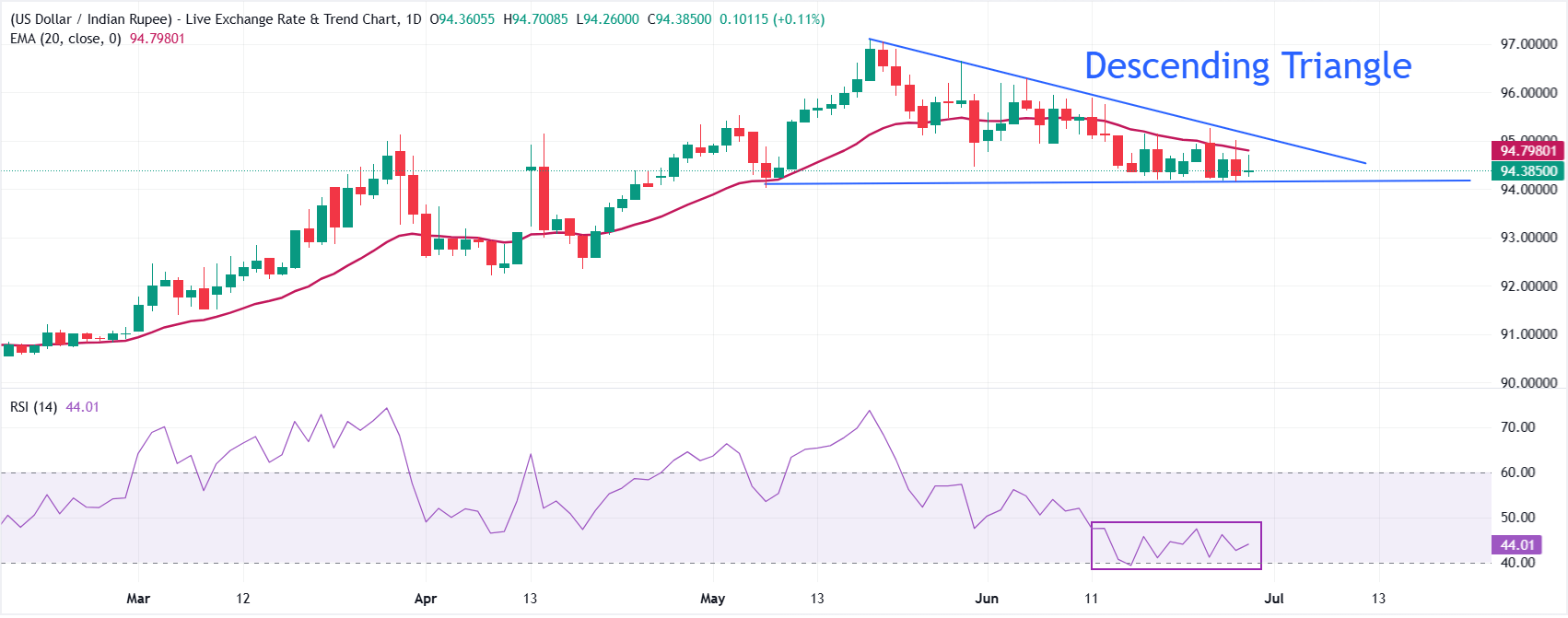
USD/INR trades flat at around 94.38, keeping a bearish near-term tone as spot holds below the 20-period exponential moving average (EMA) at 94.80 and under the broader downward resistance trend line of the Descending Triangle formation starting near 97.10.
The pair has been sliding off recent highs and now trades closer to its rising support line from 94.1051, while the Relative Strength Index (14) around 44 suggests waning bullish momentum and leaves the door open for further downside pressure.
On the topside, initial resistance is defined by the 20-period EMA at 94.80, with a subsequent barrier coming from the longer-term descending trend line near 97.10. On the downside, the immediate focus is on the horizontal support line drawn from 94.10, with the current price area around 94.38 acting as a pivotal zone where a sustained break lower would reinforce the bearish bias and expose deeper losses in the coming sessions.
(The technical analysis of this story was written with the help of an AI tool.)
Indian economy FAQs
The Indian economy has averaged a growth rate of 6.13% between 2006 and 2023, which makes it one of the fastest growing in the world. India’s high growth has attracted a lot of foreign investment. This includes Foreign Direct Investment (FDI) into physical projects and Foreign Indirect Investment (FII) by foreign funds into Indian financial markets. The greater the level of investment, the higher the demand for the Rupee (INR). Fluctuations in Dollar-demand from Indian importers also impact INR.
India has to import a great deal of its Oil and gasoline so the price of Oil can have a direct impact on the Rupee. Oil is mostly traded in US Dollars (USD) on international markets so if the price of Oil rises, aggregate demand for USD increases and Indian importers have to sell more Rupees to meet that demand, which is depreciative for the Rupee.
Inflation has a complex effect on the Rupee. Ultimately it indicates an increase in money supply which reduces the Rupee’s overall value. Yet if it rises above the Reserve Bank of India’s (RBI) 4% target, the RBI will raise interest rates to bring it down by reducing credit. Higher interest rates, especially real rates (the difference between interest rates and inflation) strengthen the Rupee. They make India a more profitable place for international investors to park their money. A fall in inflation can be supportive of the Rupee. At the same time lower interest rates can have a depreciatory effect on the Rupee.
India has run a trade deficit for most of its recent history, indicating its imports outweigh its exports. Since the majority of international trade takes place in US Dollars, there are times – due to seasonal demand or order glut – where the high volume of imports leads to significant US Dollar- demand. During these periods the Rupee can weaken as it is heavily sold to meet the demand for Dollars. When markets experience increased volatility, the demand for US Dollars can also shoot up with a similarly negative effect on the Rupee.
Author

Sagar Dua
FXStreet
Sagar Dua is associated with the financial markets from his college days. Along with pursuing post-graduation in Commerce in 2014, he started his markets training with chart analysis.