Why credit markets aren’t pricing $570B of AI debt

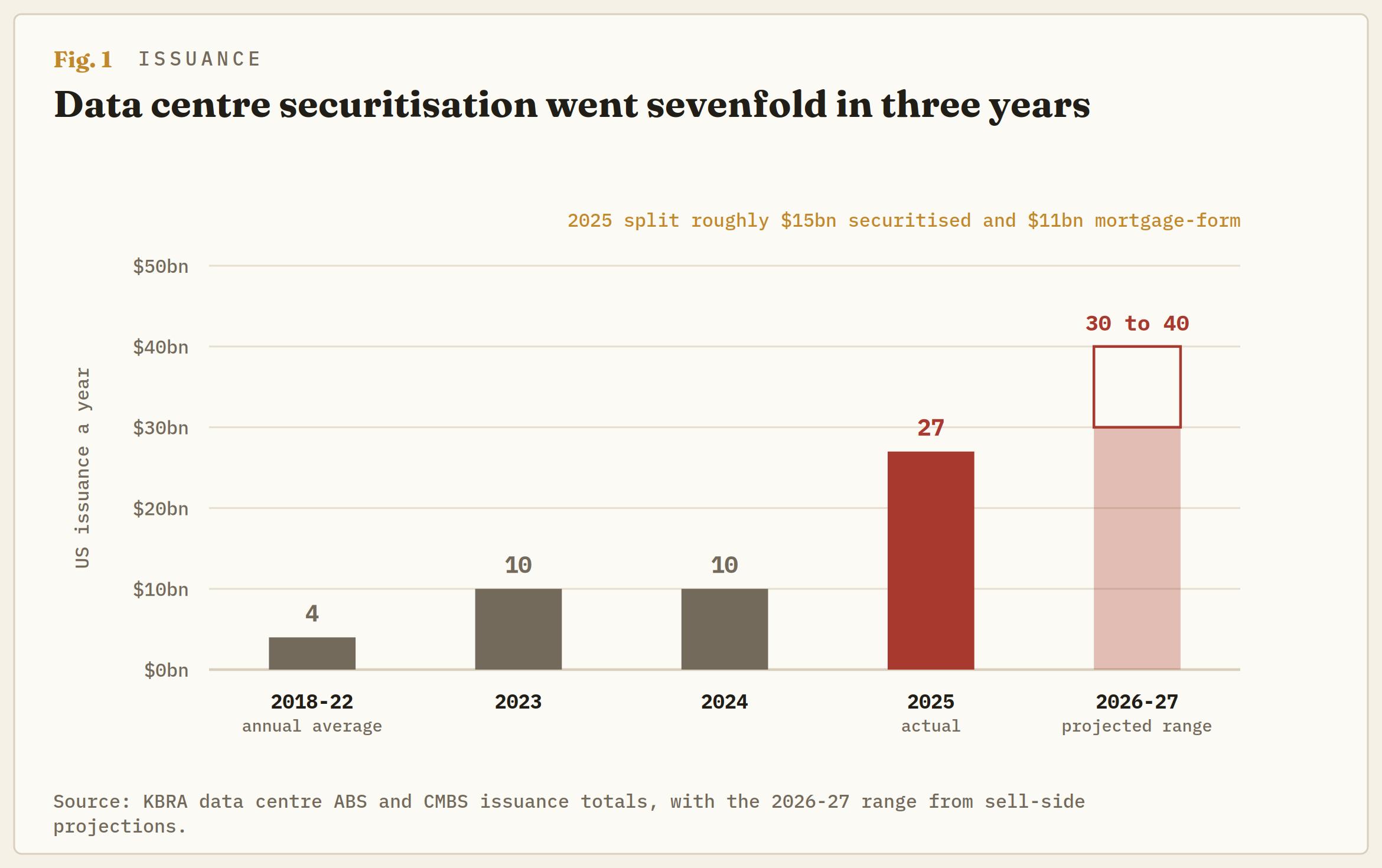
Forecasts put global artificial intelligence (AI) related debt issuance near $570 billion this year, with roughly $236 billion of it priced by the end of May at four times the prior year's pace. Data centre securitisation alone has gone from about $4 billion a year through 2022 to roughly $10 billion in each of 2023 and 2024, and then $27 billion in 2025. Sell-side desks project $30 billion to $40 billion a year of gross supply through 2027, and one house has put net issuance across 2026 to 2028 near $130 billion.
Set against that, not one credit instrument in the chain is pricing any of it as a credit risk. Not the investment-grade index, not high yield, not the listed vehicles that hold the private loans. The only thing being marked down anywhere is duration, and duration would be repricing with or without a data centre in it.
The money has moved three times
The financing of this build has migrated twice already and is midway through a third move, and each step has taken it somewhere less visible than the last.
It began in the public investment-grade market, where hyperscalers and large private issuers sold conventional senior unsecured paper. That market is deep and transparent, and it prices in front of everyone.
The second move was into securitisation. Data centre asset-backed securities (ABS) have existed since 2018 and accounted for something like $48.7 billion across 88 transactions by the middle of last year, with ABS forms taking roughly 71% of that and single-borrower commercial mortgage arrangements the balance. Both major agencies that rate the sector have now written dedicated methodologies for it, one in February 2025 and the other in January this year, which is the clearest possible signal that the asset class has outgrown being treated as ordinary commercial property.
The third move is still under way: into private credit and into arrangements that sit outside the borrower's own balance sheet. Estimates of off-balance-sheet financing tied to data centres run toward $800 billion. That figure cannot be verified the way an issuance table can, which is precisely the point of it.
At each step the paper became harder to see, harder to mark, and harder to sell. And at each step the buyer base got less liquid.
What credit is actually pricing
Here is where the market's own instruments are more informative than any forecast, and where the answer is genuinely surprising.
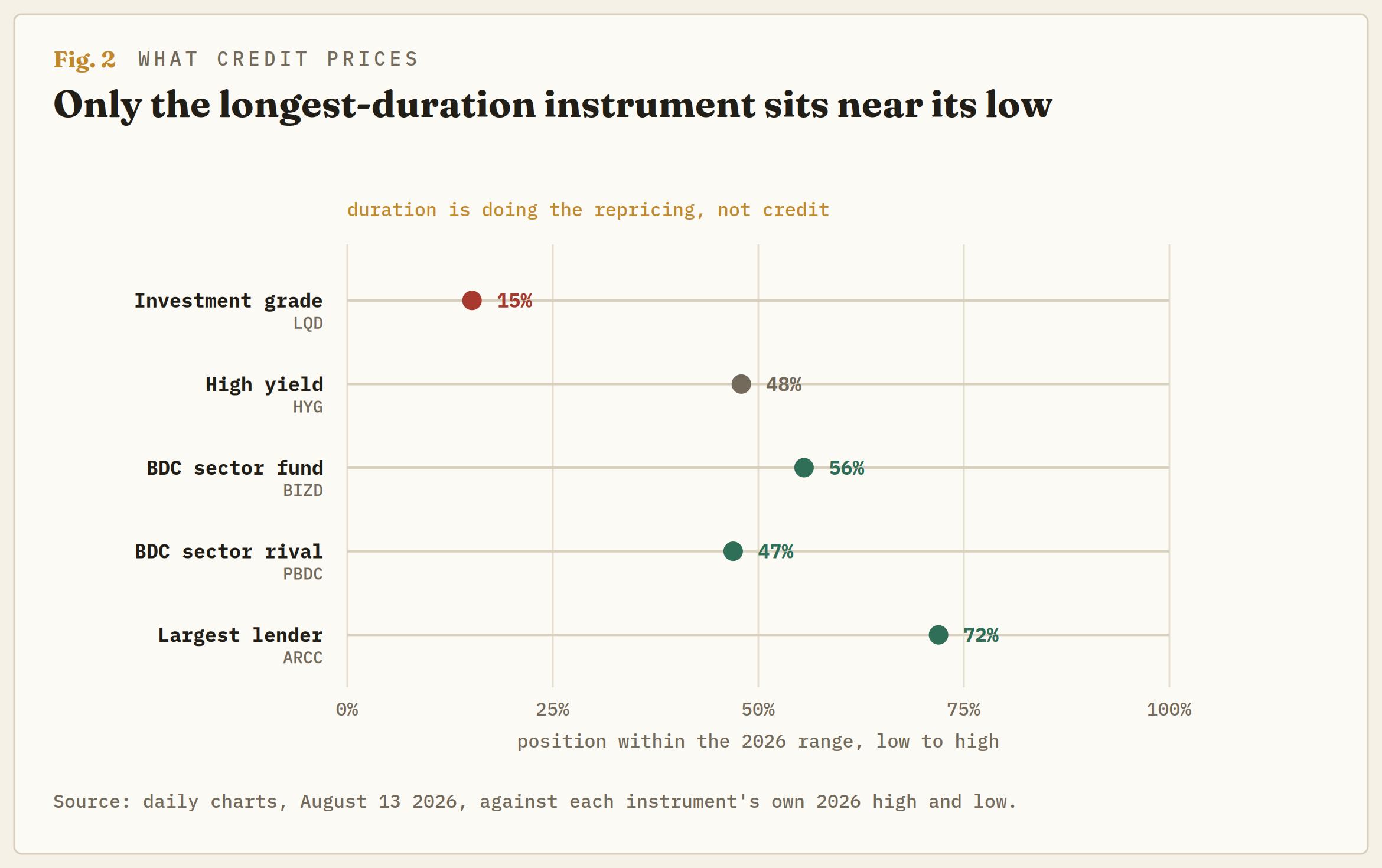
The main investment grade corporate bond fund (LQD) trades at $106.84, less than a percent above its low for the year and roughly four and a half percent beneath a January high near $112. On the face of it, that looks like credit stress.
It is not. The equivalent high yield fund (HYG) trades at $79.85, sitting almost exactly mid-range between a low near $78.60 and a high near $81.20, and less than two percent off that high. If the market were pricing a credit problem, high yield would be leading the decline and investment grade would be the refuge. The opposite is happening.
The explanation is duration. Investment-grade paper is long, high-yield paper is short and carries more coupon, and with the long end of the government curve where it is, a long corporate fund is a rates instrument wearing a credit label. Investment grade is being marked down for when it gets repaid, not for whether it does.
Now add the third leg, and it is the one that answers the private credit question directly. Business development companies hold private loans on their books, mark them quarterly, and trade daily, which makes them the only continuously priced window onto an otherwise opaque market. The sector fund (BIZD) trades at $13.47, up about 13% from its April low and roughly 8% below its January high. Its main rival (PBDC) sits at $28.55 on a near-identical shape, and the largest single lender in the sector, Ares Capital (ARCC), trades at $20.09, within five percent of its high for the year.
All three peaked in January, sold down into spring, and have spent August rallying. None is anywhere near a low. Whatever private credit has taken on from this build, it is not being priced as a problem by the people who own the vehicles.
The equity of the levered borrowers tells the same story in a louder voice. Oracle (ORCL) trades near $159 against a June high above $250 and an August low near $114, so it has lost more than a third from the top and gained nearly 40% from the bottom. CoreWeave (CRWV) trades near $111 against a May high above $138 and a July low near $60, down about a fifth from the high and up more than 80% from the low.
Those are not the charts of companies whose funding is in question. They are the charts of companies whose growth rate is in question. The market is arguing vigorously about how much these businesses are worth, and not at all about whether the money lent to them comes back.
The accounting keeps not working
There is a specific and documented reason to be skeptical that everything financed against these assets is where the reader thinks it is.
Sale-leaseback arrangements are the standard route for moving infrastructure off a balance sheet. The asset is sold to a financing counterparty and leased back, and if the arrangement satisfies the accounting tests, both the asset and the associated obligation leave the seller's books. When it does not satisfy those tests, the transaction is treated as a financing, and both come straight back on.
That is not hypothetical. In its most recent quarterly filing, SpaceX carried $13.406 billion under other financings, described as including obligations on certain AI infrastructure assets recorded as failed sale-leasebacks, against $4.562 billion at the end of last year. Nearly a tripling in six months, in one issuer, in a line item that exists precisely because the intended off-balance-sheet treatment did not hold.
One company's disclosure is one company's disclosure. But it establishes that the technique is in active use at scale, that it is failing its tests often enough to produce nine-figure movements, and that the only reason anyone can see it is that this particular borrower files with a regulator. The estimated $800 billion of off-balance-sheet data centre financing is, by definition, mostly held by entities that do not.
Everything leads back to the same tenants
The concentration problem is the one that turns a large financing into a systemic one, and it is the least discussed.
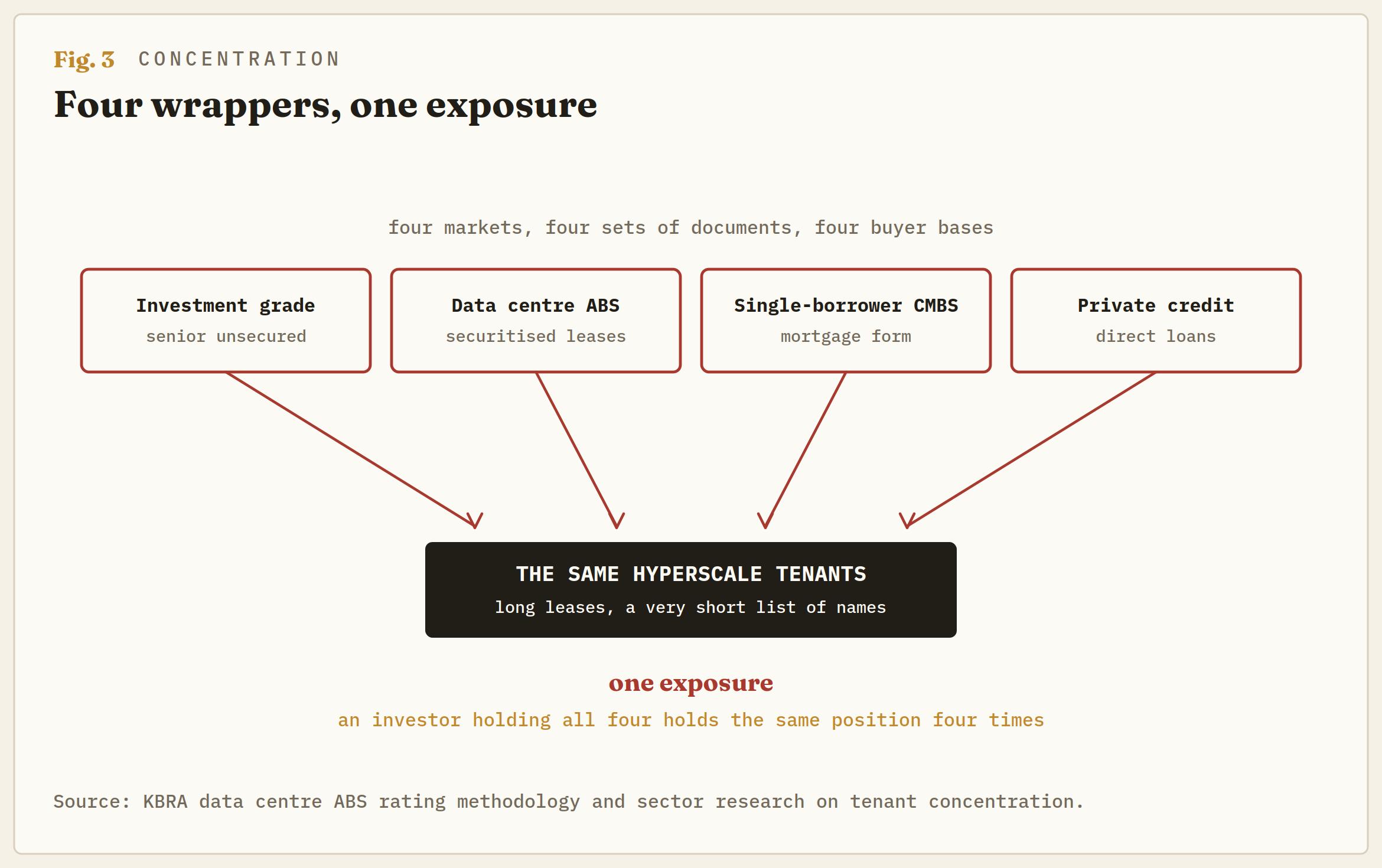
Data centre securitisation is overwhelmingly backed by wholesale hyperscale assets, which in practice means long leases to a very short list of very large technology companies. The rating methodologies for the sector are built around tenant default and rollover simulation, and the agencies flag concentration in single-tenant assets as the central credit consideration. The same names sit behind the private credit loans, the ABS, the commercial mortgage paper and the corporate bonds.
That means the diversification implied by spreading exposure across four different markets is largely nominal. An investor holding a data centre ABS tranche, a direct lending fund and an investment grade corporate bond may believe they hold three uncorrelated positions. They hold one position, three times, against the continued willingness of perhaps five companies to keep paying rent on assets built for a workload whose economics are still being established.
Concentration on the revenue side confirms it. The one issuer here that publishes the numbers drew 18.3% of quarterly revenue from one customer and 19.5% from another. Roughly thirty-eight percent of the top line, two counterparties.
The fork
This does not resolve at a price, which is why there is no level to publish for it.
It resolves on a single observable: whether the hyperscalers keep signing and honouring the leases. Their capital spending is running at somewhere between 45% and 57% of revenue, and around three-quarters of this year's capital budgets, roughly $450 billion, is going to AI infrastructure. Every arrangement described above rests on that continuing.
If it continues, none of this matters for years. The paper performs, the private credit vehicles earn their carry, and the only repricing is the duration repricing already visible in the investment-grade market, which has nothing to do with AI.
If one large tenant materially trims commitments, the correlation that has been assumed away shows up everywhere at once, because it was always the same exposure wearing four different wrappers. The least liquid holders would be the private credit vehicles and the off-balance-sheet arrangements, which are also the ones with the least frequent marks and the widest gap between carrying value and clearing price.
Watch three things rather than the spread. Watch hyperscaler capital spending guidance and lease commitments in the quarterly filings, because that is the underlying variable and everything else is derivative of it. Watch the first data centre securitisation that prices materially wide of guidance, which would be the first genuine market signal in a sector that has so far cleared everything it has brought. And watch the listed private credit vehicles for a move to a sustained discount to net asset value, because that is where an opaque market gets a public price whether it wants one or not.
None of those three has flashed yet. That is the point. A financing programme of this size with no priced risk anywhere in it is not evidence that the risk is absent, only that nobody has been asked to quote on it.
Author

Joshua Gibson
FXStreet
Joshua joins the FXStreet team as an Economics and Finance double major from Vancouver Island University with twelve years' experience as an independent trader focusing on technical analysis.