Indian Rupee falls further amid higher oil prices, FIIs extend selling streak
- The Indian Rupee drops further against the US Dollar as crude oil prices remain higher.
- Iran reaffirms its stance despite the US threatening to attack Iranian infrastructure.
- Traders trim hawkish Fed bets as US inflation cools down on both the retail and wholesale levels.

The Indian Rupee (INR) trades lower against the US Dollar (USD), extending its losing streak for the third trading day on Thursday. The USD/INR pair rises to near 96.32 as elevated crude oil prices have renewed fears of higher foreign outflows. The continued military aggression between the United States (US) and Iran in the Middle East has disrupted the energy supply again.
In the opening trade, the MCX Crude Oil contract expiring on July 20 is up 0.7% to near Rs. 7,664, closer to its monthly high of Rs. 7,832.
Currencies from economies, such as India, which rely heavily on oil imports to meet their energy needs, tend to underperform in a high-oil-price environment.
Trump threatens to attack Iranian infrastructure
Earlier in the day, the US Central Command (CENTCOM) announced that it launched another wave of strikes against Iran in a further effort to keep the Strait of Hormuz, a critical chokepoint to almost one-fifth of global energy supply, open.
The ongoing aggression in the Middle East is unlikely to stop anytime soon, as Iran has shut the door on US threats to attack Iranian infrastructure.
US President Donald Trump said in an interview with Fox News on Wednesday that he will authorize military forces to strike Iran’s bridges and power plants next week if the nation doesn’t come to the table for negotiations.
In response, Iran’s top negotiator and parliamentary speaker Mohammed Bagher Ghalibaf said that the country has “never welcomed war, nor do we now," adding that “we must always be prepared for battle and stand firm to protect our national security and interests."
US Dollar faces pressure from repricing Fed interest rate expectations
The US Dollar gains temporary ground in the Asian trade on Thursday, but has been battered badly in the last two trading days. At press time, the US Dollar Index (DXY), which gauges the Greenback’s value against six major currencies, trades marginally higher to near 100.52, closer to its almost four-week low of 100.35 posted on Wednesday.
US Dollar Price This week
The table below shows the percentage change of US Dollar (USD) against listed major currencies this week. US Dollar was the weakest against the British Pound.
| USD | EUR | GBP | JPY | CAD | AUD | INR | CHF | |
|---|---|---|---|---|---|---|---|---|
| USD | -0.58% | -1.10% | 0.23% | -0.79% | -0.73% | 1.03% | -0.22% | |
| EUR | 0.58% | -0.54% | 0.82% | -0.23% | -0.20% | 1.45% | 0.36% | |
| GBP | 1.10% | 0.54% | 1.32% | 0.32% | 0.34% | 2.24% | 0.94% | |
| JPY | -0.23% | -0.82% | -1.32% | -1.11% | -0.95% | 0.52% | -0.50% | |
| CAD | 0.79% | 0.23% | -0.32% | 1.11% | 0.16% | 1.60% | 0.62% | |
| AUD | 0.73% | 0.20% | -0.34% | 0.95% | -0.16% | 1.49% | 0.47% | |
| INR | -1.03% | -1.45% | -2.24% | -0.52% | -1.60% | -1.49% | -1.23% | |
| CHF | 0.22% | -0.36% | -0.94% | 0.50% | -0.62% | -0.47% | 1.23% |
The heat map shows percentage changes of major currencies against each other. The base currency is picked from the left column, while the quote currency is picked from the top row. For example, if you pick the US Dollar from the left column and move along the horizontal line to the Japanese Yen, the percentage change displayed in the box will represent USD (base)/JPY (quote).
Traders dialing down Federal Reserve (Fed) interest rate hike expectations on the back of easing US inflationary pressures have weakened the US Dollar. Both the US Consumer Price Index (CPI) and Producer Price Index (PPI) reports for June have shown that price pressures cooled down significantly.
According to the CME FedWatch tool, the odds of the Fed delivering an interest rate hike in the meeting later this month have dropped significantly to 10.2% from 31% recorded a week ago.
FIIs remain net sellers for three consecutive trading days
Foreign Institutional Investors (FIIs) turned out to be net sellers on Wednesday, extending their selling streak for the third trading day. On Wednesday, overseas investors pared their stake worth Rs. 735.83 crore. The sentiment of foreign investors appears to be dampening due to elevated crude oil prices.
Technical Analysis: USD/INR aims to extend advance towards 97.00
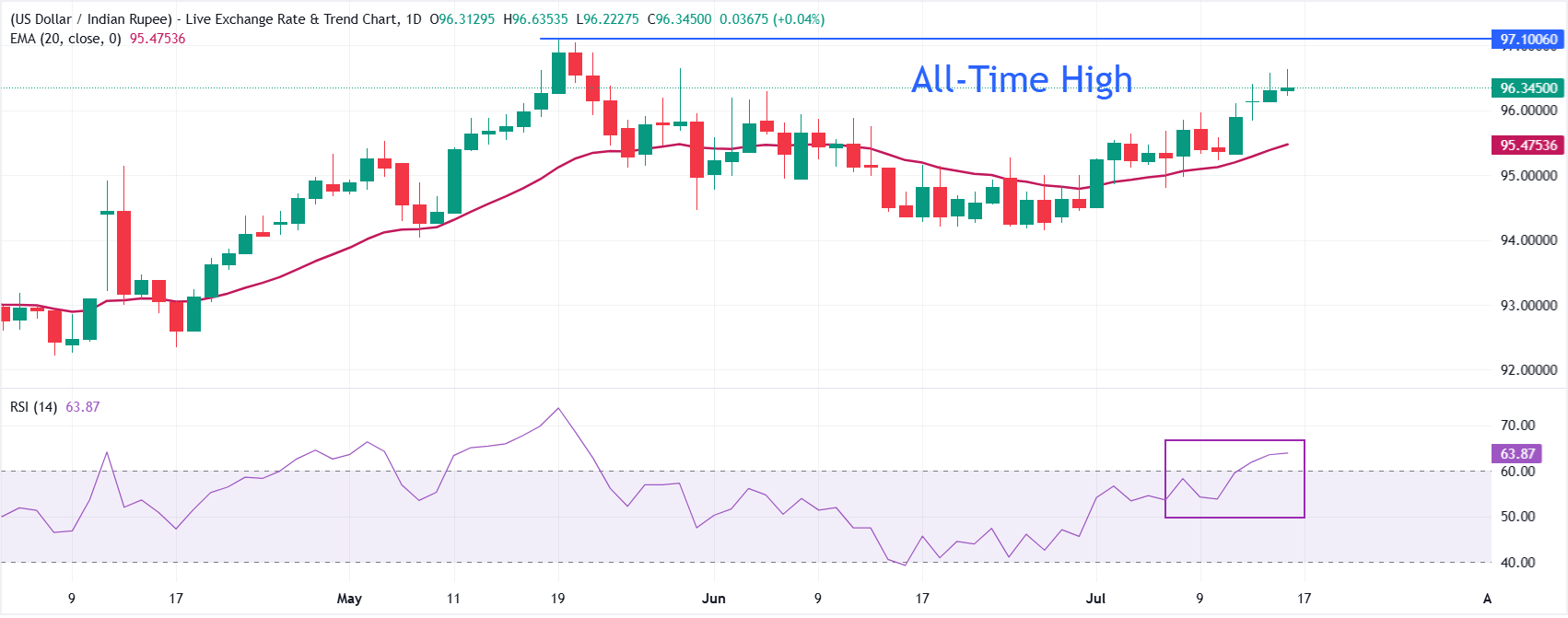
USD/INR trades higher at around 96.35 at press time, keeping a clear bullish near-term bias as price holds above the 20-period Exponential Moving Average (EMA) at 95.47. The fact that spot remains comfortably supported by this short-term EMA suggests the uptrend is intact, while the Relative Strength Index (RSI) at 63.9 stays in bullish territory without yet signaling overbought conditions, hinting that buyers still retain control.
On the downside, immediate support is seen at the 20-period EMA at 95.48, followed by 95.00. Looking up, the pair aims to revisit the all-time high around 97.10.
(The technical analysis of this story was written with the help of an AI tool. Know more.)
Indian economy FAQs
The Indian economy has averaged a growth rate of 6.13% between 2006 and 2023, which makes it one of the fastest growing in the world. India’s high growth has attracted a lot of foreign investment. This includes Foreign Direct Investment (FDI) into physical projects and Foreign Indirect Investment (FII) by foreign funds into Indian financial markets. The greater the level of investment, the higher the demand for the Rupee (INR). Fluctuations in Dollar-demand from Indian importers also impact INR.
India has to import a great deal of its Oil and gasoline so the price of Oil can have a direct impact on the Rupee. Oil is mostly traded in US Dollars (USD) on international markets so if the price of Oil rises, aggregate demand for USD increases and Indian importers have to sell more Rupees to meet that demand, which is depreciative for the Rupee.
Inflation has a complex effect on the Rupee. Ultimately it indicates an increase in money supply which reduces the Rupee’s overall value. Yet if it rises above the Reserve Bank of India’s (RBI) 4% target, the RBI will raise interest rates to bring it down by reducing credit. Higher interest rates, especially real rates (the difference between interest rates and inflation) strengthen the Rupee. They make India a more profitable place for international investors to park their money. A fall in inflation can be supportive of the Rupee. At the same time lower interest rates can have a depreciatory effect on the Rupee.
India has run a trade deficit for most of its recent history, indicating its imports outweigh its exports. Since the majority of international trade takes place in US Dollars, there are times – due to seasonal demand or order glut – where the high volume of imports leads to significant US Dollar- demand. During these periods the Rupee can weaken as it is heavily sold to meet the demand for Dollars. When markets experience increased volatility, the demand for US Dollars can also shoot up with a similarly negative effect on the Rupee.
Author

Sagar Dua
FXStreet
Sagar Dua is associated with the financial markets from his college days. Along with pursuing post-graduation in Commerce in 2014, he started his markets training with chart analysis.