Gold slides for third consecutive day as US inflation data take centre stage
- Gold remains under pressure as markets brace for the September US inflation report.
- Traders expect the Fed to hold interest rates in October, with another hike likely in December.
- XAU/USD maintains a bearish bias below daily SMAs, with $4,100 acting as immediate support.

Gold (XAU/USD) drifts lower on Wednesday, extending losses for a third consecutive day as buyers remain on the sidelines ahead of the US Consumer Price Index (CPI) report due at 12:30 GMT. Meanwhile, the US Dollar (USD) also steadies following Tuesday’s pullback. At the time of writing, XAU/USD trades around $4,142, down 0.45% on the day.
The US Dollar Index (DXY), which tracks the Greenback’s value against a basket of six major currencies, trades around 102.25 after touching an intraday low of 102.08.
Market expectations point to another pickup in US inflation, with headline CPI seen rising 0.6% in September after a 0.4% increase in August. Annual inflation is expected to climb to 3.6% from 3.4%. Core CPI, which excludes food and energy, is expected to ease to 0.2% MoM from 0.3%, while the annual rate is forecast to tick up to 2.5% from 2.4%.
The report could reshape expectations for the Federal Reserve’s (Fed) next move. Ahead of the release, traders assign a 78% probability that the central bank will leave interest rates unchanged at its October 27-28 meeting, while pricing in a 90% chance of a rate hike in December, according to the CME FedWatch Tool.
ING strategists expect today’s US inflation data to come in slightly firmer than the market anticipates, projecting that “MoM US CPI [will] be 0.1pp higher than consensus in both headline and core.” In their view, such a print “shouldn’t be enough for markets to price in 50%+ chances of an October Fed hike,” but it would “reinforce expectations of further tightening down the road and, by extension, the Dollar’s floor.”
They see scope for only a modest repricing of near-term Fed risk, saying that “markets may marginally increase expectations for an October hike,” and emphasise that “for pricing to return above 50% (now 20%) we probably need to see headline close to 1.0% MoM and/or core at 0.4% MoM today.”
Higher energy prices linked to Middle East tensions remain a key driver of inflation. Persistent threats to Oil supplies raise the risk that elevated fuel costs will keep inflation above the Fed’s 2% target for longer. Against this backdrop, New York Fed President John Williams said on Tuesday that it “may be appropriate to have one more rate hike” in 2026. However, he currently sees no need for further increases in 2027 and expects inflation to move toward the central bank’s target next year.
Gold’s near-term direction now hinges on the US inflation report. A softer-than-expected reading could offer some relief, but the prospect of another Fed rate hike may keep gains limited, as higher interest rates increase the opportunity cost of holding the non-yielding metal.
Technical analysis: XAU/USD remains rangebound below key daily SMAs
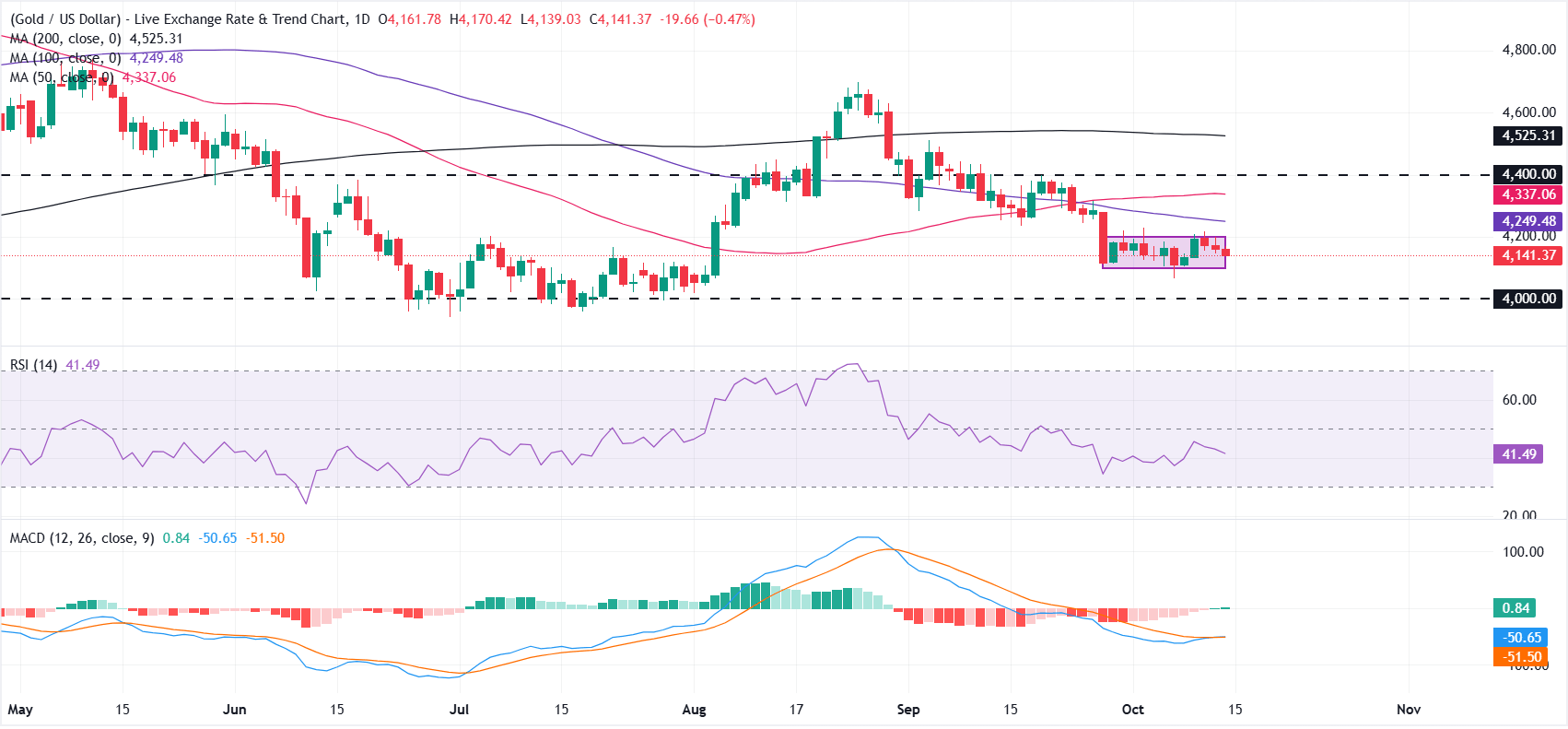
XAU/USD remains largely confined to the $4,100-$4,200 range seen since the start of the month, while trading below the 50-day, 100-day and 200-day Simple Moving Averages (SMAs) on the daily chart.
Momentum indicators point to consolidation. The Relative Strength Index (RSI) around 42 remains below the neutral 50 mark, while the Moving Average Convergence Divergence (MACD) has turned slightly positive, suggesting limited directional conviction.
On the topside, initial resistance lies at the $4,200 psychological mark, followed by the 100-day SMA at $4,249 and the 50-day SMA at $4,337. A stronger recovery would face the $4,400 horizontal barrier ahead of the 200-day SMA at $4,525.
On the downside, initial support stands at $4,100. A sustained break below this level could open the door toward the $4,000-$3,950 support zone.
(The technical analysis of this story was written with the help of an AI tool. Know more.)
Gold FAQs
Gold has played a key role in human’s history as it has been widely used as a store of value and medium of exchange. Currently, apart from its shine and usage for jewelry, the precious metal is widely seen as a safe-haven asset, meaning that it is considered a good investment during turbulent times. Gold is also widely seen as a hedge against inflation and against depreciating currencies as it doesn’t rely on any specific issuer or government.
Central banks are the biggest Gold holders. In their aim to support their currencies in turbulent times, central banks tend to diversify their reserves and buy Gold to improve the perceived strength of the economy and the currency. High Gold reserves can be a source of trust for a country’s solvency. Central banks added 1,136 tonnes of Gold worth around $70 billion to their reserves in 2022, according to data from the World Gold Council. This is the highest yearly purchase since records began. Central banks from emerging economies such as China, India and Turkey are quickly increasing their Gold reserves.
Gold has an inverse correlation with the US Dollar and US Treasuries, which are both major reserve and safe-haven assets. When the Dollar depreciates, Gold tends to rise, enabling investors and central banks to diversify their assets in turbulent times. Gold is also inversely correlated with risk assets. A rally in the stock market tends to weaken Gold price, while sell-offs in riskier markets tend to favor the precious metal.
The price can move due to a wide range of factors. Geopolitical instability or fears of a deep recession can quickly make Gold price escalate due to its safe-haven status. As a yield-less asset, Gold tends to rise with lower interest rates, while higher cost of money usually weighs down on the yellow metal. Still, most moves depend on how the US Dollar (USD) behaves as the asset is priced in dollars (XAU/USD). A strong Dollar tends to keep the price of Gold controlled, whereas a weaker Dollar is likely to push Gold prices up.
Author

Vishal Chaturvedi
FXStreet
I am a macro-focused research analyst with over four years of experience covering forex and commodities market. I enjoy breaking down complex economic trends and turning them into clear, actionable insights that help traders stay ahead of the curve.
















