China's rare earth leverage has an expiration date: November 10. Here's what Beijing is deciding

China is approaching a major strategic deadline in its trade confrontation with the United States (US). On November 10, the suspension of additional rare earth export restrictions Beijing announced in October 2025 is set to expire. Unless Chinese authorities decide otherwise, these measures could take effect, significantly tightening Beijing's control over materials essential to the automotive, technology, energy and defense industries.
The deadline comes against a particular diplomatic backdrop. Washington and Beijing extended their trade truce until January 10, 2027, after discussions between US President Donald Trump and Chinese President Xi Jinping. However, the extension announced on September 28 by China's Ministry of Commerce (MOFCOM) does not explicitly mention the rare-earth restrictions.
This distinction creates significant uncertainty: the easing of trade tensions between the world's two largest economies does not automatically guarantee that the suspension of additional export controls will remain in place. For Beijing, the decision goes far beyond mineral exports. It concerns China's ability to maintain a strategic industrial advantage, secure concessions from Washington, and slow the development of competing supply chains.
November 10: The deadline that could reshape global rare earth trade
The restrictions announced on October 9, 2025, represent a major expansion of China's export control framework. They cover five additional rare earth elements, including Erbium, Holmium and Europium, as well as certain equipment and technologies required for their processing. However, their most sensitive feature is their extraterritorial reach.
Announcement No. 61 provided that certain products manufactured outside China, but containing at least 0.1% by value of Chinese-origin rare earth materials, may require authorization from Beijing. The framework notably covers certain magnetic materials, components and products using specific Chinese technologies.
In practice, a European or American company could, therefore, have to comply with Chinese regulations for certain transactions conducted between third-party countries. In principle, this provision resembles US restrictions that allow Washington to control certain semiconductor exports manufactured abroad using American technologies.
China would effectively gain a comparable instrument, applied to strategic materials on which its competitors depend. However, November 10 does not mark the automatic introduction of a worldwide embargo. If the suspension expires without an extension, affected companies would face broader licensing requirements rather than a blanket ban on all exports.
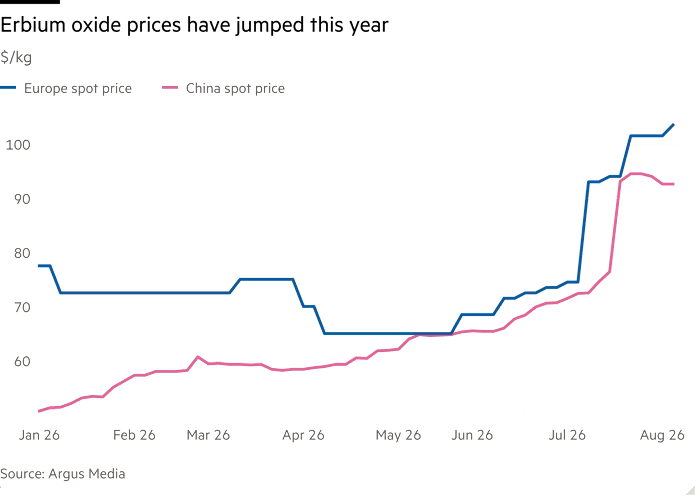
Nevertheless, uncertainty surrounding the deadline is already enough to influence procurement decisions. In an article published by The Financial Times, Argus Media Rare Earth Pricing Manager Maeve Flaherty warns: “Market participants both inside and outside of China believe that export controls may be reimposed on erbium, cutting off erbium supply to the rest of the world.”
According to figures reported by the financial newspaper in August, European Erbium prices had risen by 50% since early June, illustrating precautionary buying by manufacturers ahead of the November deadline.
China's restrictions never really disappeared
The November 2025 trade truce does not mean that Beijing has abandoned its control over strategic exports. Restrictions introduced in April 2025 remain fully in force. They require export licenses for seven medium and heavy rare earth elements, including Dysprosium, Terbium, Samarium and Yttrium, as well as several derivative products. These elements play an essential role in manufacturing high-performance permanent magnets used in electric vehicles, wind turbines, industrial robots and military equipment.
According to Chinese customs data cited by Tech Times, exports of Dysprosium, Terbium and Yttrium remain approximately 50% below the levels recorded before the restrictions were introduced. The continued application of these measures shows that suspending the October restrictions does not restore completely unrestricted trade.
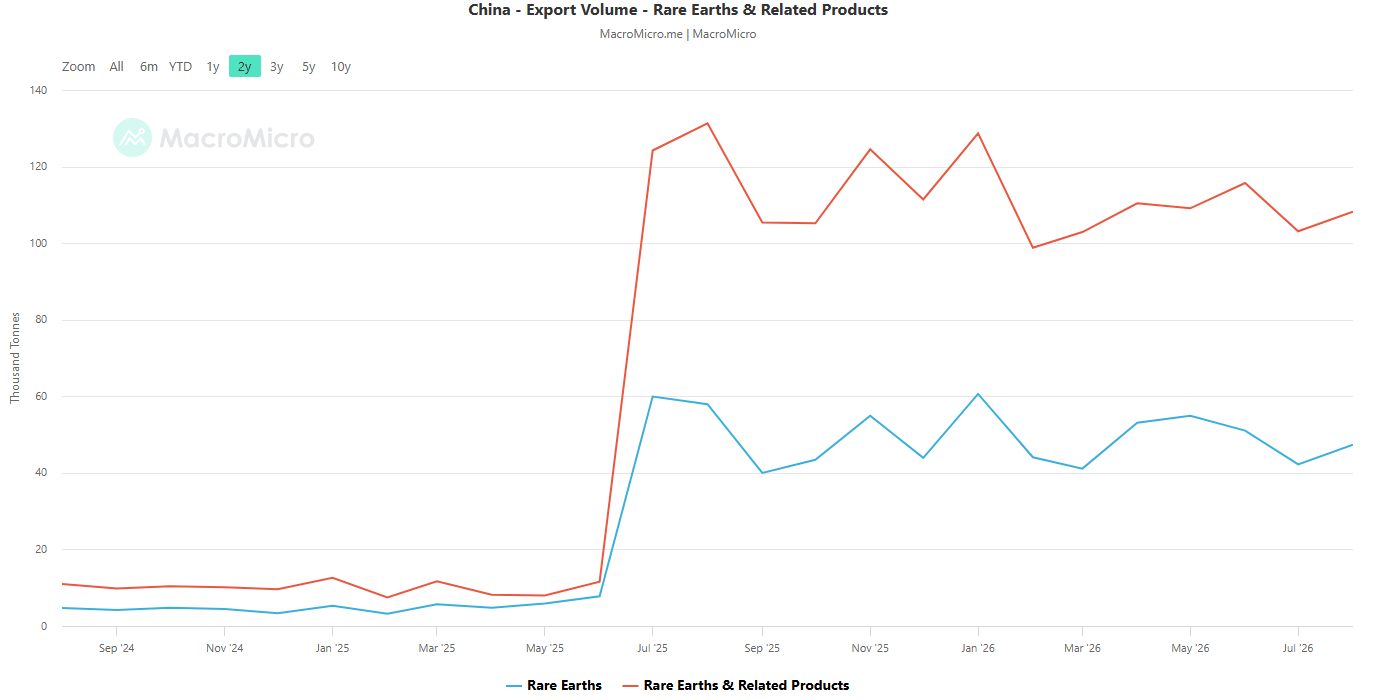
In an analysis published by Mining Technology, EBC Financial Group states that the available data "does not suggest readiness", referring to the ability of global supply chains to operate independently of China.
Beijing also continues to use targeted restrictions against certain foreign companies. In June, Chinese authorities placed MP Materials and USA Rare Earth on a dual-use export control list. In July, fourteen European entities faced similar measures amid diplomatic tensions linked to European sanctions against Russia.
These decisions fall under frameworks separate from the restrictions suspended in October 2025. Nevertheless, they demonstrate that China retains several instruments to exert selective pressure without interrupting all its exports.
Why Beijing's strongest weapon is not mining
China's dominance rests less on mineral extraction than on industrial processing. According to estimates from GlobalData, global rare earth production reached approximately 390,000 tonnes of rare earth oxide equivalent in 2025, including 270,000 tonnes produced in China, representing 69% of the total. The United States accounts for 13% of global mine production, while Australia represents 7%.
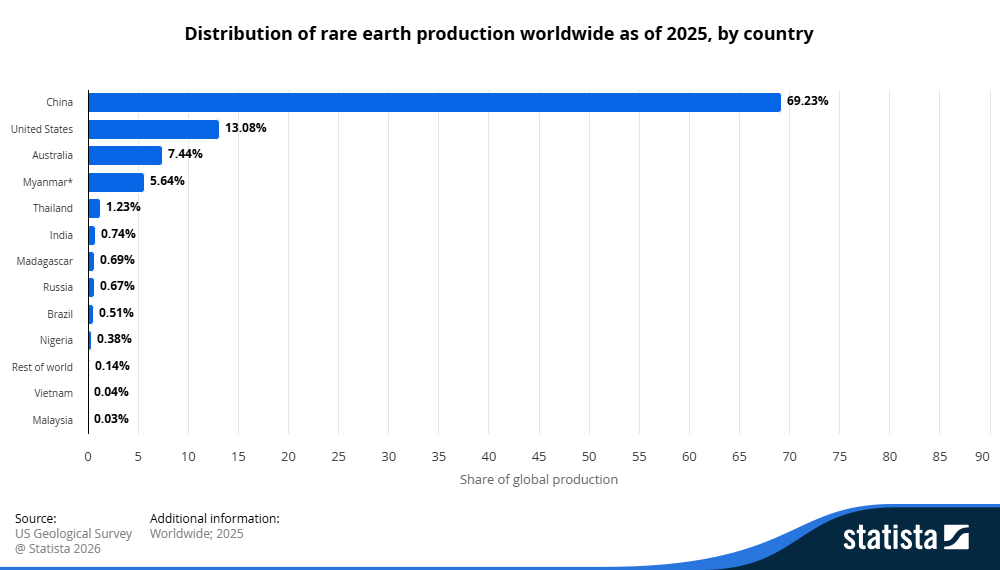
However, these figures reveal only part of the imbalance. China accounts for up to 90% of global rare earth processing, according to GlobalData, and its dominance is even greater in certain segments of permanent magnet manufacturing.
Several complex industrial stages are required between extracting an ore and producing a magnet suitable for an electric motor. These operations require specialized facilities, technical expertise and several years of industrial development. The concentration of these capabilities allows Beijing to influence not only available supply volumes but also the speed at which its competitors can develop alternatives.
The International Energy Agency estimates that full implementation of China's export control framework could expose up to $6.5 trillion in annual industrial production outside China to potential disruptions. This figure represents the value of economic activity exposed to risk, not a forecast of actual losses.
For automakers, semiconductor manufacturers and defense companies, the main risk extends beyond rising prices. It also includes potential delivery delays, production shutdowns, and difficulties identifying alternative suppliers.
What Beijing is really deciding: Three scenarios for November 10
Three main scenarios are emerging ahead of the deadline, as highlighted by EBC Financial Group in its analysis reported by Mining Technology.
Scenario 1: Extend the suspension and preserve the trade truce
China could extend the suspension of additional restrictions, potentially until January 10, 2027, to align it with the timetable of its trade truce with Washington. This option would preserve relative trade stability and avoid another escalation that could also hurt Chinese companies.
An extension would not mean the disappearance of structural tensions. Instead, it would allow both countries to continue negotiations while maintaining their respective strategies to reduce dependencies.
Scenario 2: Restore selective controls and maximize leverage
Beijing could also reactivate certain restrictions while preserving exports intended for less sensitive civilian applications. This approach would allow China to target specific companies, technologies or end users, particularly in the defense, aerospace and advanced technology sectors.
It would offer a major strategic advantage in maintaining export revenues while keeping pressure on the most sensitive foreign industries.
China could also prioritize restrictions on processing equipment and technologies rather than on the minerals themselves. Beijing could continue selling materials to foreign manufacturers while limiting their ability to develop independent production chains.
A selective licensing system would, therefore, provide lasting control without necessarily triggering a broad trade disruption.
Scenario 3: Bring back the full October 2025 restrictions
The most confrontational scenario would involve fully reinstating the measures announced in October 2025, including their extraterritorial provisions. Such a decision would significantly increase regulatory obligations for international companies using Chinese-origin materials or certain Chinese technologies.
It could also accelerate precautionary purchases, support prices for the affected rare-earth elements and increase the premiums paid for materials sourced through supply chains independent of China.
However, this strategy would come at a cost for Beijing. Overly aggressive restrictions could accelerate Western investment in competing capabilities while encouraging technological substitution and recycling. The Chinese government must, therefore, weigh the immediate benefits of trade pressure against the preservation of its long-term industrial influence.
The United States is investing billions, but time is running short
Washington is attempting to reduce its dependence on China by providing financial support to companies capable of building a domestic supply chain. MP Materials is expanding its separation and magnet manufacturing operations in the United States, with support from the US Department of Defense. Its 10X industrial project in Texas is expected to help increase its total magnet production capacity to approximately 10,000 tonnes annually, with operations scheduled to begin in 2028. USA Rare Earth is also developing its manufacturing capabilities, while Energy Fuels is working to expand its processing facilities in Utah.
Outside the United States, Lynas Rare Earths is one of the leading alternative producers, and it operates separation facilities in Malaysia. Several European projects are also seeking to develop refining and magnet production capabilities.
However, investment alone is not enough to eliminate these dependencies quickly. The European Union Institute for Security Studies points out that “even the impressive state-directed American and Japanese diversification campaigns are not on track to solve critical material dependencies before 2035.”
The challenge notably involves mastering industrial processes, ensuring the availability of specialized engineers and securing qualification of new materials by manufacturers. Forecasts from Bloomberg Intelligence illustrate this difficulty. Despite an expected 4.4-fold increase in Neodymium-Praseodymium production outside China between 2024 and 2030, the research provider still anticipates a global shortfall of 36% by 2030, against a backdrop of annual demand growth of approximately 7%.
An additional US regulatory deadline compounds these industrial constraints. From January 1, 2027, further restrictions on the origin of rare earth materials used in certain magnets supplied under US military contracts are scheduled to take effect.
Hence, American manufacturers face two separate timelines: a possible tightening of Chinese export controls in November and stricter domestic sourcing requirements in January.
The real question is how long China can keep its advantage
The November 10 deadline is, above all, a test of China's economic strategy. Beijing currently enjoys a considerable advantage, built over several decades of investment in refining, metallurgy and magnet manufacturing.
However, that advantage is not necessarily permanent. Every new restriction encourages the United States, Europe and their partners to finance alternative capabilities, even when those alternatives remain more expensive.
Extending the suspension would allow China to preserve its commercial position without surrendering its control mechanisms. Selectively reactivating restrictions would strengthen its ability to exert targeted pressure. Fully restoring the measures would provide greater short-term leverage but could accelerate international diversification.
For markets, the question extends beyond the November 10 decision itself. The real issue is whether Beijing chooses to maximize its immediate negotiating power or preserve its trading partners' industrial dependence for as long as possible.
Whatever its decision, the concentration of processing capabilities means that China retains substantial influence over global supply chains. November 10 could change the rules of rare earth trade. On its own, however, it will not change the industrial balance that gives Beijing its power.
Author

Ghiles Guezout
FXStreet
Ghiles Guezout is a Market Analyst with a strong background in stock market investments, trading, and cryptocurrencies. He combines fundamental and technical analysis skills to identify market opportunities.
















