Indian Rupee extends recovery as US-Iran to sign MoU on Sunday
- The Indian Rupee opens strongly against the US Dollar as fresh de-escalation in US-Iran tensions weakens oil prices.
- India’s Fiscal Budget is expected to widen to 4.8% of GDP this year amid the Middle East crisis.
- Investors await India’s CPI data for May, which is seen arriving higher at 4% YoY.

The Indian Rupee (INR) rises sharply higher higher against the US Dollar (USD) on Friday. The USD/INR pair tumbles to near 95.12 on reports that the United States (US) and Iran will sign a Memorandum of Understanding (MoU) in Geneva on Sunday, resulting in a significant decline in oil prices.
In India's afternoon trading hours, the MCX Crude Oil contract expiring on June 18 trade 3.8% lower to near 8,020, the lowest level seen in over seven weeks.
The appeal of currencies from economies, such as India, which rely heavily on oil imports to meet their energy needs, improves when oil prices come under pressure.
US and Iran to sign MoU on Sunday
A Bloomberg report showed in the day that the US and Iran are edging closer to signing an agreement to reopen the Strait of Hormuz as the Group of Seven (G7) world leaders are set to meet next week.
Financial market participants were already confident that the US and Iran would reach an agreement, as US President Trump said in an event at the Oval Office on Thursday that he canceled planned military strikes on Iran, as negotiators from both sides are on “final elements of the deal”. Trump added, “Discussions and final points have been, in both concept and great detail, approved by all parties involved.” He further added that both parties will be signing the deal soon, and “Time and place of signing to be announced shortly.”
The US-Iran deal hopes have also resulted in a significant increase in Indian bourses. Nifty 50 ends the day with 2% gains to near 23,623.
India’s Fiscal Deficit to widen to 4.8% of GDP this year
According to a report from Bloomberg, India is preparing for a wider-than-expected budget deficit this year, as the war in Iran drives up energy subsidy costs and adds pressure on government finances. However, it has not been confirmed by Indian authorities.
Authorities are willing to let the deficit widen by as much as 0.5% to 4.8% of Gross Domestic Product (GDP) compared with the 4.3% goal set in February.
India’s CPI data arrives higher at 3.93%
India's Consumer Price Index (CPI) data for May has arrived at 3.93% Year-on-Year (YoY), higher than 3.48% in April, but misses the 4% estimate. The inflation data will likely have a limited impact on market expectations for the Reserve Bank of India’s (RBI) monetary policy outlook, if oil prices remain lower, a scenario that will anchor inflation expectations.
FIIs keep paring stake in Indian stock market
So far in June, Foreign Institutional Investors (FIIs) have remained net sellers on all trading days of June, offloading their stake worth Rs. 64,641.43 crore. Overseas investors have been paring their stake in the Indian stock market due to uncertainty over India Inc.’s earnings projections in the wake of Middle East conflicts.
Technical Analysis: USD/INR sees more downside towards 94.00
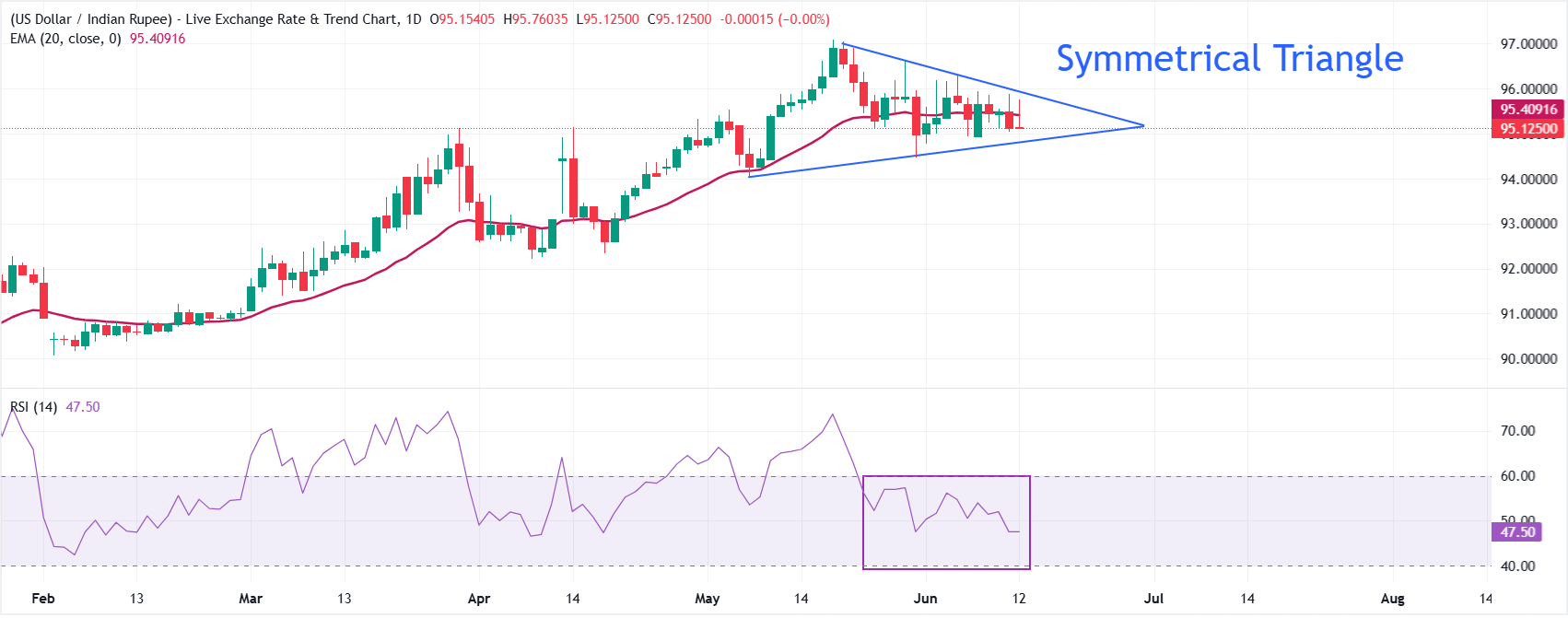
USD/INR trades sharply lower at around 95.12, keeping a bearish near-term tone as spot holds beneath the 20-day Exponential Moving Average (EMA) at 95.41.
The failed push above the downtrend resistance line, which now comes in around 95.96, leaves the pair capped, while the Relative Strength Index (RSI) near 47 hints at fading momentum rather than an imminent reversal.
On the topside, immediate resistance is seen at the 20-day EMA near 95.41, with the descending resistance trend line around 95.96 acting as a stronger barrier if bulls attempt a rebound. On the downside, initial support is aligned with the broken-uptrend area around 94.79, and a sustained break below this zone would reinforce the bearish structure and expose deeper losses toward the May 7 low at 94.03.
(The technical analysis of this story was written with the help of an AI tool.)
Economic Indicator
Consumer Price Index (YoY)
The India Consumer Price Index released by the Ministry of Statistics and Programme Implementation measures the average price change for all goods and services purchased by households for consumption purposes. CPI is the main indicator to measure inflation and changes in purchasing trends. A high reading is positive (or bullish) for the INR, while a low reading is negative (or bearish).
Read more.Last release: Fri Jun 12, 2026 10:30
Frequency: Monthly
Actual: 3.93%
Consensus: 4%
Previous: 3.48%
Author

Sagar Dua
FXStreet
Sagar Dua is associated with the financial markets from his college days. Along with pursuing post-graduation in Commerce in 2014, he started his markets training with chart analysis.

















