Gold trades sideways, underpinned by haven flows
- Gold trades in a $50 range, below the recent $2,758 record high, as it remains underpinned by haven flows.
- Relentless bombing by Israel and increased uncertainty over who will win the US presidential election are driving the flows.
- XAU/USD forms a mini range within a broader uptrend, but higher highs are still possible.

Gold (XAU/USD) remains stuck in this week’s mini range, exchanging hands in the $2,720s on Friday, as the precious metal is still supported by safe-haven flows due to a high level of geopolitical risk. The ongoing conflict in the Middle East and increasing uncertainty over who will win in the US election are both key factors driving investors to safe-play assets such as Gold.
Gold still supported as geopolitical risk premia ratchet up
Gold is likely to continue to find support from safe-haven flows as the war in the Middle East intensifies. Reuters reported on Friday that three Lebanese journalists had been killed in the bombing of a guesthouse used by members of the international press including Al Jazeera, Sky and Reuters.
This comes at the end of a week that has seen the Israelis up their bombing campaign, wiping out entire residential blocks of neighborhoods in Beirut, including a bomb that landed close to a hospital and ended the life of a child, as well as an attack that killed three Lebanese army soldiers organizing an evacuation.
In Doha, US Secretary of State Anthony Blinken is meeting with representatives from Israel and Qatar to try to negotiate an end to the conflict. This follows a separate meeting in Cairo between Egyptian diplomats and members of Hamas tasked with the same objective.
However, Hamas senior official Osama Hamdan told Lebanese pro-Hezbollah news agency Al-Mayadeen there was no change in the group's position. "The hostages held by the resistance will only return with a stop to the aggression and complete withdrawal," Hamdan said, according to Reuters.
Adding to the cocktail of geopolitical risk is the news that Republican nominee Donald Trump is edging forward in many polls, especially in key states like Wisconsin and North Carolina. This suggests he has a good chance of winning the US presidential election.
“An Emerson poll of several swing states yesterday had Trump very marginally ahead, including a 1pt lead in Pennsylvania and Wisconsin, and a 2pt lead in North Carolina," says Jim Reid, Global Head of Macro Research at Deutsche Bank on Friday.
According to the model of leading US election website FiveThirtyEight, Trump now has a slightly higher 51% chance of winning.
Nevertheless, the website’s master poll, which aggregates, averages, and weights polls according to recency, shows Vice President Kamala Harris still in the lead with 48.1% versus Trump’s 46.4%. Most betting websites offer better odds of Trump winning over Harris.
A Trump win would upset the existing geopolitical order and potentially increase safe-haven flows despite his claims to end conflicts worldwide in a matter of days.
Technical Analysis: Gold consolidates in a sideways band
Gold trades sideways in a mini range between $2,708 and $2,758 after peaking at the later level and rolling over.
That said, the yellow metal is in a steady uptrend on all time frames (short, medium and long) which given the technical principle that “the trend is your friend” the odds favor more upside.
A break above the top of the range at $2,758 would help confirm a continuation up to the next big-figure target level lies at $3,000 (round number and psychological level).
XAU/USD Daily Chart
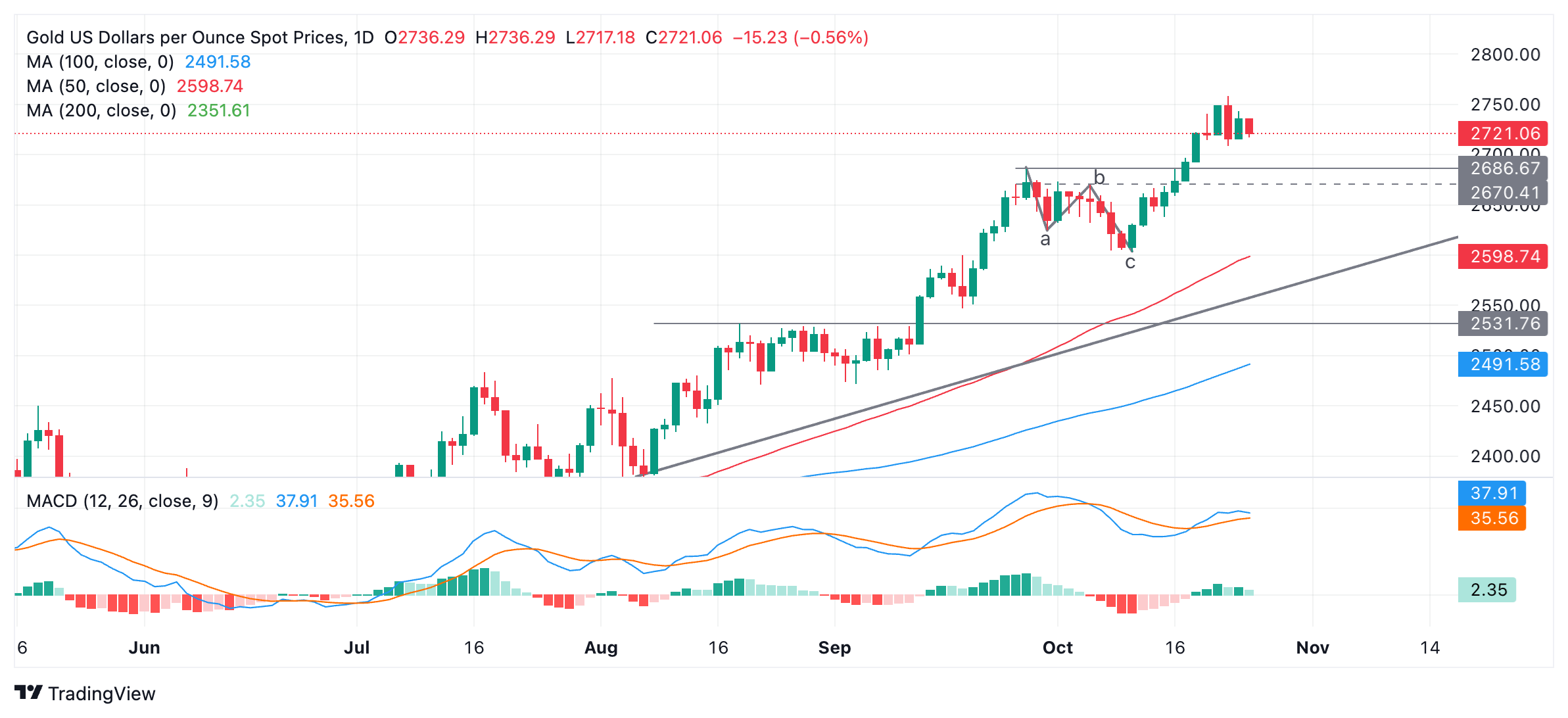
The Moving Average Convergence Divergence (MACD) is showing a bearish divergence between the September 26 high and the current price level. Although the price has risen since the September peak, the MACD is lower. This indicates waning bullish momentum and could be a sign presaging a pullback.
Gold’s overall strong uptrend, however, suggests that any corrections will probably be short-lived, with the broader bull trend resuming thereafter.
Risk sentiment FAQs
In the world of financial jargon the two widely used terms “risk-on” and “risk off'' refer to the level of risk that investors are willing to stomach during the period referenced. In a “risk-on” market, investors are optimistic about the future and more willing to buy risky assets. In a “risk-off” market investors start to ‘play it safe’ because they are worried about the future, and therefore buy less risky assets that are more certain of bringing a return, even if it is relatively modest.
Typically, during periods of “risk-on”, stock markets will rise, most commodities – except Gold – will also gain in value, since they benefit from a positive growth outlook. The currencies of nations that are heavy commodity exporters strengthen because of increased demand, and Cryptocurrencies rise. In a “risk-off” market, Bonds go up – especially major government Bonds – Gold shines, and safe-haven currencies such as the Japanese Yen, Swiss Franc and US Dollar all benefit.
The Australian Dollar (AUD), the Canadian Dollar (CAD), the New Zealand Dollar (NZD) and minor FX like the Ruble (RUB) and the South African Rand (ZAR), all tend to rise in markets that are “risk-on”. This is because the economies of these currencies are heavily reliant on commodity exports for growth, and commodities tend to rise in price during risk-on periods. This is because investors foresee greater demand for raw materials in the future due to heightened economic activity.
The major currencies that tend to rise during periods of “risk-off” are the US Dollar (USD), the Japanese Yen (JPY) and the Swiss Franc (CHF). The US Dollar, because it is the world’s reserve currency, and because in times of crisis investors buy US government debt, which is seen as safe because the largest economy in the world is unlikely to default. The Yen, from increased demand for Japanese government bonds, because a high proportion are held by domestic investors who are unlikely to dump them – even in a crisis. The Swiss Franc, because strict Swiss banking laws offer investors enhanced capital protection.
Author

Joaquin Monfort
FXStreet
Joaquin Monfort is a financial writer and analyst with over 10 years experience writing about financial markets and alt data. He holds a degree in Anthropology from London University and a Diploma in Technical analysis.