Gold firms as dovish Fed signals lift easing expectations
- Gold trades slightly firmer as markets balance shifting Fed expectations with improving risk sentiment.
- The lack of data ahead of the December 9-10 FOMC clouds the policy outlook, with key CPI and jobs delayed until mid-December.
- Technically, XAU/USD trades with a subdued tone beneath $4,100, with RSI reflecting neutral momentum.

Gold (XAU/USD) trades slightly firmer on Monday as investors weigh the evolving Federal Reserve (Fed) monetary policy outlook alongside improving sentiment in risk assets. At the time of writing, XAU/USD is trading around $4,087, up nearly 0.50% after bouncing off an intraday low near $4,040.
Market sentiment remains anchored to revived expectations of a December interest rate cut after New York Fed President John Williams said on Friday that he still sees room for a near-term easing move. His remarks helped reignite rate-cut pricing following a period of fading conviction.
However, uncertainty persists as several other policymakers maintain a more cautious stance. At the same time, the data vacuum ahead of the December 9-10 Federal Open Market Committee (FOMC) meeting is clouding the outlook, given that key inflation and employment reports will not be released until mid-December.
Improving risk appetite could limit upside for the non-yielding metal. As traders raise the probability of a December cut, global equities have stabilized after a turbulent week, reducing safe-haven demand.
Even so, the downside remains supported, with geopolitical risks still in play. The ongoing US-brokered Russia-Ukraine peace efforts remain fragile, and any setback could quickly revive haven flows and keep buyers interested on dips.
Market movers: Fed uncertainty and Russia-Ukraine negotiations keep markets cautious
- The US Dollar Index (DXY), which tracks the Greenback’s value against a basket of six major currencies, is trading around 100.17, stabilizing after dipping toward 100.00 earlier in the session and offering a mild headwind for Gold.
- Fed Governor Christopher Waller struck a notably dovish tone on Monday, expressing concern over weakening labour-market conditions and signalling support for a rate cut. Speaking to Fox Business, Waller said that since the last Fed meeting, available data shows “not much change,” adding that inflation is “not a big problem” given the softness in employment. He also warned that the September jobs figure is likely to be revised lower and noted that the concentration of hiring was “not a good sign."
- Fed commentary turned sharply mixed last week, with New York Fed President John Williams describing the current policy stance as “modestly restrictive” and signalling that there remains scope for a “further adjustment in the near term” to steer rates closer to neutral. He noted that progress on inflation has “temporarily stalled,” while economic activity has softened and the labour market has gradually cooled, with downside risks to employment increasing.
- Other Fed officials struck a more cautious tone, with voices like Fed Collins and Logan signalling reluctance to ease again in December as inflation remains sticky and policy is seen as only mildly restrictive.
- Following Fed Williams’ remarks, traders quickly lifted the odds of a December rate cut, with the CME FedWatch tool showing expectations almost doubling to roughly 70%.
- The updated US-drafted 28-point plan aimed at ending the Russia-Ukraine war is back in the spotlight after productive talks in Geneva, with Washington and Kyiv working to refine the framework following criticism that earlier terms favoured Moscow. Multiple reports indicate US President Donald Trump wants Ukraine to agree to the framework by Thursday, though US Secretary of State Marco Rubio signalled that the deadline is “not set in stone.”
Technical analysis: XAU/USD stalls under $4,100, neutral RSI highlights lack of conviction
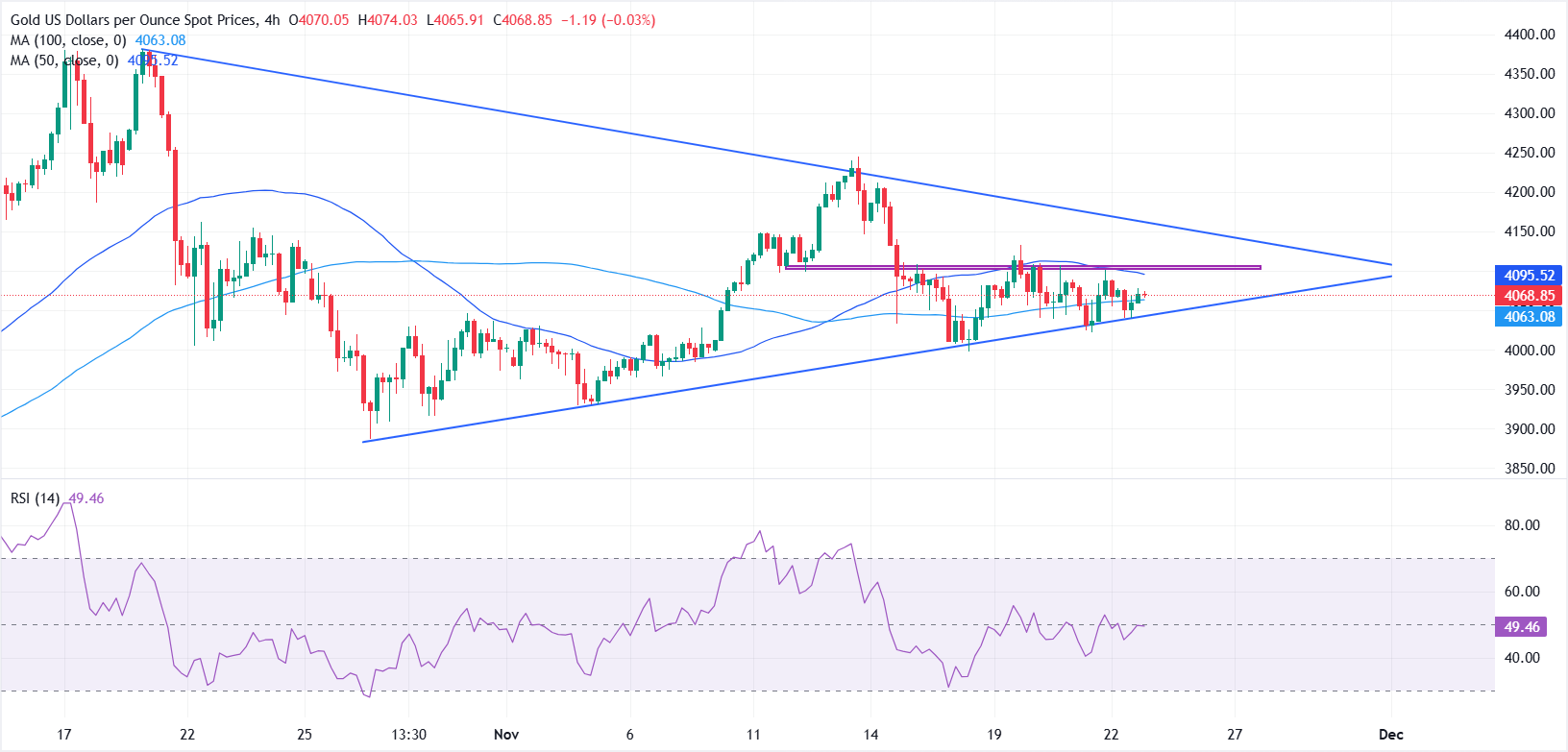
On the 4-hour chart, Gold remains vulnerable below the $4,100 mark, with price action consolidating inside a symmetrical triangle pattern. The metal continues to respect the ascending trendline support, but the lack of bullish follow-through keeps the near-term tone subdued.
The 100-period Simple Moving Average (SMA) near $4,062 is flattening and reflecting a lack of directional momentum. The 50-period SMA around $4,098 is capping the upside, keeping buyers on the defensive.
A decisive break above this level could open the door toward the descending triangle trendline positioned around $4,170-$4,200.
On the downside, initial support is seen at $4,050, followed by the rising trendline of the triangle near $4,030. A clean break below this area would expose the $4,000 psychological level, and a close beneath it risks accelerating downside pressure toward $3,900.
The RSI (14) sits near 49, firmly in neutral territory, offering no clear directional signal and aligning with the broader consolidation phase.
Gold FAQs
Gold has played a key role in human’s history as it has been widely used as a store of value and medium of exchange. Currently, apart from its shine and usage for jewelry, the precious metal is widely seen as a safe-haven asset, meaning that it is considered a good investment during turbulent times. Gold is also widely seen as a hedge against inflation and against depreciating currencies as it doesn’t rely on any specific issuer or government.
Central banks are the biggest Gold holders. In their aim to support their currencies in turbulent times, central banks tend to diversify their reserves and buy Gold to improve the perceived strength of the economy and the currency. High Gold reserves can be a source of trust for a country’s solvency. Central banks added 1,136 tonnes of Gold worth around $70 billion to their reserves in 2022, according to data from the World Gold Council. This is the highest yearly purchase since records began. Central banks from emerging economies such as China, India and Turkey are quickly increasing their Gold reserves.
Gold has an inverse correlation with the US Dollar and US Treasuries, which are both major reserve and safe-haven assets. When the Dollar depreciates, Gold tends to rise, enabling investors and central banks to diversify their assets in turbulent times. Gold is also inversely correlated with risk assets. A rally in the stock market tends to weaken Gold price, while sell-offs in riskier markets tend to favor the precious metal.
The price can move due to a wide range of factors. Geopolitical instability or fears of a deep recession can quickly make Gold price escalate due to its safe-haven status. As a yield-less asset, Gold tends to rise with lower interest rates, while higher cost of money usually weighs down on the yellow metal. Still, most moves depend on how the US Dollar (USD) behaves as the asset is priced in dollars (XAU/USD). A strong Dollar tends to keep the price of Gold controlled, whereas a weaker Dollar is likely to push Gold prices up.
Author

Vishal Chaturvedi
FXStreet
I am a macro-focused research analyst with over four years of experience covering forex and commodities market. I enjoy breaking down complex economic trends and turning them into clear, actionable insights that help traders stay ahead of the curve.