Gold slumps as EU-US trade deal dampens demand for safe havens
- Gold price weakens upon announcement of an EU-US trade deal.
- The US Dollar faces resistance ahead of Wednesday's Fed rate decision, Gold hinges on softer Greenback.
- XAU/USD trades near $3,310 as bulls struggle to clear $3,400.

Gold is trading in a narrow range on Monday, as economic data, easing trade tensions, and the fragility of the US Dollar continue to influence price action.
At the time of writing, Gold is trading near $3,310 per ounce, down from earlier highs near $3,345.
A US–EU trade deal has been announced, easing tariff risks and reducing demand for safe havens. The deal lowers the baseline tariff on most EU goods to 15%, down from the previously proposed 30%, in exchange for improved market access for US firms in digital services, agriculture, and clean energy.
The agreement, modeled on the US–Japan trade deal signed last week, aims to streamline industrial standards. The US Dollar firms on prospects of deals ahead of the FOMC meeting and avoids a disruptive tariff escalation.
It also includes a framework for cooperation on critical minerals, allowing EU exporters to benefit from the Inflation Reduction Act (IRA) incentives in the United States.
This breakthrough has boosted equity market sentiment, strengthened the US Dollar, and reduced demand for safe-haven assets such as Gold.
“We are building a stronger transatlantic economy based on fairness, access, and innovation,” said Treasury Secretary Scott Bessent, who confirmed the deal following meetings with EU Trade Commissioner Valdis Dombrovskis.
The news adds pressure to XAU/USD, which continues to trade near $3,340, as investors rotate out of safe-haven assets amid growing optimism about global trade stability.
Gold daily digest market movers: US-China trade talks in focus
- A strong labor backdrop reduces pressure on the Federal Reserve (Fed) to cut interest rates, which in turn supports higher yields and the US Dollar, both traditionally bearish for Gold.
- According to the CME FedWatch Tool, markets are pricing a 59.5% probability of a 25-basis-point rate cut in September, with a 38.9% probability that rates will remain unchanged at the same meeting.
- Although markets continue to price in at least one rate cut from the Federal Reserve (Fed) this year, rising demand for alternative assets has capped gains for Gold. The Minutes of the June FOMC meeting revealed that most Fed officials were hesitant to endorse rate cuts. The majority of officials cite concerns about inflation, particularly those stemming from elevated import costs resulting from global trade tensions.
This makes upcoming trade negotiations with the US and China especially important. A failure to reach new agreements could lead to a re-escalation in tariffs, reigniting inflationary pressure and complicating the Fed’s ability to lower rates. Such a scenario could also revive safe-haven demand for Gold.
Gold rises toward triangle support
The daily chart of spot Gold shows a symmetrical triangle pattern, indicating consolidation and the potential for a breakout. With XAU/USD still struggling to gain traction and break through triangle resistance, bulls would need to rise above the 23.6% Fibonacci retracement of the April low–high move near $3,372 in an effort to reclaim the $3,400 psychological level. A surge in bullish momentum above this zone would bring the June high of $3,452 back into play, opening the door for a potential retest of the $3,500 all-time high.
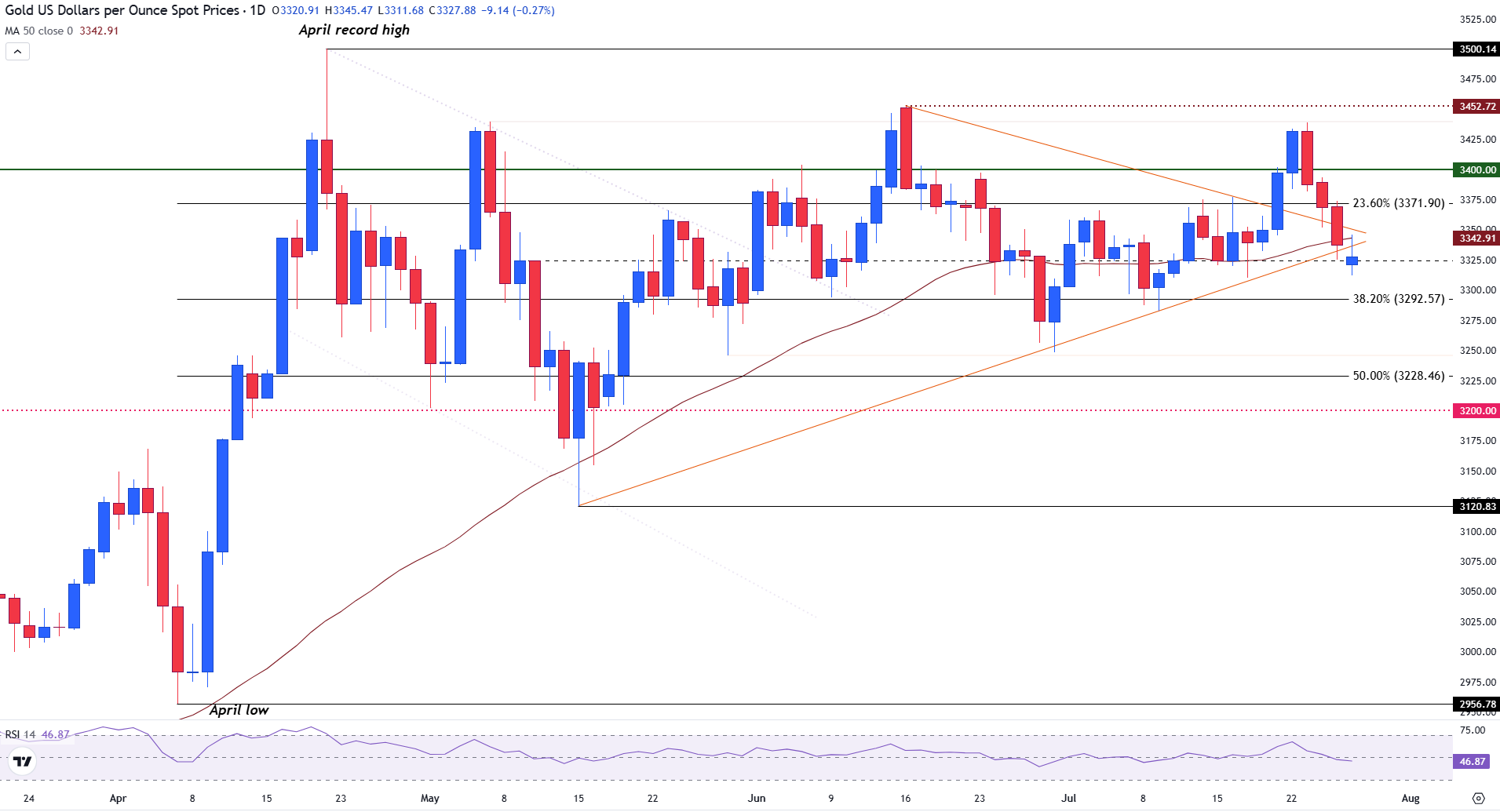
On the downside, immediate support is found at the $3,350 psychological level, resting just above the 50-day Simple Moving Average (SMA) at $3,327. The 38.2% Fibo level at $3,292 and the 50% level at $3,228 may provide a floor for price action in the event of a pullback.
Meanwhile, the Relative Strength Index (RSI) at 55 signals a slight bullish bias, without threatening overbought territory. Overall, the market appears poised for a directional move, with traders likely watching for a decisive breakout from the triangle structure.
Gold FAQs
Gold has played a key role in human’s history as it has been widely used as a store of value and medium of exchange. Currently, apart from its shine and usage for jewelry, the precious metal is widely seen as a safe-haven asset, meaning that it is considered a good investment during turbulent times. Gold is also widely seen as a hedge against inflation and against depreciating currencies as it doesn’t rely on any specific issuer or government.
Central banks are the biggest Gold holders. In their aim to support their currencies in turbulent times, central banks tend to diversify their reserves and buy Gold to improve the perceived strength of the economy and the currency. High Gold reserves can be a source of trust for a country’s solvency. Central banks added 1,136 tonnes of Gold worth around $70 billion to their reserves in 2022, according to data from the World Gold Council. This is the highest yearly purchase since records began. Central banks from emerging economies such as China, India and Turkey are quickly increasing their Gold reserves.
Gold has an inverse correlation with the US Dollar and US Treasuries, which are both major reserve and safe-haven assets. When the Dollar depreciates, Gold tends to rise, enabling investors and central banks to diversify their assets in turbulent times. Gold is also inversely correlated with risk assets. A rally in the stock market tends to weaken Gold price, while sell-offs in riskier markets tend to favor the precious metal.
The price can move due to a wide range of factors. Geopolitical instability or fears of a deep recession can quickly make Gold price escalate due to its safe-haven status. As a yield-less asset, Gold tends to rise with lower interest rates, while higher cost of money usually weighs down on the yellow metal. Still, most moves depend on how the US Dollar (USD) behaves as the asset is priced in dollars (XAU/USD). A strong Dollar tends to keep the price of Gold controlled, whereas a weaker Dollar is likely to push Gold prices up.
Author

Tammy Da Costa, CFTe®
FXStreet
Tammy is an economist and market analyst with a deep passion for financial markets, particularly commodities and geopolitics.