Gold tops $4,000 as US shutdown, weak data stoke haven demand
- Gold trades near $4,002, extending weekly gains as market uncertainty supports safe-haven demand.
- US consumer sentiment falls to its lowest since June 2022 amid prolonged government shutdown worries.
- Markets price 68% odds of a December Fed cut as job cuts surge to 20-year highs.

Gold price (XAU/USD) advances during the North American session on Friday, up 0.64% as the US government shutdown extends, while risk aversion keeps US equity markets poised for weekly losses. At the time of writing, Bullion trades at $4,002 after bouncing off daily lows of $3,974.
Bullion gains 0.64% amid risk aversion and growing bets for a December Fed rate cut
Uncertainty continues to surround the US economy, as shown by the University of Michigan preliminary Consumer Sentiment for November. The index reached its lowest level since June 2022 amid the COVID emergency, showing that households are expressing worries “about potential negative consequences for the economy” of the US government shutdown.
Consequently, Gold, which is usually sought as a hedge to uncertainty and lower interest rate environments, clung to its gains, up so far 0.13% in the week.
Meanwhile, the US job market might be slowing more sharply than expected, as the Challenger report prepared by Gray & Christmas showed on Thursday that employers fired over 150,000 people in October, the largest reduction for the month in more than 20 years.
Market participants see a 68% chance of a rate cut by the Federal Reserve (Fed) at the December meeting, according to data by the Prime Market Terminal interest rate probability tool.
Daily market movers: Gold advances amid steady US Treasury yields
- The US Dollar Index (DXY), which tracks the performance of the American currency against other six, slides 0.15%, down to 99.55.
- US Treasury yields with the 10-year Treasury note yield stabilized, following Thursday’s seven-and-a-half basis points plunge, and hovers at around 4.085%, unchanged. US real yields — which correlate inversely to Gold prices — climb nearly two basis points to 1.805%.
- The US government shutdown began its thirty-eighth day, and the chances of a reopening seem far even though the Republican Senate Leader John Thune has proposed a vote later Friday on a new continuing resolution to reopen the government through January.
- The White House Economic Adviser Kevin Hassett told CNN that the shutdown is hurting the economy more than they expected, anticipating a reduction of 1 to 1.5% in GDP growth this quarter.
- The New York Fed Consumer Survey showed that inflation expectations for one year in October dipped from 3.4% to 3.2%. For a three and five-year period, they remained unchanged at 3% each.
- The University of Michigan revealed that Consumer Sentiment in November plunged to 50.3 from 53.6 in October. The survey updated households’ inflation expectations. For a one-year period, it rose to 4.7% from 4.6%, and for a five-year period, dipped from 3.9% to 3.6%.
- Fed Vice Chair Philip Jeffferson said that “The Fed should proceed slowly with further rate cuts as policy approaches the neutral rate.” He commented that his approach would be meeting by meeting and cited “a potential lack of government data due to the shutdown.”
- Data from the World Gold Council (WGC) revealed that Gold ETFs recorded inflows of 54.9 tonnes in October, led by strong demand from North America (+47.2 tonnes) and Asia (+44.8 tonnes), while Europe saw outflows of 37.4 tonnes.
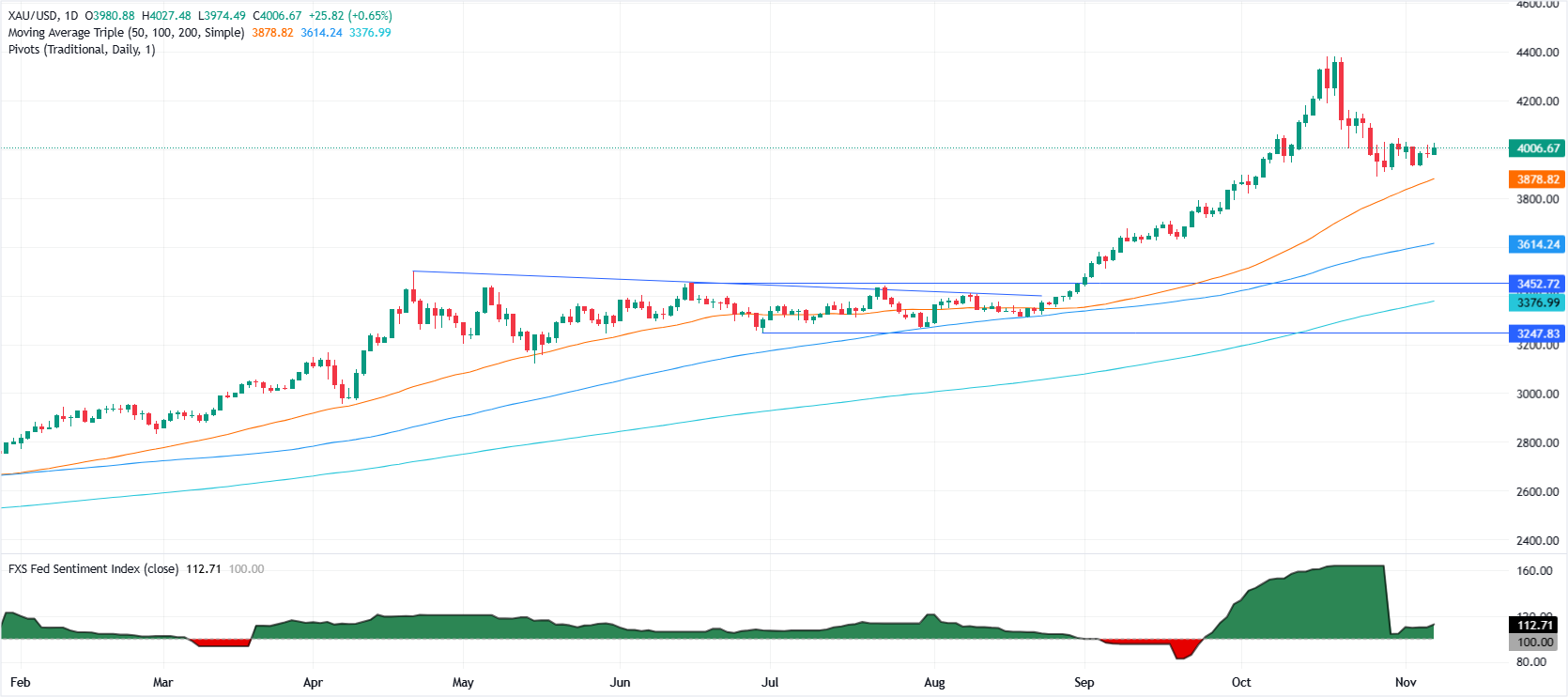
Technical outlook: Gold price climbs towards $4,000
Gold’s technical picture remains bullish, though bulls must achieve a daily close above $4,000 to remain hopeful of higher prices. Bullish momentum is increasing as depicted by the RSI.
If XAU/USD climbs above $4,000, bulls could target the 20-day Simple Moving Average (SMA) at $4,082. A breach of the latter will expose $4,100. Conversely, a drop below $4,000 would expose the $3,950, followed by the October 28 low of $3,886.
Gold FAQs
Gold has played a key role in human’s history as it has been widely used as a store of value and medium of exchange. Currently, apart from its shine and usage for jewelry, the precious metal is widely seen as a safe-haven asset, meaning that it is considered a good investment during turbulent times. Gold is also widely seen as a hedge against inflation and against depreciating currencies as it doesn’t rely on any specific issuer or government.
Central banks are the biggest Gold holders. In their aim to support their currencies in turbulent times, central banks tend to diversify their reserves and buy Gold to improve the perceived strength of the economy and the currency. High Gold reserves can be a source of trust for a country’s solvency. Central banks added 1,136 tonnes of Gold worth around $70 billion to their reserves in 2022, according to data from the World Gold Council. This is the highest yearly purchase since records began. Central banks from emerging economies such as China, India and Turkey are quickly increasing their Gold reserves.
Gold has an inverse correlation with the US Dollar and US Treasuries, which are both major reserve and safe-haven assets. When the Dollar depreciates, Gold tends to rise, enabling investors and central banks to diversify their assets in turbulent times. Gold is also inversely correlated with risk assets. A rally in the stock market tends to weaken Gold price, while sell-offs in riskier markets tend to favor the precious metal.
The price can move due to a wide range of factors. Geopolitical instability or fears of a deep recession can quickly make Gold price escalate due to its safe-haven status. As a yield-less asset, Gold tends to rise with lower interest rates, while higher cost of money usually weighs down on the yellow metal. Still, most moves depend on how the US Dollar (USD) behaves as the asset is priced in dollars (XAU/USD). A strong Dollar tends to keep the price of Gold controlled, whereas a weaker Dollar is likely to push Gold prices up.
Author

Christian Borjon Valencia
FXStreet
Markets analyst, news editor, and trading instructor with over 14 years of experience across FX, commodities, US equity indices, and global macro markets.
















