Gold subdued as US Dollar strength and fading Fed cut bets weigh
- Gold steadies above $4,050 after last week’s two-day slide from a three-week high.
- Stronger US Dollar and fading Fed rate-cut bets continue to cap the upside.
- Markets eye delayed US data, with the September NFP due on Thursday.

Gold (XAU/USD) kicks off the week on a subdued note, consolidating losses after a two-day slide that followed last week’s push to over a three-week high. At the time of writing, XAU/USD is trading around $4,075 with gains capped by a firmer US Dollar (USD) and diminishing bets on a December interest rate cut by the Federal Reserve (Fed).
Traders are refraining from taking aggressive directional positions ahead of a pivotal week, with markets bracing for US economic data that was delayed by the government shutdown. The spotlight is firmly on the September Nonfarm Payrolls (NFP) report, which is expected to provide the first clear update on labor market conditions in weeks.
As attention shifts to long-delayed economic releases, Gold stays sensitive to the Fed’s cautious stance, with the FOMC Minutes also due later this week. The metal may remain range-bound, as lingering uncertainty around the Fed’s next steps should help cushion the downside.
Market movers: Fed hawks trim December rate-cut bets as data backlog looms
- The US Dollar Index (DXY), which tracks the Greenback's value against a basket of six major currencies, is trading around 99.50, extending gains for the second straight day after slipping to two-week lows last week.
- Gold is also facing headwinds as the end of the US government shutdown and easing global trade tensions surrounding US tariffs have reduced its safe-haven appeal. However, persistent geopolitical and economic risks keep the broader outlook tilted to the upside.
- The Bureau of Labor Statistics (BLS) reported on Friday that key releases delayed by the government shutdown now have revised dates, with the September Employment Situation report rescheduled to November 20 and September Real Earnings set for November 21, both at 13:30 GMT. US Labor Secretary Chavez-Deremer also noted that the agency was unable to fully gather the October Consumer Price Index (CPI) data, raising the possibility that the report may never be published.
- Fed Vice Chair Philip Jefferson delivered slightly dovish but cautious remarks on Monday, noting rising risks to employment and a gradual cooling in the labor market, in contrast to the hawkish messaging from other Fed officials last week. He said policymakers need to proceed slowly as rates approach neutral, while warning that it is still unclear how much government data will be available ahead of the next meeting.
- Fed rate-cut expectations have cooled after hawkish commentary last week, with officials stressing that inflation remains their main concern despite softer labor market signals. According to the CME FedWatch Tool, the probability of a December rate cut has dropped to around 44%, down sharply from 94% a month ago.
Technical analysis: XAU/USD holds above 100-SMA but momentum stays bearish
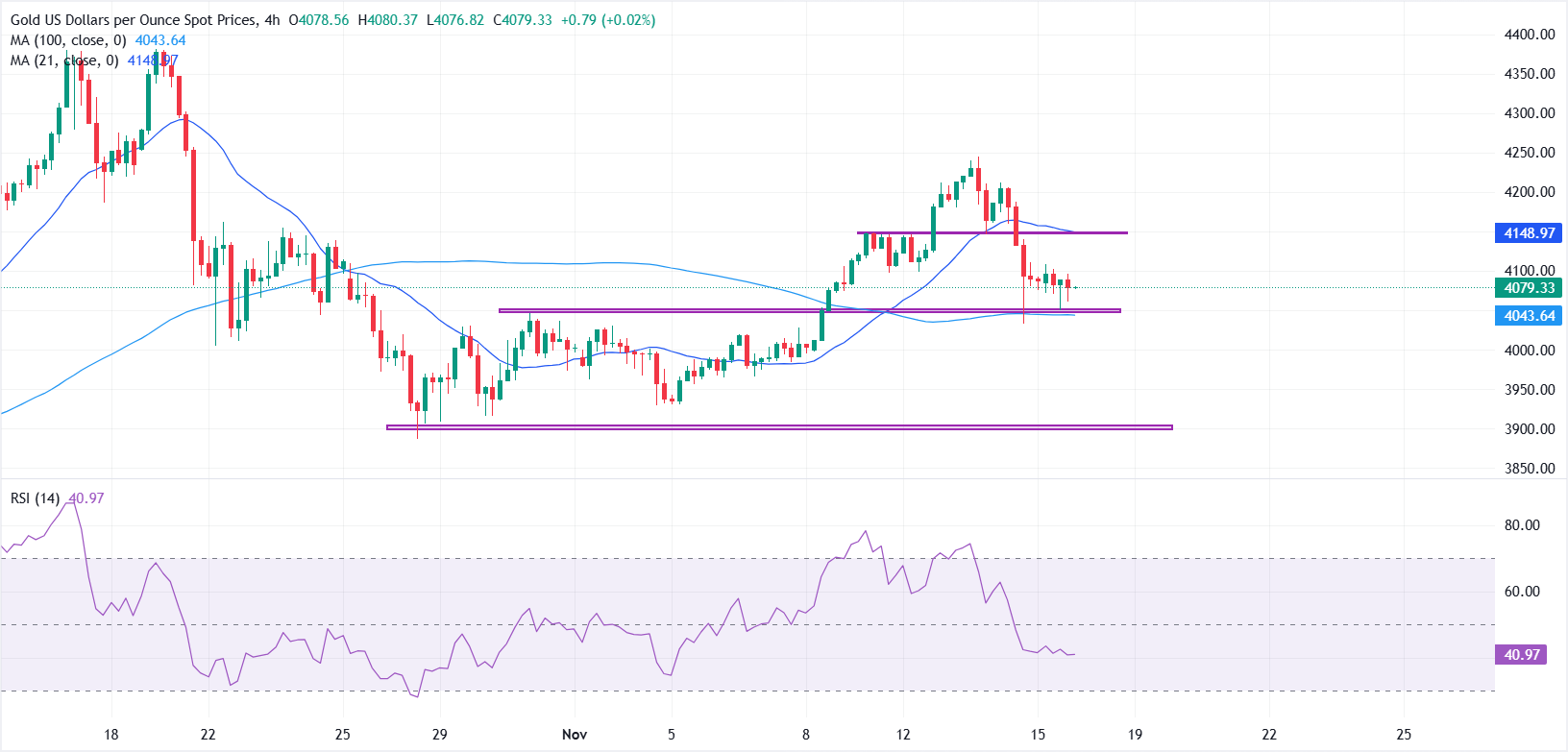
The near-term outlook for Gold appears range-bound, with the 4-hour chart showing repeated support emerging around the 100-period SMA near $4,043. This level also aligns closely with the upper boundary of the previous consolidation zone, reinforcing its importance as a strong support area.
A clear break below $4,040-$4,050 would push Gold back inside the former $4,050-$3,900 range, opening the door for a deeper pullback toward $3,900, especially if the $4,000 psychological level fails to hold.
On the upside, immediate resistance is seen at $4,100, followed by a stronger barrier at $4,150, which lines up with the 21-period SMA. A sustained break above this zone would allow bulls to re-test the $4,250 region.
Momentum remains weak, with the Relative Strength Index (RSI) holding near 41, indicating that sellers retain control in the short term.
Gold FAQs
Gold has played a key role in human’s history as it has been widely used as a store of value and medium of exchange. Currently, apart from its shine and usage for jewelry, the precious metal is widely seen as a safe-haven asset, meaning that it is considered a good investment during turbulent times. Gold is also widely seen as a hedge against inflation and against depreciating currencies as it doesn’t rely on any specific issuer or government.
Central banks are the biggest Gold holders. In their aim to support their currencies in turbulent times, central banks tend to diversify their reserves and buy Gold to improve the perceived strength of the economy and the currency. High Gold reserves can be a source of trust for a country’s solvency. Central banks added 1,136 tonnes of Gold worth around $70 billion to their reserves in 2022, according to data from the World Gold Council. This is the highest yearly purchase since records began. Central banks from emerging economies such as China, India and Turkey are quickly increasing their Gold reserves.
Gold has an inverse correlation with the US Dollar and US Treasuries, which are both major reserve and safe-haven assets. When the Dollar depreciates, Gold tends to rise, enabling investors and central banks to diversify their assets in turbulent times. Gold is also inversely correlated with risk assets. A rally in the stock market tends to weaken Gold price, while sell-offs in riskier markets tend to favor the precious metal.
The price can move due to a wide range of factors. Geopolitical instability or fears of a deep recession can quickly make Gold price escalate due to its safe-haven status. As a yield-less asset, Gold tends to rise with lower interest rates, while higher cost of money usually weighs down on the yellow metal. Still, most moves depend on how the US Dollar (USD) behaves as the asset is priced in dollars (XAU/USD). A strong Dollar tends to keep the price of Gold controlled, whereas a weaker Dollar is likely to push Gold prices up.
Author

Vishal Chaturvedi
FXStreet
I am a macro-focused research analyst with over four years of experience covering forex and commodities market. I enjoy breaking down complex economic trends and turning them into clear, actionable insights that help traders stay ahead of the curve.