Gold remains range-bound as stronger US Dollar caps upside
- Gold holds firm as risk-off sentiment supports safe-haven demand amid global equity weakness.
- ADP private payrolls rose by 42,000 in October, while the ISM Services PMI rebounded to 52.4 from 50.0.
- Technically, Gold’s short-term bias remains slightly bearish, with XAU/USD trading below the 21-period SMA near $3,990.

Gold (XAU/USD) holds steady within familiar ranges on Wednesday as a mild risk-off tone across global markets underpins demand for the safe-haven metal. At the time of writing, XAU/USD is trading around $3,975, recovering modestly from Tuesday’s low of $3,928.
The risk-off sentiment follows a broad sell-off in global equities, led by weakness in US tech and AI-related stocks. Concerns about stretched valuations and warnings from Wall Street executives of a potential correction sparked the downturn, which rippled through Asian and European markets. Meanwhile, ongoing uncertainty surrounding the prolonged United States (US) government shutdown added to the cautious tone.
However, Gold’s recovery lacks strong follow-through buying as the resilient US Dollar (USD) continues to cap upside attempts, but persistent risk aversion and buying interest near recent lows should keep downside contained.
Market movers: Dollar strengthens on upbeat US data; attention turns to Supreme Court tariff case
- The latest ADP Employment Change report showed private-sector employment rising by 42,000 in October, surpassing forecasts of 25,000 after a 32,000 drop in September. Meanwhile, the ISM Services PMI rebounded to 52.4 in October from 50.0 in September, signaling renewed expansion in the sector. The New Orders Index climbed to 56.2, its highest since October 2024, while the Prices Paid Index rose to 70.0.
- The US Dollar Index (DXY), which gauges the Greenback’s strength against six major peers, advances to 100.30, its highest level since May 29, as the Greenback extends its rally for a sixth consecutive day amid fading expectations of further Fed rate cuts.
- US President Donald Trump signed two executive orders on Tuesday aimed at easing trade tensions with China, following a recent meeting and trade agreement with Chinese President Xi Jinping. Effective November 10, the tariff on fentanyl-linked imports from China will be reduced from 20% to 10%, while the reciprocal tariff rate on Chinese goods will remain at 10% for another year, extending a truce that lowered the original rate from 34%. Beijing responded by temporarily lifting some retaliatory duties on US agricultural and industrial products.
- The legality of the Trump administration’s tariffs is back in the spotlight as the US Supreme Court prepares to hear arguments later on Wednesday over whether the use of emergency powers to impose broad import duties was lawful. Two lower courts have already ruled the tariffs illegal, and the outcome could shape the future scope of presidential authority over trade policy.
- The US government shutdown entered its thirty-sixth day on Wednesday, marking the longest in history. The funding deadlock continues to delay key economic data releases and fuel worries about its growing impact on the broader economy.
- The monetary policy outlook remains clouded after last week’s 25-basis-point (bps) rate cut, as Federal Reserve (Fed) Chair Jerome Powell signaled that further easing this year is “not a foregone conclusion.” Still, diverging opinions among Fed officials on inflation and labor market conditions have left markets uncertain over the prospect of another rate cut in December.
- According to the CME FedWatch Tool, markets now price a 68% chance of a December rate cut, down sharply from 94% before Powell’s remarks. With official economic data delayed by the ongoing shutdown, the ADP and ISM Services PMI figures could prove pivotal in shaping near-term Fed expectations.
Technical analysis: Bearish bias holds below 21-SMA, RSI signals weak momentum
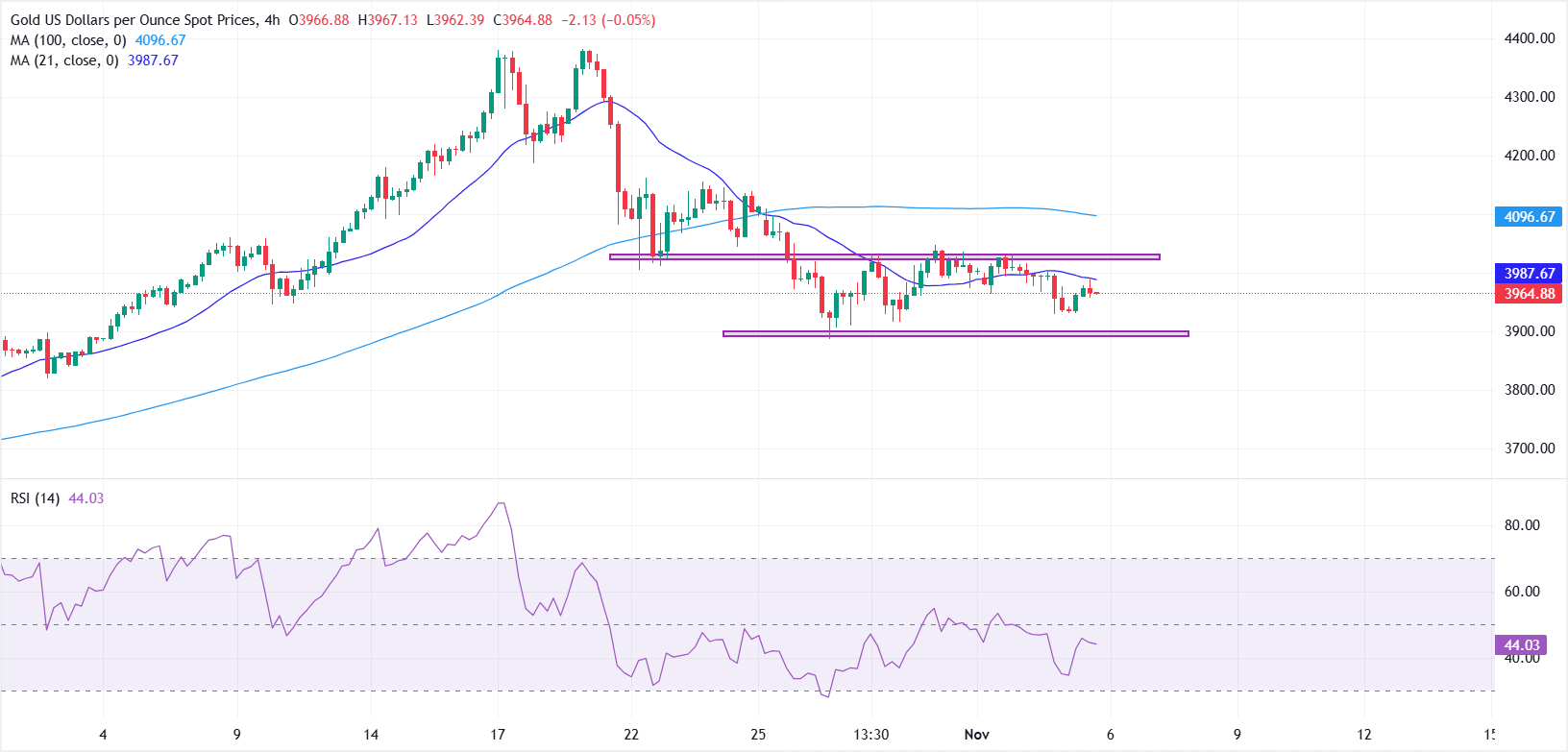
Gold remains trapped in a narrow range between $4,050 and $3,900 on the 4-hour chart, reflecting indecision among traders. The short-term bias leans slightly bearish as the metal continues to trade below its 21-period Simple Moving Average (SMA) near $3,990, which caps immediate upside attempts. A stronger recovery would need a break above the former support-turned-resistance zone at $4,020-$4,050 to attract fresh buying interest.
On the downside, repeated buying interest near the $3,900 area continues to offer a solid floor for now. A clear break below this level could open the door toward deeper losses.
The Relative Strength Index (RSI) holds around 44, suggesting subdued momentum and keeping Gold vulnerable to further range-bound trading in the near term.
Gold FAQs
Gold has played a key role in human’s history as it has been widely used as a store of value and medium of exchange. Currently, apart from its shine and usage for jewelry, the precious metal is widely seen as a safe-haven asset, meaning that it is considered a good investment during turbulent times. Gold is also widely seen as a hedge against inflation and against depreciating currencies as it doesn’t rely on any specific issuer or government.
Central banks are the biggest Gold holders. In their aim to support their currencies in turbulent times, central banks tend to diversify their reserves and buy Gold to improve the perceived strength of the economy and the currency. High Gold reserves can be a source of trust for a country’s solvency. Central banks added 1,136 tonnes of Gold worth around $70 billion to their reserves in 2022, according to data from the World Gold Council. This is the highest yearly purchase since records began. Central banks from emerging economies such as China, India and Turkey are quickly increasing their Gold reserves.
Gold has an inverse correlation with the US Dollar and US Treasuries, which are both major reserve and safe-haven assets. When the Dollar depreciates, Gold tends to rise, enabling investors and central banks to diversify their assets in turbulent times. Gold is also inversely correlated with risk assets. A rally in the stock market tends to weaken Gold price, while sell-offs in riskier markets tend to favor the precious metal.
The price can move due to a wide range of factors. Geopolitical instability or fears of a deep recession can quickly make Gold price escalate due to its safe-haven status. As a yield-less asset, Gold tends to rise with lower interest rates, while higher cost of money usually weighs down on the yellow metal. Still, most moves depend on how the US Dollar (USD) behaves as the asset is priced in dollars (XAU/USD). A strong Dollar tends to keep the price of Gold controlled, whereas a weaker Dollar is likely to push Gold prices up.
Author

Vishal Chaturvedi
FXStreet
I am a macro-focused research analyst with over four years of experience covering forex and commodities market. I enjoy breaking down complex economic trends and turning them into clear, actionable insights that help traders stay ahead of the curve.

















