Gold remains rangebound as easing Iran tensions and Fed outlook weigh
- Gold remains rangebound after hitting a fresh record high earlier this week.
- Easing Iran tensions and firm US data temper upside, though broader geopolitical risks cap the downside.
- Markets look ahead to Fed commentary and geopolitical headlines for near-term direction.

Gold (XAU/USD) remains rangebound on Friday, after surging to a fresh all-time high near $4,643 earlier this week, driven by geopolitical tensions and concerns over the Federal Reserve’s (Fed) independence. At the time of writing, XAU/USD is consolidating around $4,610, on track for a modest weekly gain.
Easing tensions in Iran are weighing on safe-haven demand. At the same time, stronger US economic data and hawkish remarks from Federal Reserve (Fed) officials have strengthened expectations that interest-rate cuts could be delayed, acting as a headwind for non-yielding Gold.
That said, broader geopolitical risks remain in play, helping to limit downside pressure. Meanwhile, investors continue to see room for around two Fed rate cuts later this year, even as near-term easing expectations fade.
Against this mixed fundamental backdrop and a light US economic calendar, Gold is expected to remain rangebound, leaving price action particularly sensitive to incoming geopolitical headlines.
Traders will also keep a close eye on Fed commentary for fresh signals on the monetary policy outlook, as the central bank heads into its blackout period ahead of the January 27-28 meeting.
Market movers: Iran headlines, US data and Fed signals steer sentiment
- Geopolitical risk premiums fade after US President Donald Trump softened his rhetoric on Iran, easing fears of imminent military action following reports of reduced protest violence and pauses in executions. However, the United States imposed fresh sanctions on Thursday targeting senior Iranian officials and entities linked to the handling of nationwide protests.
- On the monetary policy front, resilient US economic data this week have reinforced the view that the Fed is likely to stick to a gradual easing path rather than aggressive rate cuts. Markets are fully pricing in interest rates to remain unchanged at the January meeting. According to the CME FedWatch Tool, traders currently see June as the most likely timing for the first rate cut this year, with odds around 46.6%.
- Weekly Initial Jobless Claims fell to 198,000 in the week ended January 10, beating expectations of 215,000, while the four-week average eased to 205,000 from 211,500. Regional factory surveys also improved, with the Empire State index rising to 7.7 from -3.7 and the Philadelphia Fed survey climbing to 12.6 from -8.8.
- Data released earlier this week showed that the US headline Consumer Price Index (CPI) rose 0.3% MoM in December, in line with expectations and unchanged from November, keeping the annual rate steady at 2.7%. Core CPI increased 0.2% MoM, coming in below the 0.3% forecast. On a yearly basis, core inflation eased to 2.6%, undershooting expectations of 2.7%.
- Chicago Fed President Austan Goolsbee said on Thursday that he still expects the Fed to cut interest rates this year, but stressed that policymakers need incoming data to confirm that outlook. He added that rates "can still go down a fair amount," but only if there is clear evidence that inflation is retreating. Goolsbee also reiterated that the Fed’s most important challenge remains getting inflation back to the 2% target.
- Atlanta Fed President Raphael Bostic said that "we need to make sure that we stay in a restrictive stance, because inflation is still too high." Kansas City Fed President Jeffrey Schmid said that monetary policy should remain "modestly restrictive," while San Francisco Fed President Mary Daly noted that "policy is in a good place".
Technical analysis: XAU/USD consolidates near $4,600 as RSI eases
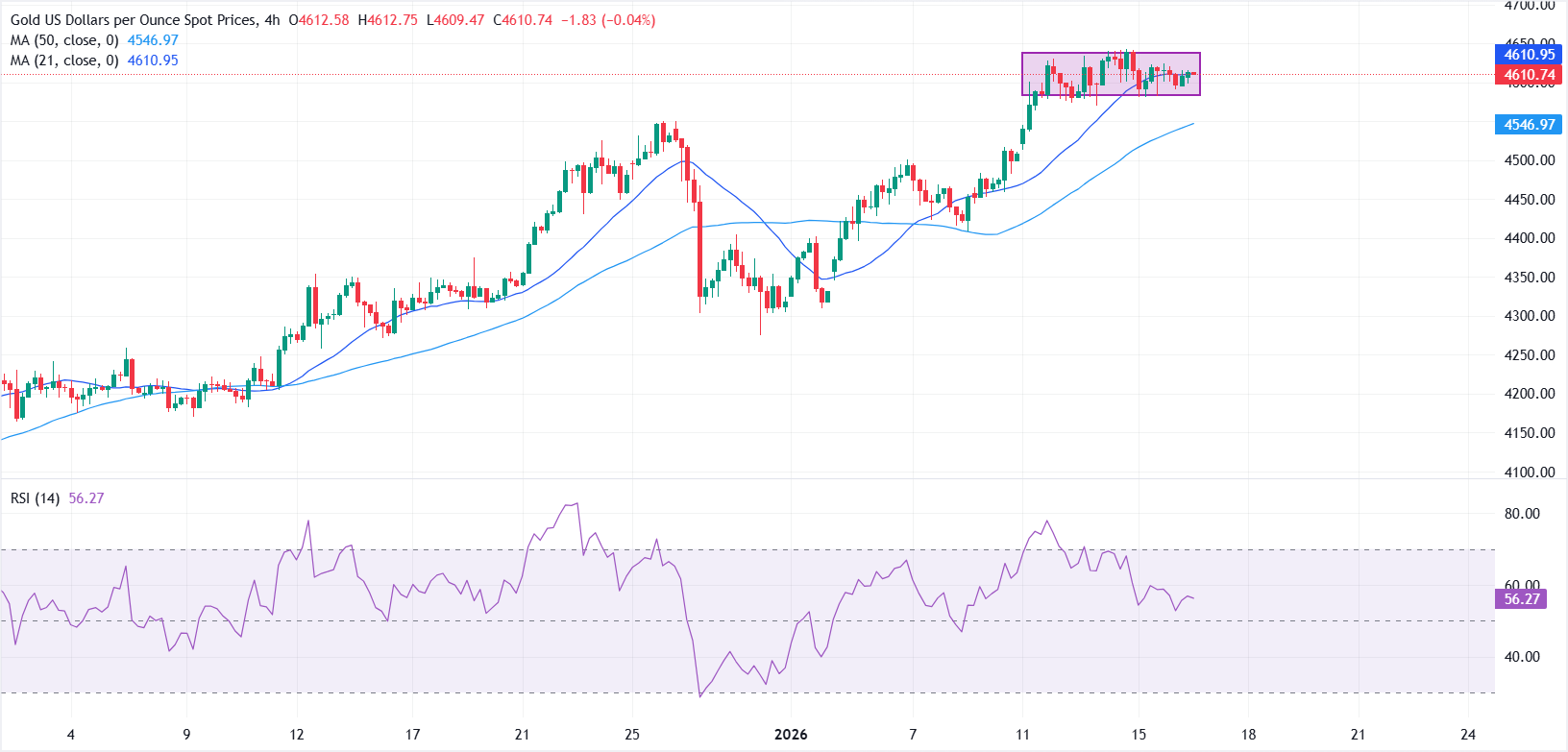
From a technical perspective, XAU/USD remains stuck in a tight consolidation range, with price action capped between the $4,580-$4,640 zone as bullish momentum cools.
On the 4-hour chart, the Relative Strength Index (RSI) has eased back from overbought territory and now hovers near the mid-50s, reflecting a loss of upside momentum.
Price is currently oscillating around the 21-period Simple Moving Average (SMA) near $4,610, which is acting as an immediate pivot. The $4,600 psychological level offers initial support, followed by a stronger cushion near $4,550, where the 50-period SMA comes in around $4,546.
A sustained break below this region could open the door for a deeper pullback, while a clear move beyond $4,640 would be needed to revive bullish momentum.
Gold FAQs
Gold has played a key role in human’s history as it has been widely used as a store of value and medium of exchange. Currently, apart from its shine and usage for jewelry, the precious metal is widely seen as a safe-haven asset, meaning that it is considered a good investment during turbulent times. Gold is also widely seen as a hedge against inflation and against depreciating currencies as it doesn’t rely on any specific issuer or government.
Central banks are the biggest Gold holders. In their aim to support their currencies in turbulent times, central banks tend to diversify their reserves and buy Gold to improve the perceived strength of the economy and the currency. High Gold reserves can be a source of trust for a country’s solvency. Central banks added 1,136 tonnes of Gold worth around $70 billion to their reserves in 2022, according to data from the World Gold Council. This is the highest yearly purchase since records began. Central banks from emerging economies such as China, India and Turkey are quickly increasing their Gold reserves.
Gold has an inverse correlation with the US Dollar and US Treasuries, which are both major reserve and safe-haven assets. When the Dollar depreciates, Gold tends to rise, enabling investors and central banks to diversify their assets in turbulent times. Gold is also inversely correlated with risk assets. A rally in the stock market tends to weaken Gold price, while sell-offs in riskier markets tend to favor the precious metal.
The price can move due to a wide range of factors. Geopolitical instability or fears of a deep recession can quickly make Gold price escalate due to its safe-haven status. As a yield-less asset, Gold tends to rise with lower interest rates, while higher cost of money usually weighs down on the yellow metal. Still, most moves depend on how the US Dollar (USD) behaves as the asset is priced in dollars (XAU/USD). A strong Dollar tends to keep the price of Gold controlled, whereas a weaker Dollar is likely to push Gold prices up.
Author

Vishal Chaturvedi
FXStreet
I am a macro-focused research analyst with over four years of experience covering forex and commodities market. I enjoy breaking down complex economic trends and turning them into clear, actionable insights that help traders stay ahead of the curve.















