Gold rebounds as fresh Fed signals revive December easing bets
- Gold trims intraday losses as Fed’s Williams signals room for a near-term rate cut.
- Mixed US labour data reinforces expectations that policymakers may remain cautious next month.
- Soft physical demand signals from China and weaker Swiss exports add to the broader market narrative.

Gold (XAU/USD) pares some of its intraday losses on Friday after fresh comments from Federal Reserve (Fed) officials revive near-term rate-cut expectations. New York Fed President John Williams said he still sees room for a near-term cut, helping the metal recover from an earlier slide.
At the time of writing, XAU/USD is trading around $4,067, after bouncing from an intraday low near $4,022, though it remains vulnerable as the metal continues to oscillate within the range established earlier this week.
Markets had been dialing back expectations for a December rate cut, with most Fed officials striking a noticeably cautious tone in recent weeks. Policymakers have repeatedly warned that inflation remains sticky and that the labour market, while cooling, is still resilient enough to justify a more patient approach.
Against this backdrop, markets now see a 70% chance of a December rate cut, a sharp jump from around 31% earlier in the day. Lower interest rates typically boost demand for non-yielding assets such as Gold.
Market movers: Traders weigh mixed labour data and cautious signals from the Fed
- Fed Williams struck a cautious note on the monetary policy outlook, acknowledging that progress on inflation has stalled, even though he still expects price growth to return to the 2% target by 2027. He noted that economic growth has slowed and the labour market has gradually cooled, with downside risks to employment increasing. Williams also said that recent tariffs have added to price pressures but are not expected to generate persistent inflation. He reiterated that monetary policy remains modestly restrictive.
- Philadelphia Fed President Anna Paulson said on Thursday she is approaching the December policy decision cautiously. She described the September labour market report as “encouraging on balance” but noted she remains more concerned about employment than inflation at the margin. Paulson added that the rate cuts delivered so far have been appropriate, though each one “raises the bar” for further easing. With upside risks to inflation and downside risks to employment, she said monetary policy must “walk a fine line.”
- September Nonfarm Payrolls (NFP) rose by 119,000, well above the 50,000 forecast. Markets also focused on the sizeable downward revision to August, which was changed to a 4,000 decline from the previously reported 22,000 gain. The Unemployment Rate climbed to 4.4%, up from 4.3% in August, exceeding expectations for 4.3% and marking its highest level since October 2021.
- This was the first official US employment report in weeks following delays caused by the government shutdown. It is also the last payroll release before the Fed’s December 9-10 meeting, following the Bureau of Labor Statistics' (BLS) confirmation on Wednesday that the October data will be published together with the November report on December 16.
- The US economic calendar features the S&P Global flash PMIs for November later on Friday, followed by the University of Michigan Consumer Sentiment Index. Attention will also turn to a heavy Fed speakers’ lineup, including New York Fed President John Williams, Fed Governor Michael Barr, Fed Vice Chair Philip Jefferson, and Dallas Fed President Lorie Logan.
- According to a Reuters report, Swiss Gold exports fell 11% in October, with shipments to China plunging 93% to just 2.1 tons, the lowest since February. Chinese dealers were offering discounts of $48–$60 per ounce in early October, signalling weak physical demand in the world’s largest consumer market. Exports to the UK also dropped sharply, sliding 69% from the previous month.
Technical analysis: XAU/USD struggles under 50-SMA as RSI stays below midline
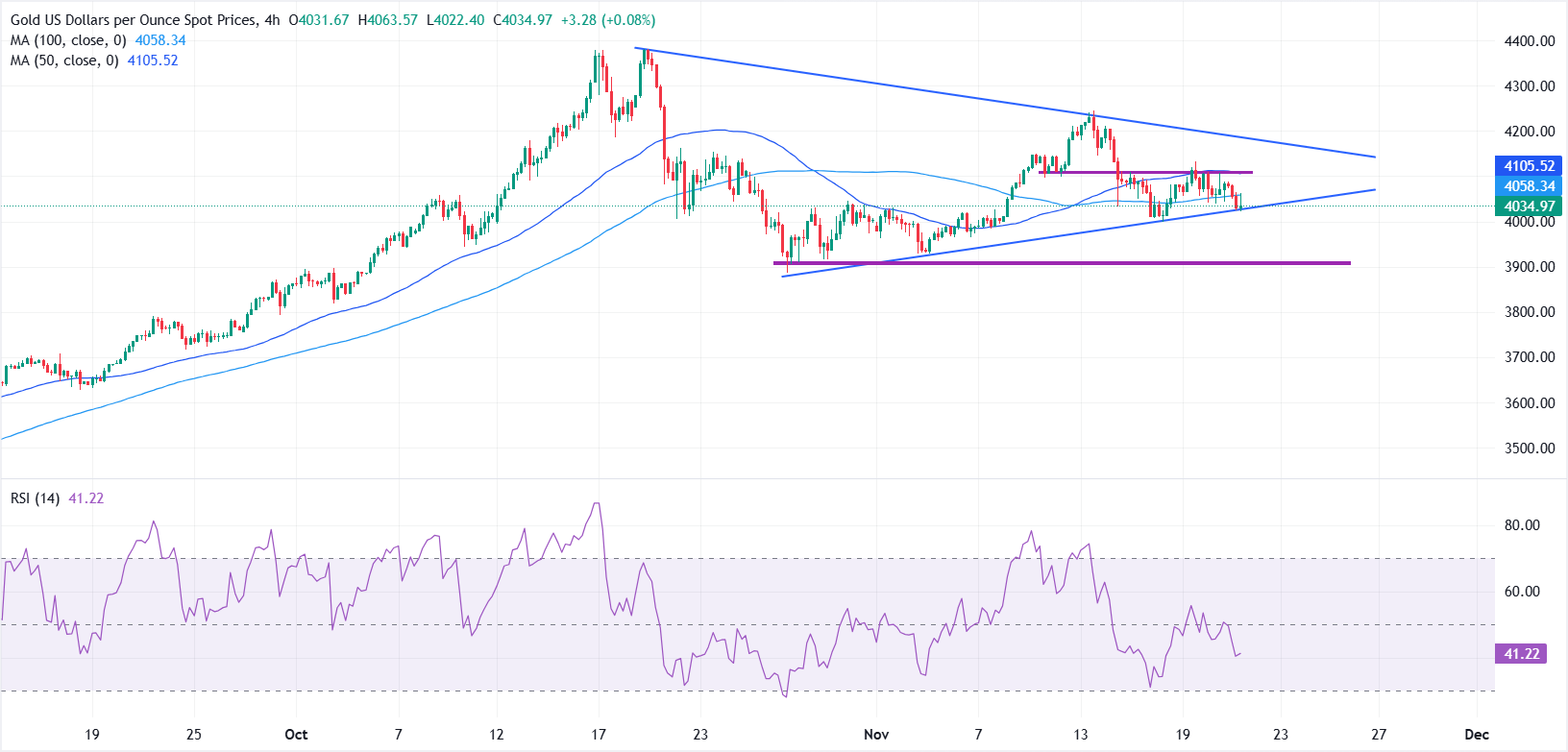
On the 4-hour chart, XAU/USD remains under pressure, trading below the 50-period Simple Moving Averages (SMAs), keeping the near-term tone tilted toward sellers. The 50-period SMA around $4,105.62 has begun to roll over, signalling weakening bullish momentum, while it still sits just above the gently rising 100-period SMA near $4,058.39.
Price rebounded from the lower boundary of a broad symmetrical triangle, with the ascending trendline containing price action throughout November. A sustained break below this trendline could open the door toward the $4,000 psychological level, followed by the October 28 low near $3,886.
On the upside, the $4,100-$4,150 region remains a firm ceiling, with bulls struggling to secure a breakout above it. Momentum remains soft, with the Relative Strength Index (14) at 42.46, holding below the 50 midline and indicating a lack of bullish impulse.
(This story was corrected on November 21 at 13:53 to reflect that Fed President Anna Paulson spoke on Thursday, not Friday.)
Gold FAQs
Gold has played a key role in human’s history as it has been widely used as a store of value and medium of exchange. Currently, apart from its shine and usage for jewelry, the precious metal is widely seen as a safe-haven asset, meaning that it is considered a good investment during turbulent times. Gold is also widely seen as a hedge against inflation and against depreciating currencies as it doesn’t rely on any specific issuer or government.
Central banks are the biggest Gold holders. In their aim to support their currencies in turbulent times, central banks tend to diversify their reserves and buy Gold to improve the perceived strength of the economy and the currency. High Gold reserves can be a source of trust for a country’s solvency. Central banks added 1,136 tonnes of Gold worth around $70 billion to their reserves in 2022, according to data from the World Gold Council. This is the highest yearly purchase since records began. Central banks from emerging economies such as China, India and Turkey are quickly increasing their Gold reserves.
Gold has an inverse correlation with the US Dollar and US Treasuries, which are both major reserve and safe-haven assets. When the Dollar depreciates, Gold tends to rise, enabling investors and central banks to diversify their assets in turbulent times. Gold is also inversely correlated with risk assets. A rally in the stock market tends to weaken Gold price, while sell-offs in riskier markets tend to favor the precious metal.
The price can move due to a wide range of factors. Geopolitical instability or fears of a deep recession can quickly make Gold price escalate due to its safe-haven status. As a yield-less asset, Gold tends to rise with lower interest rates, while higher cost of money usually weighs down on the yellow metal. Still, most moves depend on how the US Dollar (USD) behaves as the asset is priced in dollars (XAU/USD). A strong Dollar tends to keep the price of Gold controlled, whereas a weaker Dollar is likely to push Gold prices up.
Author

Vishal Chaturvedi
FXStreet
I am a macro-focused research analyst with over four years of experience covering forex and commodities market. I enjoy breaking down complex economic trends and turning them into clear, actionable insights that help traders stay ahead of the curve.
















